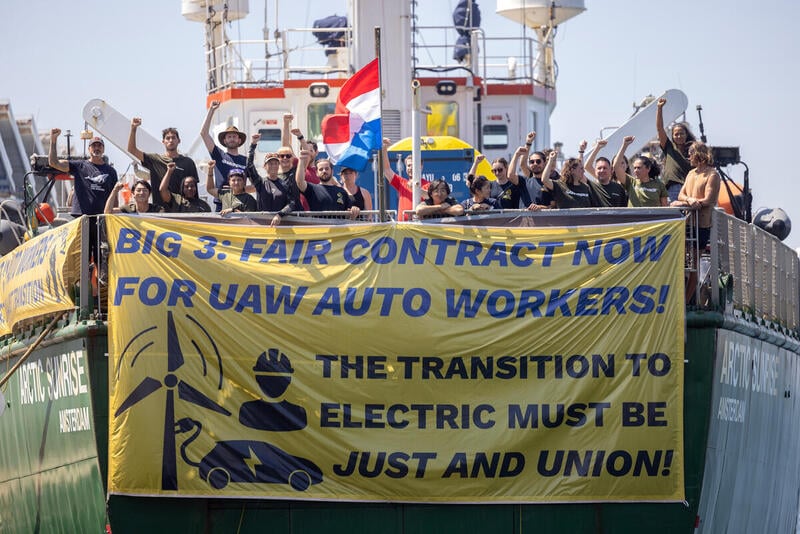
We urged the Hong Kong authorities to take action by refusing the entry of the container and to send it back to the US. Banners made our message clear: "Toxic waste not welcomed here." The captain of the ship agreed not to offload the container until the Hong Kong authorities investigate the legality.
Earlier this year, we asked the question, "Where does all the e-waste go?" On this occasion, we were able to find out exactly where it was going - but this is only the tip of an enormous e-waste mountain, regularly and illegally entering mainland China "thanks" to loopholes in Hong Kong's legislation.
When workers in the so-called "informal" recycling centres break electronic devices up so they can recover valuable metals, they are exposed to the hazardous chemical substances contained in most electronic equipment. This toxic cocktail not only threatens human health; it also pollutes the water, soil and air of the surrounding environment.
Electronics are increasingly becoming part of the "throw away" culture in many developed countries. Few electronic devices are designed to be upgradeable, and because they are made with hazardous materials - including toxic heavy metals, phthalates, polyvinyl chloride and brominated flame retardants - recycling is not always a safe and easy option.
Every year, some 20 to 50 million tons of dangerous e-waste are generated worldwide. While some can be accounted for in general household waste or landfills, some end up - often illegally, as is the case here - in the scrap yards and dumping grounds of developing countries in Asia and Africa.
In the US it is still legal to export collected e-waste to Asia and Africa. In the European Union, e-waste is regulated by EU and national law. But, even in countries with regulations there is a surprisingly large amount of e-waste that is not captured by producer responsibility programs or take-back schemes.
Ultimately, the principle of producer responsibility is key to
solving this problem. This principle requires that the
manufacturers of electronics devices take the financial and
management responsibilities for what happens to their own
end-of-life products. Companies like Sony, Samsung and Nokia have
introduced take-back schemes, but there are many other major
companies that still need to follow this example. Some maintain
that it is their customers' responsibility to pay for the costs of
recycling e-waste.
And, by phasing-out the use of toxic chemicals in electronics
devices at the design stage of a product's life, manufacturers make
it safer to recycle e-waste and reduce their own costs for dealing
with their end-of-life products. What greater incentive could they
want?
Manufacturers need to implement toxic-free design and bring
green electronics onto the markets, and introduce take-back schemes
to responsibly recycle or dispose of their products when they reach
the end of their life. For as long as electronics manufacturers
fail to live up to their responsibilities, e-waste will continue to
flow to places like China.