Recent events underscore the
immediacy of this threat including a series of nation-wide security
alerts by the FBI and a 72-hour moratorium by the railroad industry
on carrying chemicals such as chlorine in October, 2001.
Even President Bush was at risk. On September 11, when Air Force
One landed in Louisiana, the President joined more than a million
Louisiana residents who live every day in a region that is
blanketed by chemical "kill zones." These kill zones surround more
than 100 petro-chemical facilities located along the Mississippi
River between Baton Rouge and New Orleans. A 1999 federal
government study of the U.S. chemical industry found security
against terrorists to be "fair to poor."
According U.S. Environmental Protection Agency (EPA) data, as of
September 1, 2003, 112 chemical facilities in the U.S. each
threaten a million or more nearby residents. The Surgeon General of
the U.S. Army identified chemical plants as second only to
bio-terrorism in terrorist threats in the United States. Similarly,
a 2002 Brookings Institute report ranked chemical facilities third
in the number of fatalities that could occur from a terrorist
attack. And the 2001 Argonne National Laboratory study, "the
failure to identify and evaluate opportunities to reduce the risks
from these types of relatively rare accidents could ultimately lead
to thousands of fatalities, injuries, and evacuations."
Thankfully, there has never been a terrorist attack on a U.S.
chemical facility. But there have been more than 3,000 accidents
involving more than 10,000 pounds of hazardous materials since
1987, with smaller incidents occurring daily.
In the U.S., 15,000 facilities across the U.S. are required to
report their worst case accident scenarios to the EPA. These
reports contain estimates on the distance that a super toxic
chemical cloud could extend over neighboring populations. Pressure
has recently been put on the EPA to deny public access to this
basic information.
Denying access to these reports will only accomplish one thing:
it will leave the public without vital information needed to
protect themselves in the event of an attack or an accident. Hiding
basic hazard information from the public undermines the credibility
of government and industry and will lead to dedicated terrorists
being the only non-governmental people outside industry to have
this information.
Virtually all of the EPA data supplied by industry reports is
publicly available elsewhere. To produce the posted Greenpeace
maps, all that was used from the EPA reports were the names of
toxic chemical(s) used or stored at facilities and the distance
they estimate a poison gas cloud would travel in an accident. The
reports also contain estimates of the number of people living and
working in the danger zone, based on U.S. Census data. None of this
information would be difficult for determined terrorists to acquire
from other publicly available sources such as industry
publications, libraries, U.S. Census Bureau and publicly available
maps.
Copies of Greenpeace's kill zone map were provided to the EPA's
office of Homeland Security on April 2, 2002.
Unfortunately, after using terrorism as an argument to hide
potential chemical disasters, the U.S. chemical industry has done
little to eliminate the threats posed by chemical facilities. In
March 2001, Greenpeace exposed a significant example of this
failure by publishing photographic evidence from inside a Dow
Chemical plant in Plaquemine, Louisiana. The photos show the
internal control panels and operating instructions of an unguarded
pump house that releases 550 million gallons of wastewater into the
Mississippi River every day.
While investigating Dow's Clean Water Act violations, Greenpeace
activists entered this facility undetected. There were no guards at
the perimeter, no security cameras and no burglar alarms. In fact,
the door to the building was unlocked. All of these are rudimentary
security measures that the EPA recommended in a February 2000
security alert. The EPA also recommended "design" changes in plants
that fewer facilities have implemented.
Greenpeace recommends a set of short and long-term steps to
truly eliminate these unnecessary and preventable disasters. In the
short-term these include the immediate: adoption of S. 157 by
Congress, implementation of a program to end the transport of large
quantities of poisonous chemicals, reduction in storage of similar
substances to quantities that cannot threaten area populations, and
decentralized production of these substances to eliminate the need
for large container transport and storage.
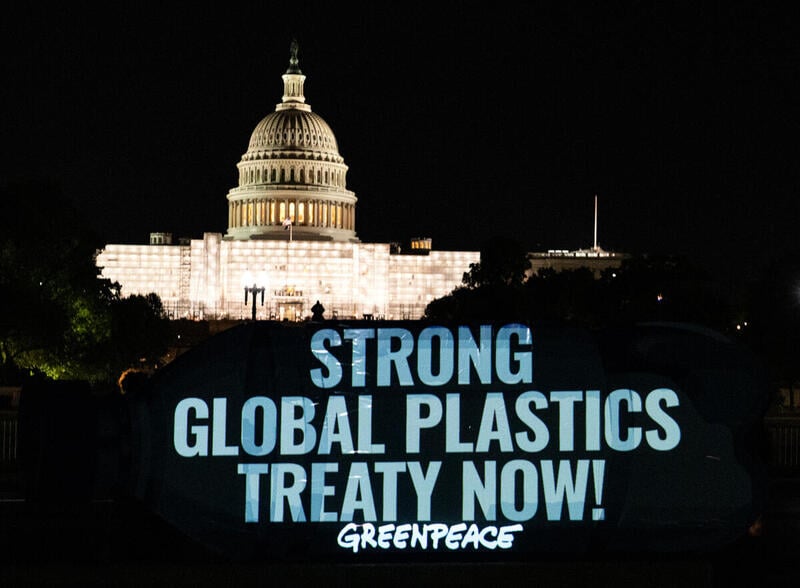
In Washington D.C., the local sewage treatment plant already
accelerated by one year an end to their use of highly toxic
chlorine gas due to its potential use by terrorists. The plant is
only four miles from the U.S. Capitol. According to the National
Transportation Safety Board and the Coast Guard, a large leak of
chlorine gas can travel two miles in only 10 minutes and remain
acutely toxic to a distance of about 20 miles.
In the long-term, virtually all of the ultra-hazardous chemicals
used in the U.S. have safer substitutes and conversion to them
should begin today. The U.S. needs many things to function, like
the besieged airline industry and the postal system. What it does
not need is to continue producing obsolete and ultra-hazardous
chemicals that pose enormous risks to the public-with or without
the threat of terrorist attack.