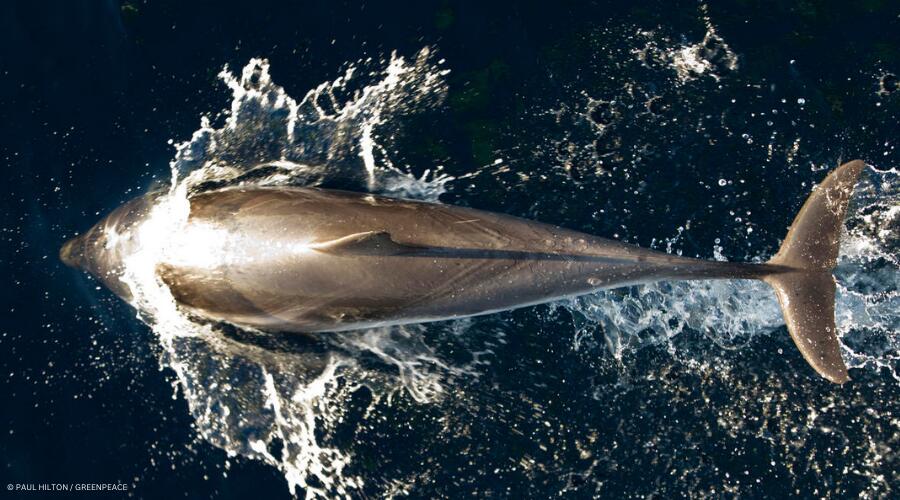
Greenpeace challenges whaling in the Southern Ocean.
The report cites lack of demand for whale meat, pressure from
protests at sea and the continued opposition from Europe and
Australia as reasons for the reduction in the minke whale quota
from 945 minke whales to 750. The quota of 50 endangered fin whales
remains unchanged.
The news follows hard on the heels of
Greenpeace revelations that the industry has been unable to
crew this year's voyage with an all-Japanese crew for the first
time, that the traditional ceremony seeing the fleet off from
Shimonoseki has been cancelled, and that 'Yushin,' the flagship
whale meat shop and restaurant in Asakusa, Tokyo, will close shop
in 2010 due to ongoing financial problems.
4,629 tons of unsold whale meat
In reports on the closing of the Yushin restaurant, the whalers
cited a lack of supply, rather than a reduction in demand, as the
reason for their financial problems. But the Institute for
Cetacean Research's own figures show 4,629 tons of whale meat
sitting surplus in storage -- an increase over last year, and
Asahi's article points to a trend that our own polling confirms:
fewer and fewer Japanese people are eating whale meat.
Those polls also confirm that very few Japanese citizens even
know that their tax money is being used to prop up the whaling
industry. We're pushing that message out through our office in
Japan, and believe that as the Japanese people learn more about how
much whaling costs, and how corrupt the program is, domestic
pressure will become key in the government deciding to hang up the
harpoons.
"We are seeing the beginning of the end of whaling in the
Southern Ocean Whale Sanctuary," said Sara Holden, our
International Whales Campaigner "If today's reports are true we
congratulate the Japanese government for making this first step,
but they can and must go further and we will not stop until the
quota is zero."
Years of campaigning paying off
The last time Japan reduced its take, it was due to the
moratorium on commercial whaling, which we and a handful of other
environmental groups fought long and hard to win -- from the
world's oceans to the halls of the International Whaling
Commission. That single piece of work has saved the lives of tens
of thousands of whales and ended the whaling programs of the former
Soviet Union, Brazil, Peru, Chile, and Spain.
Japan used a loophole which allows the killing of whales for
"scientific research" to continue whaling in the Southern Ocean,
though at a far reduced rate.
Greenpeace has sent ships to interfere with the hunt in the
Southern Ocean nine times since the Japanese government research
whaling program in the Southern Ocean Whale Sanctuary began 20
years ago, including keeping them on the run for more than two
weeks last season, saving hundreds of whales.
Winning in Japan
Opposition inside Japan is also growing thanks to the work of
our Japanese office.
Earlier this year two Greenpeace activists in Japan were
arrested for exposing corruption within the whaling program.
Whaling in Japan has had little press attention, but that changed
when we unveiled boxes of stolen whale meat on live television,
prompting calls from Japan's media and the Tokyo public prosecutor
for a full investigation of abuse of taxpayer's money.
Instead, our own activists were arrested.
The political prosecution of Junichi Sato and Toru Suzuki has
been denounced by Amnesty International and, in a periodic
evaluation completed last month, the United Nations Human Rights
Committee severely reprimanded the Japanese government for the
"unreasonable restrictions placed on freedom of expression" in
Japan. It also condemned the abuse of trespass laws by Japanese
police to harass activists who are critical of government
policy.
"The extreme reaction by the authorities shows Greenpeace's work
in Japan has put the whaling establishment under pressure" said Jun
Hoshikawa, Executive Director of Greenpeace Japan. "The whale meat
market has clearly collapsed and is unprofitable, and the stigma of
scandal and corruption has made it an unattractive and less
lucrative industry to work for. The whaling industry's days are
numbered, and it's time for the Japanese taxpayer to demand the
government stops subsidising this bankrupt program."
Take action
If Japan is going to start rounding up political prisoners for the crime of defending whales, they're going to have to arrest a whole heaping lot of us. Sign the petition to stand in solidarity with Junichi and Toru.