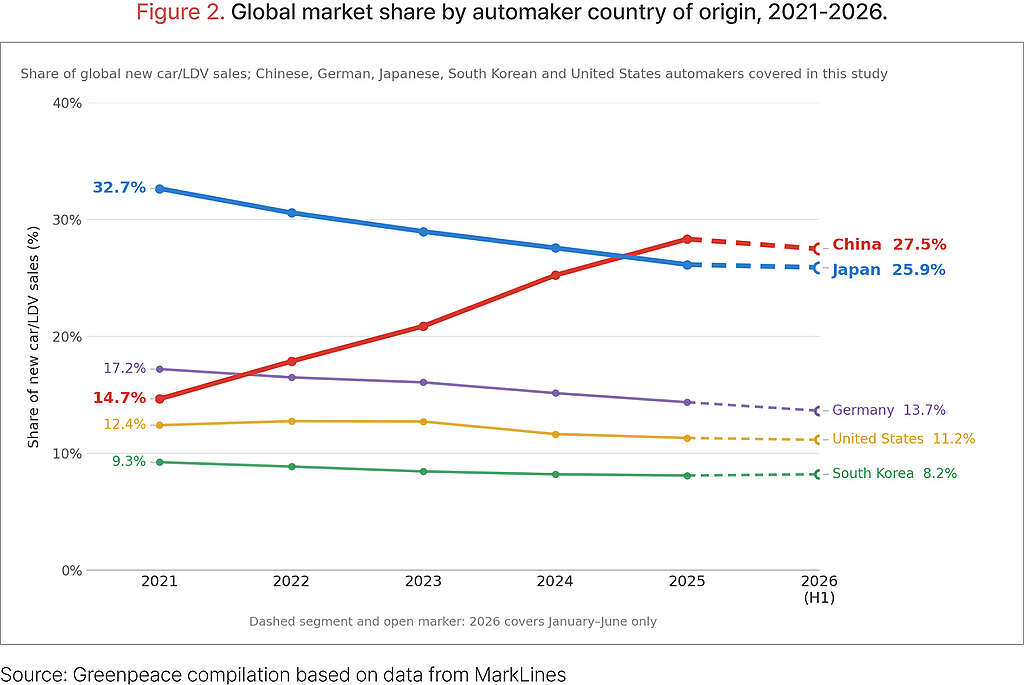
TOKYO, October 27, 2026 — Japanese automakers’ combined share of the global passenger-vehicle market fell from 32.7% in 2021 to 25.9% in the first half of 2026, while Chinese automakers’ share rose from 14.7% to 27.5%, overtaking Japan as the world’s largest national group by passenger-vehicle sales. The shift was most severe in markets where battery-electric vehicle (BEV) adoption grew the fastest, according to a new Greenpeace East Asia report released today.
The report, A Changing Landscape: The Challenges Facing Japanese Automakers in China and Southeast Asia’s EV Race, analyses MarkLines sales data and finds that Japanese automakers are losing the most ground in China and Southeast Asia—two key regions undergoing rapid electrification.
“Japanese automakers are not simply facing a difficult quarter or a difficult year. They are watching their decades-long dominance slipping away as electric vehicles reshape the global car market. Their reliance on combustion engines and hybrids is costing them ground in China and Southeast Asia. As the oil price shocks from the Middle East conflict accelerate the global move to renewable energy and zero-emission transport, their delay makes catching up increasingly difficult,” said Erin Eunseo Choi, climate and energy campaigner at Greenpeace East Asia.
The analysis tracks passenger-vehicle sales by eight leading Japanese automakers—Toyota, Honda, Nissan, Isuzu, Mazda, Mitsubishi Motors, Subaru, and Suzuki—across seven regions: Japan, the United States, China, Europe, Southeast Asia, Latin America, and India. It benchmarks their performance against 25 international competitors from China, Germany, the United States, and South Korea. The regions analysed account for about 87.4% of Japanese automakers’ global sales, while the full dataset covers about 88.3% of global passenger-vehicle sales.
Between 2021 and 2025, BEVs expanded from 6.5% to 17.3% of global new-car sales, while internal combustion engine vehicles (ICEVs) fell from 83.5% to 61.7%, the report found. This structural shift is unfolding as major Japanese automakers scale back their EV ambitions: Toyota has reportedly cut its planned 2026 BEV output from 1.5 million to approximately 800,000 units, while Honda has withdrawn its target for BEVs and fuel-cell electric vehicles to make up 100% of global sales by 2040, alongside its 2030 EV sales target, shifting emphasis back toward conventional hybrids.[1][2]
Greenpeace warns that recent oil-price volatility following the Middle East conflict has added urgent pressure on consumers and fleet owners to switch to EVs. This exposes the vulnerability of Japanese automakers’ heavy reliance on ICEVs and conventional hybrids, threatening further erosion of their long-standing leadership in the global auto industry.
Key Findings
- China and Southeast Asia saw the steepest losses: Japanese automakers’ market share fell from 21.5% to 8.5% in China and from 73.9% to 50.9% in Southeast Asia between 2021 and H1 2026. Japanese brands captured just 2.3% of China’s BEV market in 2025.
- The biggest Japanese brands also lost global ground: Toyota’s global market share fell from 13.3% to 11.3% between 2021 and H1 2026. Honda’s dropped from 6.3% to 3.9%, and Nissan’s from 5.0% to 3.3%.
- Hybrids and home-market strength offer only limited shelter: Japanese automakers retained 94.4% of Japan’s domestic market in H1 2026 and about 39% of the U.S. market. While their share held up better in regions where ICEVs and hybrids still dominate, this resilience has failed to halt their broader global decline.
Greenpeace Calls for Faster Transition
Greenpeace East Asia is calling on Japanese automakers to:
- Set clear, binding timelines to phase out sales of all combustion-engine vehicles, including conventional hybrids;
- Establish transparent, interim BEV sales targets for 2030, 2035, and 2040;
- Commit to absolute value-chain greenhouse gas reductions rather than relative efficiency gains.
The report specifically calls on market leader Toyota to end global ICEV sales by 2030 and cut its Scope 1–3 emissions by at least 43% from 2019 levels by 2030, aligning with a 1.5°C climate pathway to reach carbon neutrality by 2050.
“Japanese automakers still have a chance to regain their footing, but the window is closing fast,” said Choi. “The market is sending a clear signal: consumers and governments are no longer waiting for a gradual transition. Japanese automakers need to treat battery electric vehicles not as one option among many, but as the core of their future business model, and back that shift with credible targets and real investment.”
ENDS
Notes:
The full report, A Changing Landscape: The Challenges Facing Japanese Automakers in China and Southeast Asia’s EV Race, is available here (English) and here (Japanese). The Japanese version of this press release is available here.
[1] Greenpeace East Asia, Toyota’s Electric Vehicle Backtrack Deepens the Climate Crisis, Undermining the 1.5°C Pathway (27 October 2025).
[2] The New York Times, “Honda Posts First-Ever Annual Loss After Pullback From E.V.s” (14 May 2026)
Media Contacts:
Yujie Xue, International Communications Officer, Greenpeace East Asia, +852 5127 3416, [email protected]
Natalia Emi Hirai, Communications Manager, Greenpeace Japan, +81 (0)8065584446, [email protected]