Our vision


Solutions to deforestation exist.

We're campaigning for zero deforestation globally by 2020.

And how do we plan to do this exactly?

Greenpeace is campaigning for a future that will allow our forests to thrive - filled with unique wildlife and able to sustain local people and economies whilst cleaning the air of carbon: a future with no deforestation.

This may be ambitious, but it is possible. In fact, because stopping forest destruction is one of the easiest and most cost effective ways to prevent catastrophic climate change, we think it's essential.

To protect these precious ecosystems, the international communitycorporationsindigenous communities and individuals will need to work together in an unprecedented, concerted effort. Greenpeace is campaigning to realize this vision in several ways.  

Let's start with YOU. 

Consumer Power

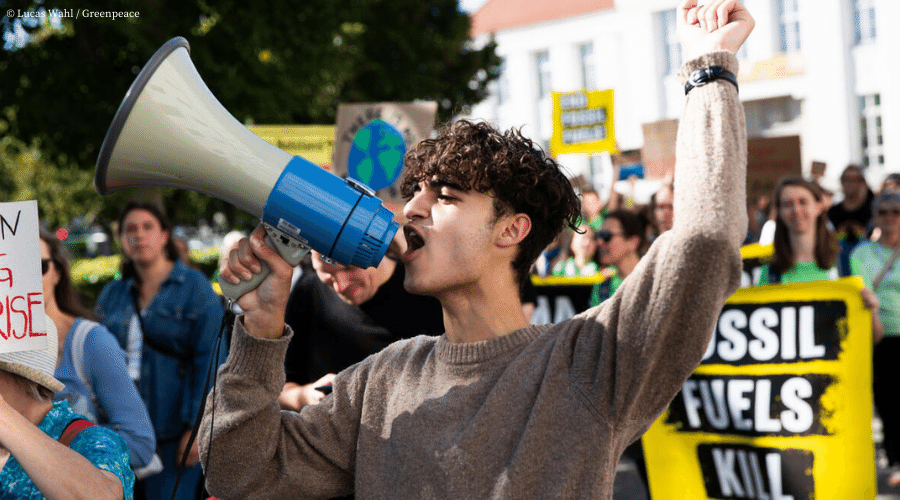
Consumer power - or people power - works. It works because the destruction of ancient forests is driven by global demand for products like paper, timber and palm oil, and only thrives because most consumers rarely hold the producers accountable. But, when we do - en masse - our power is phenomenal.

We believe that consumer power - when combined with political solutionscorporate action and the work of forest communities - can help to achieve our vision of zero deforestation by 2020.  Read more about the impact consumers have had on convincing corporations like Kimberley-ClarkKraft and Burger King  to minimize their contribution to deforestation.

Corporations/Markets

If corporations have the ability to destroy the world's intact forests, they also have the power to help save them. 

Companies can make an impact by introducing zero-deforestation policies that require suppliers to produce commodities such as timber, beef, soy, palm oil and paper fiber in a way that has a minimal impact on natural forests and the climate. Companies can also introduce paper procurement policies that set ambitious targets to maximize use of post consumer recycled wood, pulp, paper and fiber in their products and ensure that any virgin fiber used is certified by a rigorous third party certification system such as the Forest Stewardship Council (FSC).

Read more about the Forest Stewardship Council.

Greenpeace investigates, exposes and confronts environmental abuse by corporations around the world, and takes action with its supporters. Our campaigns have shifted the buying behavior of major companies, creating immediate impacts in the market and on the ground. Dig deeper into what our research has uncovered.

Be a forest-friendly consumer! 

  • Buy forest-derived products made from 100% post-consumer content materials 
  • Buy virgin-forest fiber products with a seal from a credible forestry certification system, like the Forest Stewardship Council (FSC)
  • Learn about the FSC and false forms of forest certification
  • As a consumer ask questions about how the products you buy impact the forests.
  • Educate your friends, family, and community about how our actions here can impact forests thousands of miles away.

Politics

In order to achieve zero deforestation by 2020 we need ambitious and science-based domestic and international forest policies from our government.

We use U.S. laws like the Wilderness Act, Lacey Act and the Roadless Rule to protect U.S. forests and stop illegal wood products from entering the U.S. marketplace.

We also support and use treaties like the Convention on International Trade in Endangered Species (CITES) to help protect forests and the endangered plant and animal species that rely on forests for habitats.

The international community must also urgently commit to mechanisms that reduce greenhouse gas emissions from deforestation in tropical forest developing nations. Forests for Climate is a landmark proposal for an international funding mechanism to protect tropical forests. Developing countries with tropical forests that choose to participate in Forests for Climate would make commitments to protecting their forests and in exchange would have the opportunity to receive funding for capacity-building efforts and for national-level reductions in deforestation emissions. This would provide a strong incentive for developing countries to continually improve their forest protection programs. Read more about Forests for Climate. Read more about forest protection deals.

Read more about Forests for Climate.

Read more about forest protection deals.

The latest updates


Two Years after Fukushima, Duke Energy still making risky nuclear bets

Publication | March 7, 2013 at 9:00

Two years ago the disastrous Japanese earthquake and tsunami were exacerbated by the manmade disaster at the Fu- kushima Daiichi nuclear plant. The meltdowns and explosions at three General Electric (GE)-designed nuclear reactors forced countries...

The Myth of China's Endless Coal Demand: A missing market for US Exports

Publication | February 27, 2013 at 0:07

The US coal industry - reeling from sagging domestic demand, plummeting profits, and tanking stock prices - is desperate for a new market for its wares, and it thinks it has found one in China. But in reality, the Chinese market for US coal...

The Myth of China’s Endless Coal Demand

Image gallery | February 20, 2013

Herakles Farms in Cameroon

Publication | February 19, 2013 at 8:00

The palm oil project being developed by the US-owned company Herakles Farms in Cameroon demonstrates the threat posed by badly managed expansion of oil palm plantations.

Donors Trust: Laundering Climate Denial Funding

Publication | February 15, 2013 at 11:10

Over the past year, Greenpeace and other researchers have discovered that Donors Trust, a shadowy funding operation for anti-government extremists, is laundering millions of dollars in climate denial funding for donors who do not want to be...

11 - 15 of 1599 results.