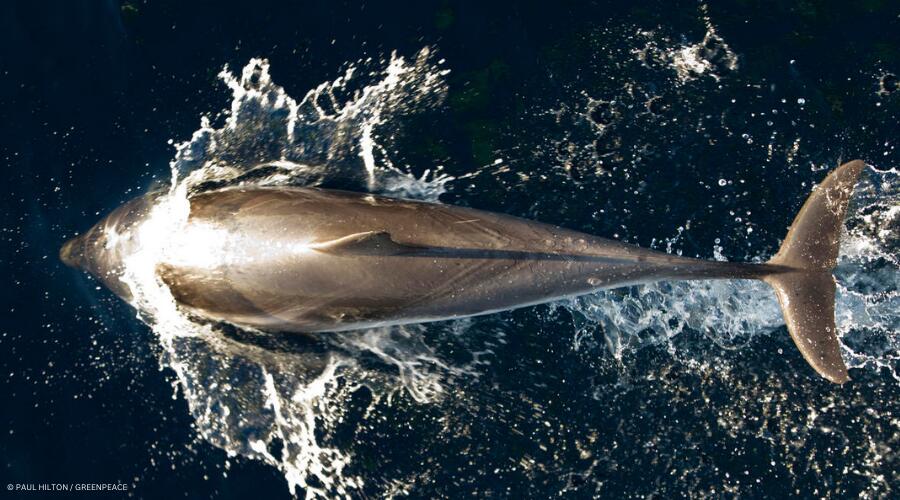
The saying goes that "looks can be deceiving," and it's an accurate expression for the menhaden fish. This little fish plays a powerful role in the undersea world. The menhaden may be near the bottom of the food chain, but it supports many species from popular sport fish all the way up to Atlantic whales. And if the Chesapeake Bay and Atlantic Ocean are where the menhaden call home, this little fish could win the Good Housekeeping Award. That's because the menhaden is a filter-feeder, meaning it cleans impurities in the water. That's crucial to the Chesapeake Bay, where water pollution from farm and sewage runoff is creating increasingly severe problems for the bay and its inhabitants.

But this hard-working little fish is disappearing fast, and its job in the food chain is irreplaceable.

Finding Nemo: What happens to a little fish sucked out of its environment?

The menhaden is not only a small fish, but it's also rather bony - not exactly appetizing for most people. But there is an enormous fishing operation sucking millions of these little fish out of coastal waters every year. In fact, menhaden make up America's second largest fishery. So, if people aren't eating the menhaden, why is this little fish being targeted?

The Omega Protein company vacuums massive quantities - hundreds of thousands of tons - of menhaden through state-of-the-art factory fishing vessels that locate entire schools of these tiny fish. The company then processes menhaden for use as protein supplements and fishmeal.

Ironically, much of Omega's fishmeal is sold to feed livestock or fish farms - uses that harm marine ecosystems and threaten fishing communities. In fact, one of the main uses for Omega's fishmeal is as chicken feed, adding to the high-nutrient wastes already choking many bays and estuaries - including the Chesapeake.  Runoff from chicken farms is also connected to the outbreak of toxic algae in the mid-Atlantic region. Omega fishmeal is also used as food for large-scale fish farms, which privatize the oceans and threaten wild fish stocks and traditional fisheries through pollution and parasitic infestations, among other dangers. Most of the remaining fishmeal goes into pet food. 

Menhaden populations today are at near record lows, and there are reports that some of their predators are starting to go hungry. The time to act is now, before the tiny menhaden is lost forever.

Latest Update

Fishing Cap Nixxed to Appease Big BusinessRead the full story.

The latest updates


Despite scientists warning of growing crisis, Arctic Council fails to act for Arctic...

Blog by Cassady Sharp | May 15, 2013

The Arctic Council meeting in Sweden just wrapped up, and while we were thrilled to deliver photos of 280 global “I Love the Arctic” photos to the delegates including US Secretary of State John Kerry, we were disappointed that the … Continue...

Algonquin community defends their lands against Resolute Forest Products

Blog by Guest Post | May 14, 2013

This post is written by Tina Nottaway, Spokesperson for the Traditional Algonquin Nation of the One Nation “KWE,” I am an Anishinaabe woman who speaks the Algonquin language fluently. I live in the la Verendrye Wildlife Reserve in Quebec, which...

Not only is another world possible, she’s on her way. On a quiet day, I can hear her...

Blog by Kumi Naidoo | May 14, 2013

Opening remarks at the Peoples’ Arctic Conference in Kiruna, Sweden: (Not interested in reading all the way through? You can listen to Kumi Naidoo’s speech here). Greetings my friends, and welcome to the conference, the Peoples’ Arctic: Unified...

April 2013 Photo of the Month

Blog by Robert Meyers | May 6, 2013

Not quite the photo op you’d expect from this location, but Christian Åslund’s shot from the North Pole is the April 2013 Greenpeace USA Photo of the Month. Here Team Aurora prepares to lower a titanium time capsule through a … Continue reading →

April 2013 Photo of the Month

Blog by Robert Meyers | May 6, 2013

Not quite the photo op you’d expect from this location, but Christian Åslund’s shot from the North Pole is the April 2013 Greenpeace USA Photo of the Month. Here Team Aurora prepares to lower a titanium time capsule through a … Continue reading →

US government considering seismic testing proposal, nearly 140,000 whales and...

Blog by Phil Kline | May 6, 2013

138,500 whales and dolphins will be injured and possibly killed It was only a couple months ago that Greenpeace celebrated a big victory on the West Coast when the California Coastal Commission voted to deny the Navy permission to conduct … ...

US government considering seismic testing proposal, nearly 140,000 whales and...

Blog by Phil Kline | May 6, 2013

138,500 whales and dolphins will be injured and possibly killed It was only a couple months ago that Greenpeace celebrated a big victory on the West Coast when the California Coastal Commission voted to deny the Navy permission to conduct … ...

EU bans three bee-killer pesticides: a light of hope for bees and agriculture

Blog by Matthias Wüthrich | May 6, 2013

The next time you see a bee buzzing around, it’s worthwhile remembering that much of the food we eat depends significantly on pollination these insects provide. But bees and other pollinators are declining globally, particularly in North America...

EU bans three bee-killer pesticides: a light of hope for bees and agriculture

Blog by Matthias Wüthrich | May 6, 2013

The next time you see a bee buzzing around, it’s worthwhile remembering that much of the food we eat depends significantly on pollination these insects provide. But bees and other pollinators are declining globally, particularly in North America...

Why California should not be allowed to outsource hot air

Blog by Daniel Brindis | May 3, 2013

This week Greenpeace and other leading environmental groups including Sierra Club California, California Environmental Justice Alliance, Asia Pacific Environmental Network, and Friends of the Earth sent a letter to California Governor Jerry Brown...

1 - 10 of 2672 results.