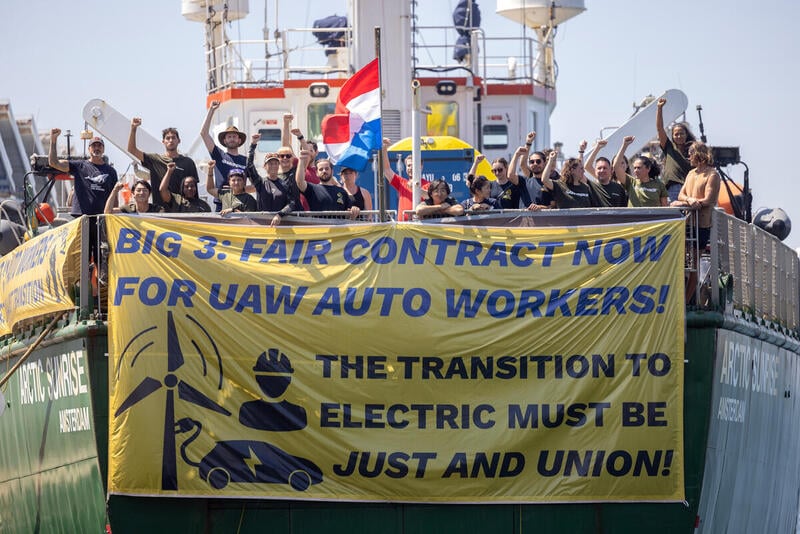
It's an oddity of living on board a ship that wherever you go, you bring
your home with you. And if it's a Greenpeace ship, pretty much whenever
you visit a town, the townspeople also get a chance to visit you. So it
feels more like exchanging visits than just going visiting.
Today we exchanged visits with Narsaq. Our guidebook says the town's
name means "the plain", although its landscape is a little bumpier than
I associate with the word "plain". I would say "mountainous",
"fjordish" or at least "hilly " would be more like it - but then maybe
this is as flat as costal Greenland gets. At any rate, the town has a
good harbor, about 1,800 people, houses in the usual colors (red, blue,
green and yellow - very pretty), and icebergs just off shore.
The main industry here is the fish plant, and fishing is also a big form
of recreation. They do get a few tourists, and you might be surprised to
learn that some of them come for the fishing, which I'm told is
excellent. They also have a mighty big hill (it would be called a
mountain in some places). I'm told that part way up the hill you can
find rare stones called Tuttupit, which range in color from pink to
purple and are only found one other place in the world. Walking the
surrounding hills is another favorite past time for both locals and
tourists. Considering the spectacular landscape, I'd guess the views
are worth the more than any precious stones you might find.
The local kids are keen on roller blading. During today's open boat, one
of them was even cruising around the deck. Others were playing
Attortaanneq - known in English as "tag" - chasing and hiding from each
other. Here's a tip: favorite hiding place is behind the bridge chart
table.
The adults here echoed the same disturbing news about a changing climate
that we had heard in Ittoqqortoomiit - less sea ice, warmer water, a
local glacier has visibly thinned, and Otto (our local guide and
interpreter) told us that the weather has become more unpredictable,
which is a very big deal if you are a hunter or fisherman.
Another local told us about a glacier fed, hydro power plant being built
nearby to replace diesel generators. This is probably being done as much
for cost reasons as environmental reasons. Either way, hydropower, when
done right, is a highly reliable and environmentally benign source of
renewable energy.
In a town this size it is easy to know where your energy comes from. In
a big city, it can be less obvious. Where does your electricity come
from? How much of it is generated from renewable sources? Try asking
your power company these questions. No mater where you live, just
letting your power company know a customer cares is important. In some
areas, you can even choose to buy your electricity exclusively from
renewable sources. In the US, also be sure to take part in the Thin Ice
Contest.
- Andrew