Between 1990 and 2003, Brazil’s cattle herd more than doubled from 26.6 million to 64 million head of cattle. © GreenpeaceAt the World Social Forum in Belém, in the heart of the Amazon, we’ve released evidence confirming cattle ranching to be the biggest driver of Amazon deforestation.
Greenpeace Brazil has produced a series of maps that show in greater detail than ever before the direct links between cattle ranching and forest destruction in the Amazon state of Mato Grosso.
The maps have been released as part of our
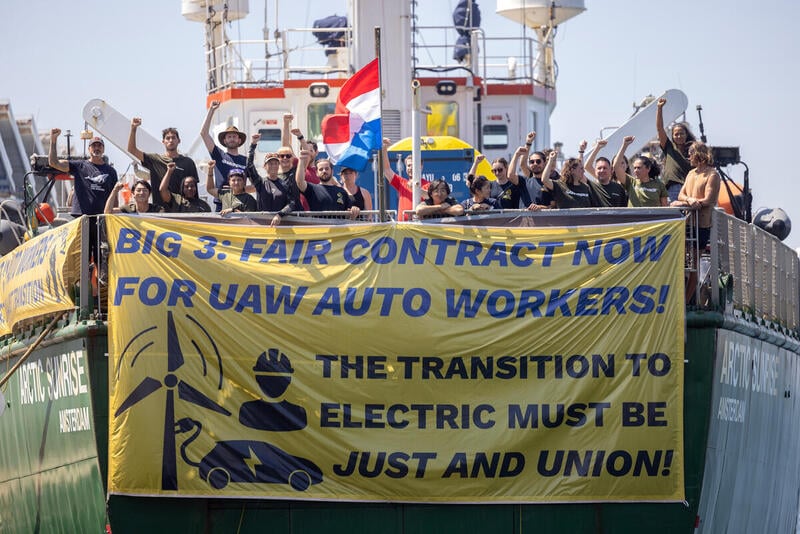
"Save the Planet - Now!" Brazilian ship tour.
Brazil is the world's fourth biggest climate polluter, and 75
percent of its greenhouse gas emissions are the result of
deforestation. The Brazilian government has made promises to tackle
destruction of the Amazon as part of its commitment to combat
global warming, but its plans to expand the cattle industry are at
odds with this commitment.
Maps produced using innovative techniques
Our Amazon team used specialized techniques to analyze and
compare satellite images of vegetation (or lack thereof) on the
ground, and data showing the growth of infrastructure, such as
roads and agribusiness. It is the first time that these two types
of data have been put together in this way. Our maps in the report
Amazon cattle
footprint, clearly show how much former rainforest is now
used for cattle pastures in Mato Grosso.
Click here to download the full Google Earth layer (8mb KMZ
file)
We focused on Mato Grosso because it is area of the Amazon with
the highest rates of deforestation. It is also where the cattle
industry is largest - there are well over 25 million cows in the
region, and 7 of the 10 biggest cities in the Amazon producing
cattle and cattle products are found there.
Plans to expand cattle industry undermines Brazil's commitment
to tackle deforestation.
Forests are carbon sinks. When they are logged the stored carbon
is released into the atmosphere. Tropical forest destruction is
responsible for a fifth of global greenhouse gas emissions - more
than the entire international transport sector. Deforestation in
Brazil makes the country the world's fourth biggest climate
polluter.
Billions urgently needed to protect rainforests and save the
climate
The European Commission estimates that halving deforestation
will cost anywhere from €15-25 billion annually. It is not just the
Brazilian government's responsibility to protect our climate by
protecting our rainforests. As world leaders prepare for the most
important climate negotiations ever, taking place in Copenhagen,
Denmark at the end of the year, we need to see commitments from
industrialized countries that pay as much attention to saving the
world's rainforests as they have done to bailing out fat cat
bankers.
Brazil has promised to
tackle deforestation as part of its climate commitments. But,
as our maps clearly show, unless it stops expansion of the cattle
industry in the Amazon, there is no chance that it can live up to
this promise.
Zero deforestation by 2015: we've got the solution
If we are to have a fighting chance against climate change,
global greenhouse gas emissions have to peak by 2015, and then
start to fall dramatically. That means halting deforestation
completely by 2015 in the Amazon. But, even without its plans to
expand the cattle industry, the Brazilian government's promises to
tackle Amazon deforestation are not strong enough. The plan aims to
reduce deforestation by 72 percent by 2017. This is a good start
but it's not enough. It misses the 2015 deadline, and will not halt
deforestion. Luckily we've got the solution - working together with
Brazilian NGOs we produced a "zero-deforestation"
plan that shows how it can be done.
Support our work
We don't accept funds from governments or corporations, but we've been able to support projects like this thanks to individual donations from people like you. Please give what you can to keep Greenpeace Amazon in action.