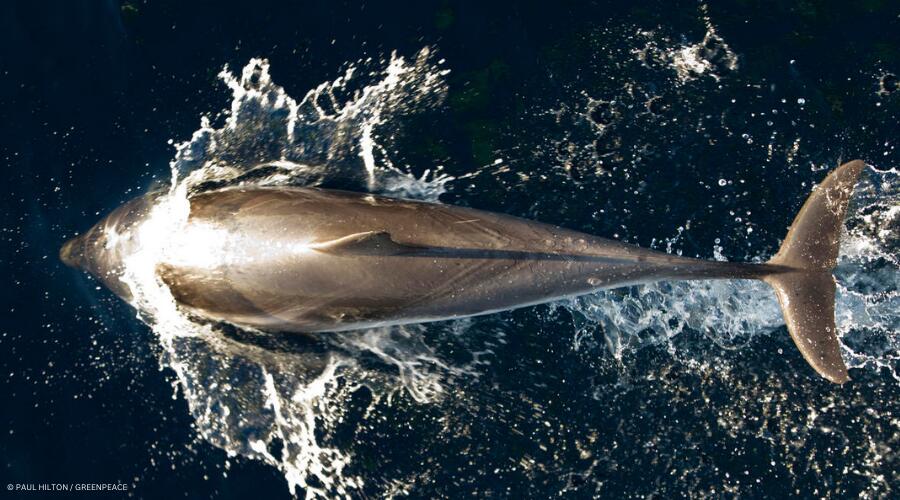
Japan's annual Southern Ocean whale hunt is conducted under the
guise of science but has been condemned internationally. This
season, Japan aims to kill more than 1,000 whales, including 50
endangered fin whales and, for the first time in 20 years, 50
threatened humpback whales will also be harpooned.
The International Whaling Commission has called for an end to
the killing of whales in the Southern Ocean Whale Sanctuary under
Japan's whaling program.
The Greenpeace ship Esperanza is en route to the Southern
Ocean, fast approaching the Japanese fleet as it heads toward the
Whale Sanctuary. You can read the crew blog
here >>.
"The Japanese government's "scientific" whaling program is a
sham and a source of diplomatic tension between Japan and countries
that support whale conservation, like the United States. Whaling
has no place in Antarctica - it's a place of peace and science, and
this is not science," said Karli Thomas, expedition leader aboard
the Esperanza.
An opinion poll carried out in Japan by the Nippon Research
Centre, in June 2006, showed that 95 per cent of Japanese people
never or rarely eat whale meat. More than two-thirds of Japanese do
not support whaling on the high seas.
Another study recently conducted by Julia Bowett, a PhD student
from the University of Tasmania, found that among Japanese students
approximately 65 percent agreed with the view that scientific
research on whales should only use non-lethal methods.
To prove that you don't need to kill whales for research,
Greenpeace is collaborating with a team of scientists on the "Great
Whale Trail" project.
Data from satellite tagging of whales, harmless skin biopsies
and fluke identification has already yielded valuable information
about the migration patterns of threatened humpback populations,
without a single harpoon being fired.
We will display the location of the whaling fleet as it is
tracked south by the Esperanza on the same map on which it is
tracking humpback migration routes from their breeding grounds in
New Caledonia and the Cook Islands.
"Japan's whalers are deceiving the Japanese public by painting
the word "research" on their ships," said Junichi Sato, Greenpeace
Japan Whales Project leader. "Real scientists don't need to kill
whales to study them. This is commercial whaling poorly dressed up
as science."
"The Japanese Government should already know that information
about whales can be gained without killing them. The Antarctic
whale hunt is an expensive waste of Japanese taxpayers' money and
goes against public opinion in Japan and overseas. The time has
come for the Japanese government to end this hunt."
Japan has close to 4,000 tons of whale meat from its
"scientific" whaling program in cold storage - uneaten, unsold, and
unwanted.
Take action
Tell Japan to Stop Whaling!
Donate
You can create your own fundraising page to help end whaling in the Southern Ocean forever.