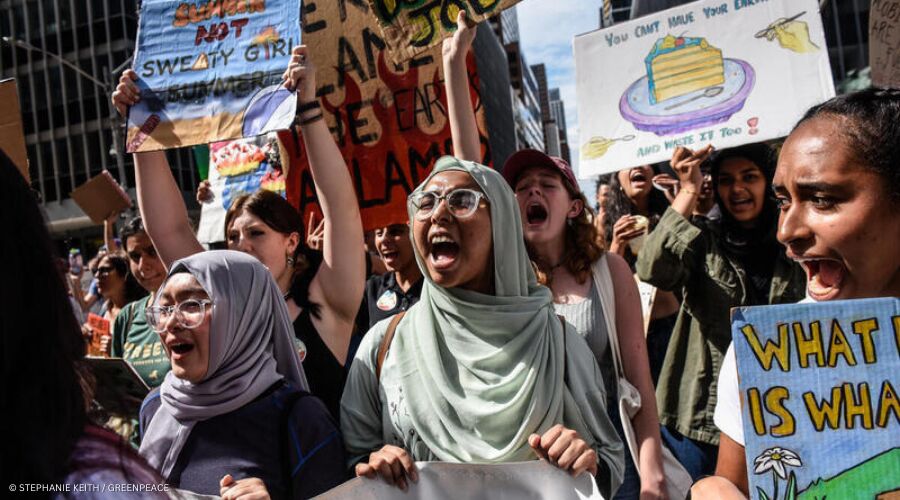
Amadou Kanoute, Executive Director Greenpeace Africa stresses Africa is in a position to leapfrog dirty development and become a leader in helping to avert catastrophic climate change and protect the natural environment.
A second office will be opened on November 24th in Kinshasa,
Democratic Republic of Congo, followed by a third in Dakar,
Senegal, next year. These areas are central to tackling climate
change, deforestation and overfishing.
While the environmental threats facing Africans are urgent and
critical, Africa is in a position to leapfrog dirty development and
become a leader in helping to avert catastrophic climate change and
protect the natural environment. While Africa contributes very
little to global warming, the region will be one of the hardest hit
by its effects. Over 180 million people in sub-Saharan Africa could
die as a result of climate change by the end of the century.
Unpredictable rainfall, lower crop yields and dwindling resources
are causing mass migration, increased tension and conflict.
The launch comes just weeks ahead of the United Nations climate
change talks in Poznan, Poland (December 1st - 13th), where
agreements will be made to set the world on a path to cut
greenhouse gas emissions and prevent human induced climate change.
South Africa needs to take a strong stand at the UN climate talks
for a deal that includes substantial funding from the
industrialized world for developing countries to adapt to and
mitigate the devastating effects of climate change. The South
African government should also support Central African countries by
backing moves to create a funding mechanism that makes protecting
tropical forests and the climate more economical than logging.
Tropical forest destruction accounts for about 20 percent of global
greenhouse gas emissions.
Climate change
South Africa, the 14th highest carbon emitter in the world, must
commit to measurable actions to reduce its greenhouse gas
emissions, including ending its dependence on coal, without
resorting to expansions in nuclear power. The country, as with
Africa as a whole, is in a position to harness abundant renewable
energy sources - solar, wind and biomass - and take a lead in an
African energy revolution. An energy revolution that would not only
help reduce climate changes but would bring electricity to rural
areas, which is crucial for rural development, provide jobs and
economic growth.
Protecting the rainforest
Industrial logging threatens the Congo Basin rainforest and the
40 million people who depend on it for their livelihoods. It plays
a vital role in regulating the global climate and is the fourth
largest forest carbon reservoir in the world. Yet if logging is
allowed to continue at the projected rate, the Democratic Republic
of the Congo risks losing 40 percent of its forest within 40 years.
Greenpeace is calling for the adoption of an international
financing mechanism, Forests for Climate, that makes the Congo
Basin rainforest and others like it more economically valuable
intact than as timber.
Defending the oceans
Off the coast of West Africa marine life is being carried away
by foreign trawlers, devastating local communities and depriving
them of critical nutrition while also causing poverty and food
insecurity to increase. Illegal, unreported, and unregulated
fishing must stop. Greenpeace will work for sustainable fishing and
fish processing operations, managed and financed by Africans, as
well as increased monitoring and control. The area needs a network
of well enforced marine reserves.
Tackling environmental problems in Africa is vital to ensuring a
future for its children and the world as a whole. While it is most
likely to be one of the hardest and quickest hit by the effects of
climate change, some of which can already be seen, Africa is also a
major part of the solution. Through harnessing its renewable energy
potential and protecing its tropical forests Africa can lead the
way in environmental development.