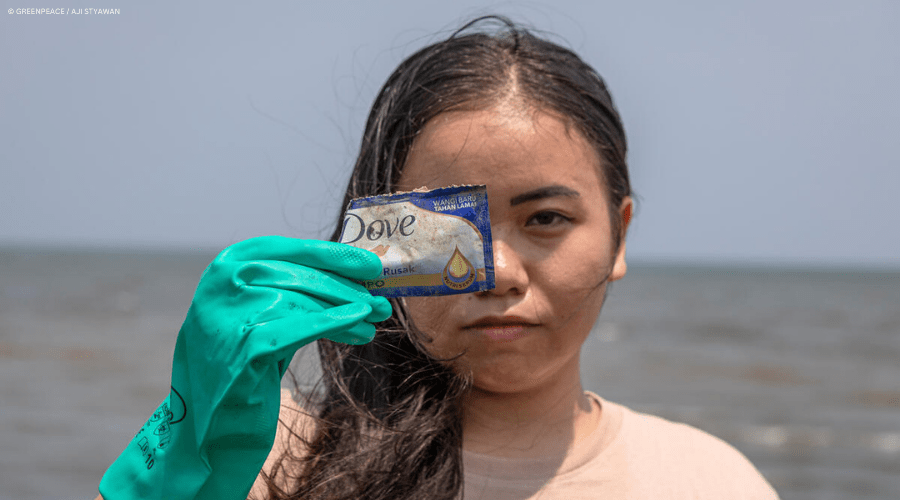
Our research shows that Unilever, maker of Dove and many other
well-known brands, is buying palm oil from companies that are
destroying valuable rainforest and peatland areas; bad news not
only for the millions of people who depend on these for their way
of life and endangered species such as the orangutan, but also for
the global climate.
Monkey Business
In the United Kingdom, at the Unilever factory at Port Sunlight,
near Liverpool, sixty Greenpeace activists occupied the production
lines, while in London employees at Unilever's HQ were greeted on
their way to work by screeching mating calls and orangutans
clambering all over the building. At Unilever's Rotterdam HQ, in
the Netherlands, six activists scaled the waterfront building and
hung a banner reading, "Unilever, Don't Destroy the Forests." In
Rome, another ten orangutans stopped Unilever employees entering
their Italian HQ. Jumping out of a huge box marked, "Stop Dove from
Destroying Rainforests," the orangutans handed out flyers outlining
the palm oil situation and demanding a moratium.
Palm oil and forest destruction
Why Unilever? For a start, Unilever is one of the largest users
of palm oil in the world, funnelling up to 1 in every 20 litres
produced from Indonesia into some of its many products. This means
Unilever has a huge influence on the way palm oil is made.
Further, as chair of the Roundtable on Sustainable Palm Oil
(RSPO), Unilever has even more clout. The RSPO is a group of
retailers, manufacturers and suppliers whose aim is to create
standards for the production of sustainable palm oil. As things
stand, however, it's little more than a greenwashing operation, as
card-carrying members of the RSPO continue to be involved in the
destruction of Indonesia's rainforests.
Following its creation in 2002, the RSPO set up a certification
scheme, but six years later not a drop of certified oil is yet
available. Even when certified palm oil does become available later
this year, there's nothing to prevent it being blended with
non-certified palm oil. This will make it impossible for RSPO
members to guarantee that their palm oil does not come from
recently deforested areas. All this was documented in our '
Cooking the Climate' report, produced last November, in
which Unilever featured prominently. Since then, we've collected
fresh evidence of Unilever's role in deforestation.
The proof
Today's actions coincide with the release of our new report, '
How Unilever's suppliers are Burning Up Borneo'. The
report details how some of Unilever's key palm oil suppliers -
Sinar Mas, Wilmar, Sime Darby and IOI among them - are devastating
forest and peatland areas in Central Kalimantan. Not only are
millions of people who live in or rely on the forests for their
survival being put at risk, but as these areas are destroyed many
endangered species are at even greater risk of extinction,
including Sumatran tigers, Javan rhinoceroses and orangutans.
There are also devastating consequences for the climate. As the
forests and tropical peatlands of Indonesia are destroyed and
converted into oil palm plantations, huge volumes of greenhouse
gases are released, accelerating climate change. Indonesia is the
third largest emitter of these gases in the world, in large part
due to the destruction of its forests at the hands of the palm oil
industry.
This is not great going for a company that paints itself green
and responsible: take a look at Unilever's website, where it makes
a big deal of its efforts to be both environmentally and socially
responsible. As our report shows, when it comes to palm oil the
reality is very different!
What's next
We want Unilever to clean up its act, not just with the palm oil
it uses in Dove but in all its products. To start the ball rolling,
we've devised a three-point action plan for Unilever:
- support an immediate moratorium on the destruction of
rainforest and peatland areas in Indonesia to grow palm oil;
- stop trading with palm oil suppliers who are involved in this
destruction; and
- pressure the RSPO to also support a moratorium.
UPDATE
Despite insisting a week ago that they wouldn't be bounced into
taking action, Unilever boss, Patrick Cescau performed a swift
about turn today and announced that his company is supporting our
call for a moratorium - a complete halt - on rainforest destruction
in Indonesia. A moratorium would buy time, and allow proper
regulations to be put in place that protect the rainforest in years
to come. Unilever's announcement is potentially good news for
orang-utans and for the climate.
Speaking at the May Day Climate Change Summit attended by Prince
Charles and the UK Prime Minister Gordon Brown, he also promised
that all of Unilever's palm oil would be sustainably sourced by
2015. Although we've already warned him that promises of
sustainable palm oil will amount to nothing unless Unilever's
suppliers stop trashing Indonesia's rainforests. Now we want to see
some of the other big palm oil buyers, like Nestle and Procter
& Gamble, join with Unilever to create change on the
ground.
-->
Donate
To maintain our independence, Greenpeace doesn't accept corporate donations. That gives us the freedom to bite the hand of any government or business. It also makes us entirely dependent on people like you to keep us going. Please help.