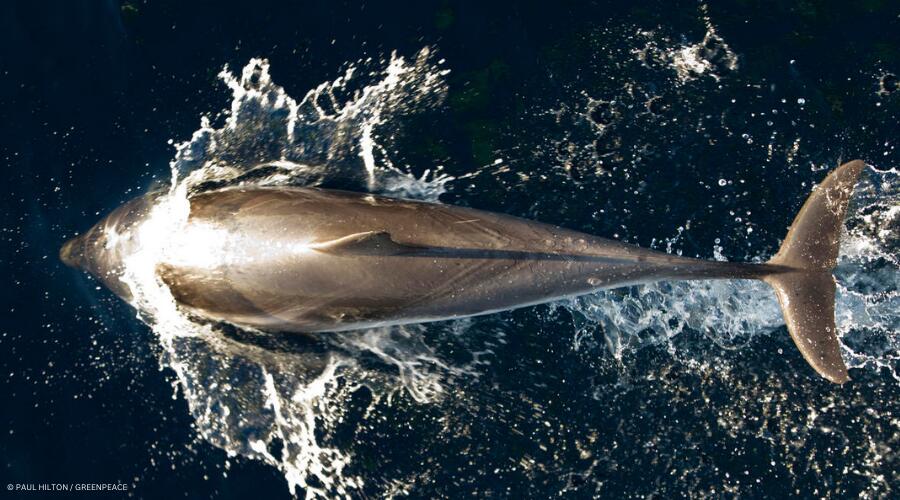
The whaling factory ship, Nisshin Maru, is back Tokyo Bay. Its time in the Southern Ocean Whale Sanctuary was cut short by a tragic fire, which claimed the life of one crewmember and threatened the Antarctic environment. Over the course of this past season 505 minke and three endangered fin whales were killed.
Recently an International Whaling Commission (IWC) review of Japan's so-called whaling program has revealed that after 18 years of so-called scientific research, killing more than 6,778 whales, Japan has gathered absolutely NONE of the scientific data it claimed it would.
Scientific review
Japan justifies its whale hunts by issuing "scientific" whaling
permits. Its original Antarctic whaling program (called JARPA) ran
from late in 1987 through early 2005 - despite repeated requests by
the IWC to call it off.
Late last year, 56 scientists (including 29 from Japan) held a
workshop under the auspices of the International Whaling
Commission's Scientific Committee to review JARPA. The goal of
this workshop was simply to evaluate how well the objectives of
JARPA had been met.
'Scientific' whaling research is a failure
The reviewing scientists recently issued conclusion is that none
of JARPA's four objectives was reached.
A major objective was to establish the natural mortality rate
for minke whales. The results?
"It was noted that the confidence intervals around the estimates
of natural mortality estimated from the JARPA data alone spanned
such a wide range that the parameter remains effectively unknown at
present." and "in particular, even a zero value was not excluded by
the analysis."
So, their bogus research program could not establish reliable
mortality rates for minke whales and the statistical analysis
cannot even rule out a zero mortality rate - which would make minke
whales immortal!
Attempts to determine if whale populations were increasing or
decreasing also failed.
The workshop noted that, "the current confidence intervals for
the estimates of trend are relatively wide. These results are,
therefore, consistent with a substantial decline, a substantial
increase, or approximate stability in minke whale abundance in
these geographic areas over the period of JARPA."
As Junichi Sato, Whale Campaign Coordinator for Greenpeace Japan
put it, "The Japanese people have spent 18 years and millions of
yen funding a so-called research program that has produced nothing
of substance."
What next for the factory ship?
The whalers are rushing to repair their factory ship in time for
a North Pacific whale hunt later this year. And next December, the
whalers plan to hunt up to 935 minke whales, 50 endangered fin
whales and 50 threatened humpback whales off the coast of
Antarctica.
Instead, the Nisshin Maru should be retired, and Japan's
thinly-veiled commercial whaling program ended. The government
should also give a full public account of the cause of the fire.
Our own ship, the Esperanza, arrives in Japan this week, and we
have invited both whalers and government officials to meet on
board.
Take Action
Tell the Bush Administration to keep the whaling fleet out of the Southern Ocean for good.