Feature story - June 3, 2003
Our Executive Director, John Passacantando, speaks out on sonar testing used by the U.S. Navy and the health effects it has on our marine mammals.
This article was originally published
in the
Editorials & Opinion section of the Monday, May 26, 2003
edition of The Seattle Times
May, 2003
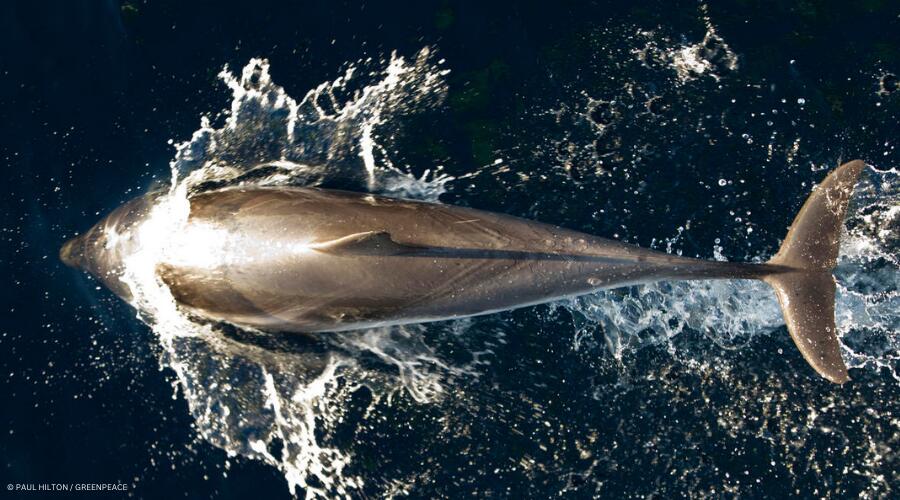
Earlier this month, the dead bodies of six harbor porpoises were
found off the coast of Washington state after a vessel of the U.S.
Navy conducted mid-range sonar tests in nearby waters. Additional
porpoises were stranded, and scores of marine mammals were seen
jumping out of the water and otherwise trying to escape the testing
area.
This is yet another egregious example of how sonar testing by
the U.S. Navy greatly threatens the health of our marine
mammals.
Just a few years ago - and in very similar circumstances - the
U.S. Navy had to admit that its own sonar was responsible for the
killing of 14 beaked whales in the Bahamas.
It is now beyond scientific doubt that whales are extremely
sensitive to sound in the oceans. Yet the Department of Defense and
the Bush administration are currently on a crusade to loosen the
provisions of the Marine Mammal Protection Act (MMPA) to exclude
the "harassment" of whales, claiming that the requirements of the
MMPA are too stringent and negatively impact our armed forces
preparedness.
Whales are also at risk of death from seismic testing techniques
used by the offshore oil and gas industry. In this case as well,
the Bush administration has shown blatant disregard for the
survival of whales by allowing the industry to play by a completely
different set of rules in the Gulf of Mexico and ignore the
requirements of the MMPA.
Americans have long valued whales as magnificent creatures of
the ocean, and we expect our government to take all necessary
measures to protect these awesome animals.
The Bush administration needs to act decisively and immediately.
At the upcoming meeting of the International Whaling Commission
(IWC) to be held in Berlin next month, the administration must
support a recently introduced initiative that will protect whales
from all environmental threats. If passed, this initiative will
transform the IWC from a body designed to organize the slaughter of
whales to a forum that will ensure their survival.
President Bush needs to show the
nation that he is truly committed to the protection of whales by
halting the devastating use of sonar by our Navy, by strengthening
- not gutting - the MMPA, and by supporting the conservation agenda
at the International Whaling Commission.