
[2024 Annual Report] Talking about climate is talking about life

この投稿を読むとわかること
- Voice of the people helps to accelerate mandatory solar power generation
- Investigating temperatures in schools—using data to expose the severe heat in classrooms and stimulating discussion in the national diet and local assemblies
- 80% of residents across Japan in favour of “taking measures to combat global warming”.
- Greenpeace delegation participates in COP29, lobbying governments and providing real-time updates to the Japanese media
- Calling on domestic auto makers to cut emissions
- Promoting sustainable mobility with vision document and investigative report
- Short film about the effects of climate change awared highest prize at international film festival! The film was featured at COP29 as a moving piece that resonated with many
- Experiencing ‘Local & Climate’ through art—Creating learning opportunities together through the HELP Exhibition in Shiga and Aomori
- Messages from Greenpeace staff

In 2024, Japan’s Basic Energy Plan and greenhouse gas reduction targets were widely discussed. Greenpeace saw these discussions as a decisive opportunity to influence Japan’s journey towards a decarbonized society, and actively made policy recommendations to both national and regional governments in order to effect positive change. Read on to learn about achievements made by our multifaceted campaign, which was conducted in collaboration with citizens, experts, and other civil society organizations.
Voice of the people helps to accelerate mandatory solar power generation
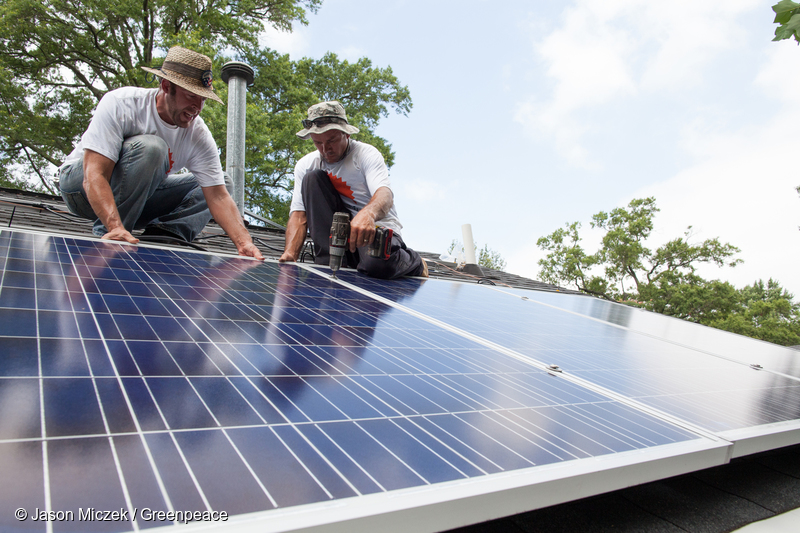
In 2023, Tokyo and Kawasaki City made the installation of solar panels compulsory. The Zero Emissions Network, of which Greenpeace is the secretariat, actively worked with citizens in Kanagawa prefecture in order to encourage this movement to spread further. We engaged with the local government and held information sessions for citizens, and as a result a total of 858 public comments, which is 10 times more than the previous total, were submitted, contributing to Kanagawa prefecture’s decision to make the installation of solar power generation facilities compulsory. The original plan proposed by the prefecture, which was to wait and review examples of precedents from “other municipalities” before moving forward, was changed to also include precedents from outside of Japan. This is a significant success that will help speed up the move to make solar panels compulsory.
Investigating temperatures in schools—using data to expose the severe heat in classrooms and stimulating discussion in the national diet and local assemblies
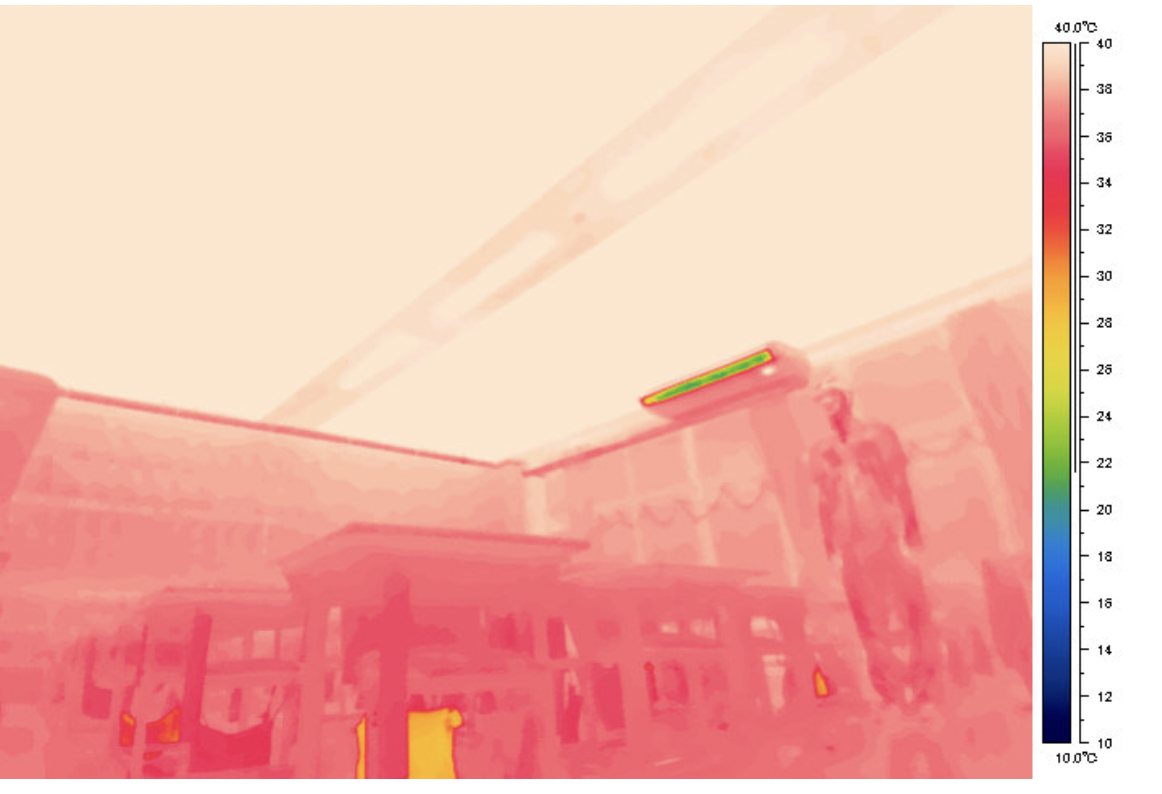
Documentation courtesy of Mae Masayuki, Tokyo University Associate Professor.
Even with the air conditioner on, air near the ceiling was close to 40℃.
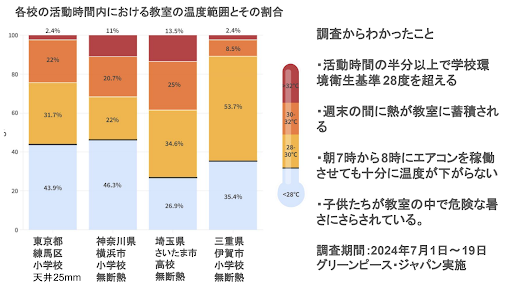
Many existing school buildings were built 30 to 40 years ago, and have very little insulation. The learning environment in old school buildings, which do not protect children from the cold or the heat, is worsening, especially as the frequency of extreme weather events increases. At Greenpeace, we have launched a project to promote insulation retrofitting for schools.
In order to assess the current situation, we first conducted a study to measure the temperature in classrooms. The study was conducted over 19 days, from July 1, in elementary schools in Tokyo, Kanagawa, and Mie, and a highschool in Saitama. Even with the use of air conditioners, temperatures in the classrooms exceeded the Ministry of Education’s recommended maximum temperature of 28℃ more than half of the time during the study. On July 8th, when it was extremely hot, the classroom temperature in all four schools exceeded 28℃ for the whole day, with temperatures at two other schools never dropping below 30℃ and 32℃ respectively.
The results of our investigation were reported widely by the media, and were referenced in questions brought up in both local government assemblies and the national diet, helping to stimulate domestic discussion around the issue of insulation in schools. We also created a dedicated website (Japanese only) introducing the issue and presenting the benefits of insulation, as well as outlining action that can be taken immediately. Insulation not only helps to reduce CO₂ emissions, but also helps protect our health, and at Greenpeace, we are working to promote the use of insulation through policy changes.
80% of residents across Japan in favour of “taking measures to combat global warming”.
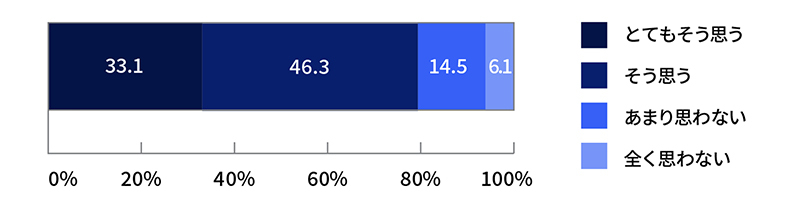
How do people in Japan feel about climate change? We conducted an opinion poll on climate change, interviewing 1,000 residents from 5 prefectures (Tokyo, Saitama, Kanagawa, Shiga, and the Suwa area of Nagano). In all regions, more than 80% of respondents said they were “concerned about climate change”. In response to questions that were tailored to each region, 79% of respondents in Tokyo and 96% in Nagano responded that “more should be done to combat global warming”, and 89% of respondents in Kanagawa answered that we should “promote renewable energy self-sufficiency within the prefecture”. Overall, the survey revealed that citizens have a high level of interest in climate change measures. We published the results of the survey and called on local governments to do more to promote climate policies.
Greenpeace delegation participates in COP29, lobbying governments and providing real-time updates to the Japanese media
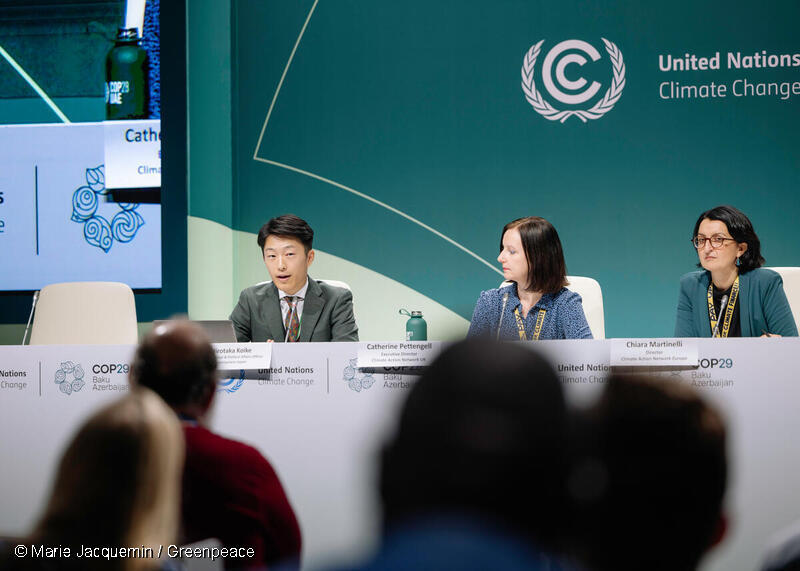
A delegation from Greenpeace, including staff from Japan, participated in the Conference of the Parties to the United Nations Framework Convention on Climate Change (COP29) in Azerbaijan. The delegation called on developed countries to take responsible action, and to make decisions that are aligned with the 1.5°C target set by the Paris Agreement. While the UK has succeeded in abolishing coal power, Japan has yet to even present a road map for its phaseout. Japan’s slowness to act has been severely criticised internationally, and as the world’s 5th highest emitter of CO2, Japan still has much work to do.
Calling on domestic auto makers to cut emissions
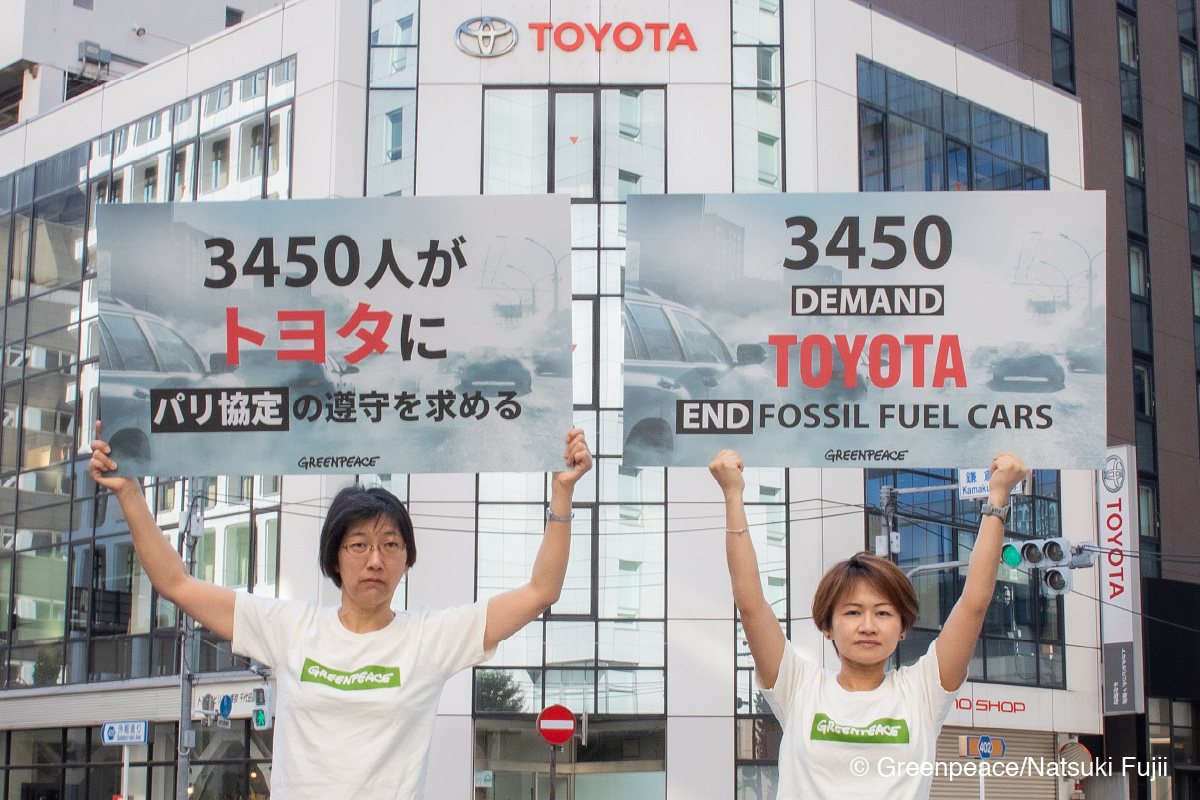
乗用車の販売台数で世界1位の座にあるトヨタ。同社が世界中で販売する乗用車および過去に販売した乗用車から毎年排出される温室効果ガスの量は、日本の年間総排出量の約半分以上に相当します。グリーンピーToyota is the world’s top-selling automaker. The amount of greenhouse gases emitted by Toyota cars is equivalent to approximately half of Japan’s total annual emissions. At Greenpeace, we collected over 3,500 signatures from people all over the world calling on Toyota to urgently decarbonize, and submitted this petition to Toyota along with an open letter. In the open letter we asked Toyota about the three following points: (link to details of the letter)
1) The basis of its current greenhouse gas emissions reduction targets
2) The relationship between its electric vehicle (EV) sales targets and greenhouse gas reductions
3) The impact of climate change on vulnerable people, and the climate finance needs of developing countries.
We will continue to engage in discussions with Toyota and other Japanese automakers and put pressure on them to commit to more ambitious climate change measures.
Promoting sustainable mobility with vision document and investigative report
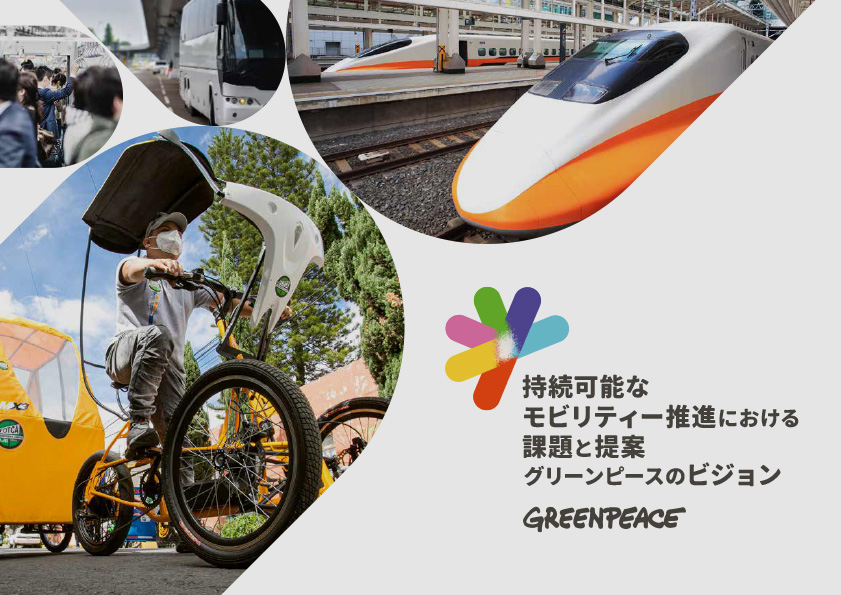
Greenpeace has published a vision document, outlining our future vision for sustainable mobility from the perspectives of convenience, safety, and climate change.
Additionally, we also published a report analysing whether the top seven global automakers are able to meet the new tighter emission regulations that will come into force in the USA from 2027. Our report revealed that all seven companies would not be able to meet the new standards with their existing production plans. However, these new emissions regulations were formulated under president Biden, therefore it is possible that they will be repealed by the Trump administration, and this would also impact Japanese automakers. CO2 emissions from the transport sector have a huge impact, accounting for 20% of total emissions domestically. Increased monitoring and lobbying by civil society to ensure that climate change policies are not delayed any further are more important now than ever.
Short film about the effects of climate change awared highest prize at international film festival! The film was featured at COP29 as a moving piece that resonated with many

Greenpeace’s documentary film MIWATARI won the highest prize, the Grand Jury Prize in the documentary category, at an international film festival held in Thailand. Miwatari is a natural phenomenon observed at lake Suwa in Nagano Prefecture, and its frequency has decreased dramatically due to global warming. MIWATARI was made by the creative unit HAKUA in 2023 as part of the HELP exhibition, and depicts how this natural phenomenon, which is deeply rooted in local traditions, is being lost. A digest of the film was showcased at a side event at COP29 in November 2024.
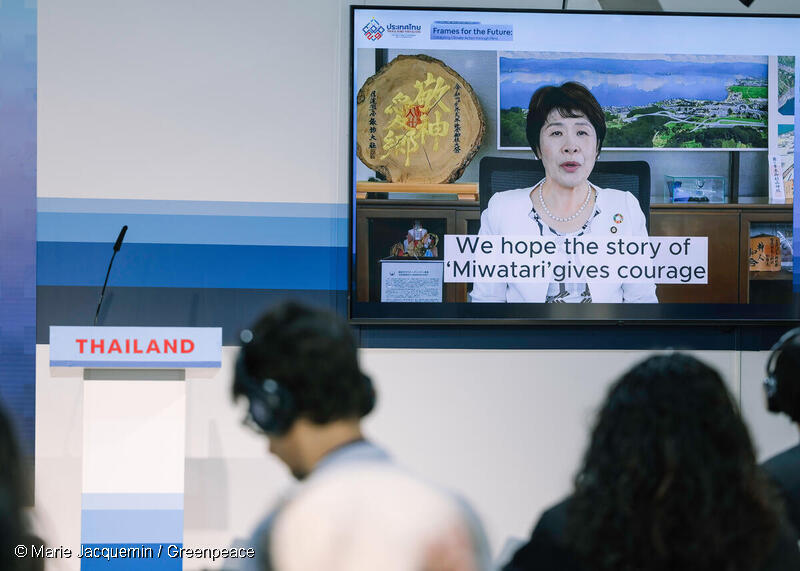
During the screening of Miwatari at the COP side event, Greenpeace’s Political and External Affairs Officer spoke about the meaning behind the film, and presented a video message from the mayor of Suwa. We also held a film screening and talk event in Suwa city, where the film was shot. The chief priest of Yatsuguri Shrine and representatives from the community and companies spoke at the event, and talked about how climate change is already having a huge impact on the making of fermented foods, such as Japanese sake and miso.
Experiencing ‘Local & Climate’ through art—Creating learning opportunities together through the HELP Exhibition in Shiga and Aomori
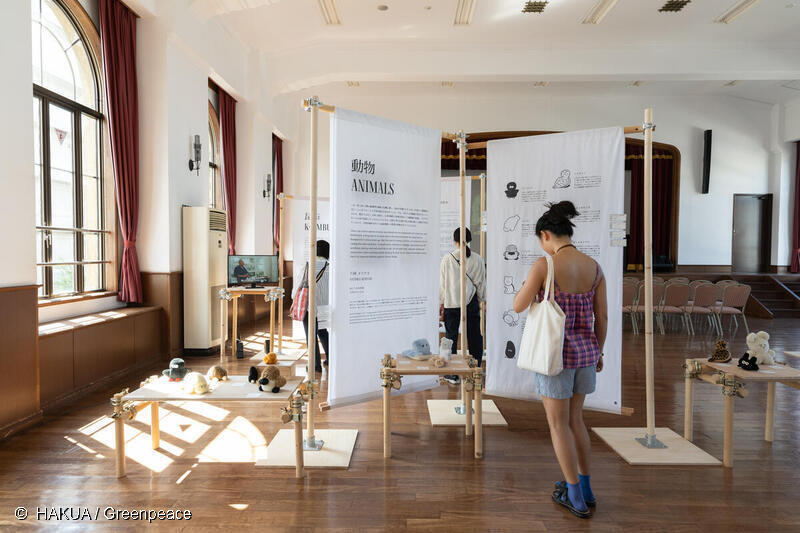
The exhibition “HELP: A EULOGY 30 YEARS IN THE MAKING” is a collaboration between Greenpeace and creative unit HAKUA, that uses art to make the climate crisis feel personal and immediate. Following the success of the first exhibition held in Aoyama, Tokyo in 2023, we toured the country in 2024, exhibiting in Otsu City in Shiga Prefecture (August) and in Hirosaki City in Aomori Prefecture (November).
As well as displaying exhibits from the original event in Tokyo, we also invited a wide range of local guests to the touring exhibition and hosted various side events and talk events to discuss the impact of global warming on local communities. In Shiga we collaborated with local highschool students, and in Aomori we worked with Apple (Ringo) Creative Award. These three HELP exhibitions also attracted attention as ‘reusable exhibitions’, using minimal single-use materials, and gifting exhibits to participants to take home with them at the end of the day.
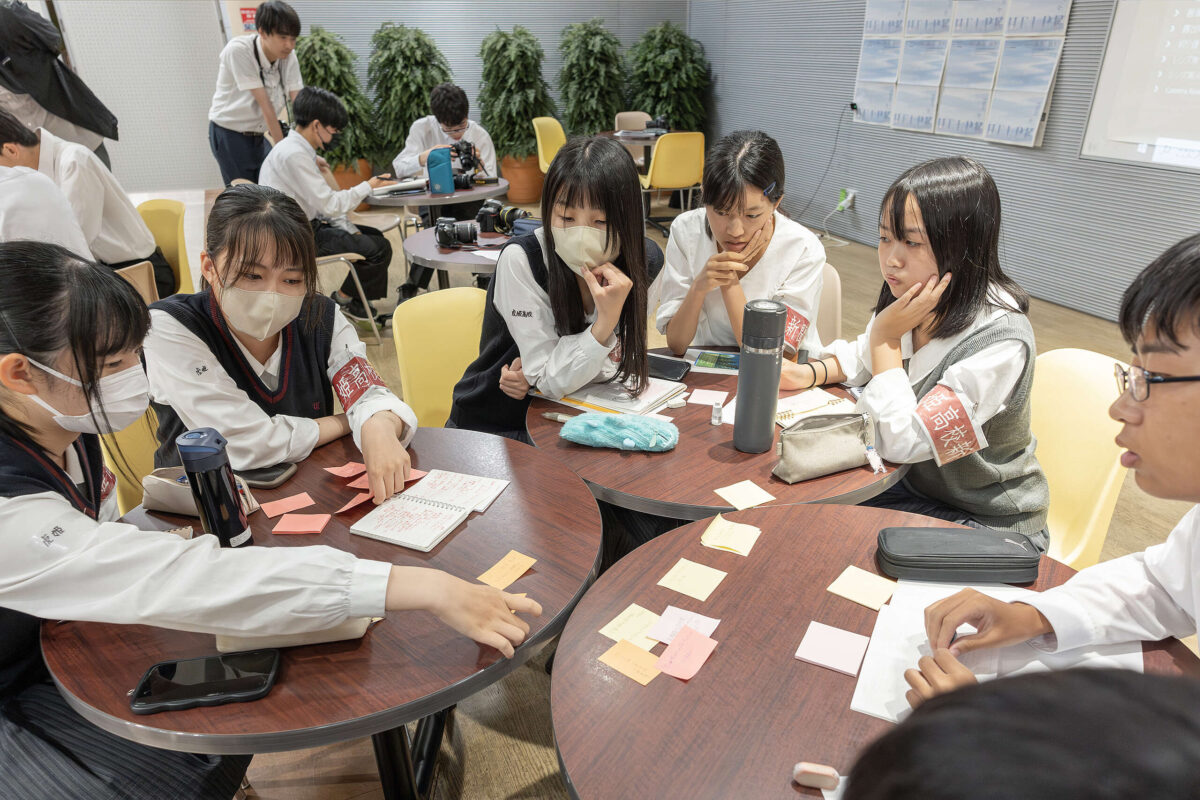
As part of the collaboration with highschool students, we organized a youth workshop about climate change. 13 students from the newspaper club of three high schools in Shiga participated in the event, which included a lecture by Greenpeace staff and the director of Kyoto University’s Center for Ecological Research, who is an expert in the water habitat of lake Biwa. The lecture was followed by a workshop to create a newspaper about lake Biwa and climate change. Greenpeace published the students’ article as a full page ad in the local newspaper to coincide with COP.
At a later date, Greenpeace also helped the students to visit the prefectural offices of national diet members, to present their article. The discussions between the students and the diet members about climate change initiatives were featured in the local newspaper.
Messages from Greenpeace staff

Project Manager, Hisayo Takada
2024 was a year when we met many new creators, experts and local community members as we travelled around Aomori, Shiga and Nagano prefectures, building on all the great opportunities and connections born out of the HELP exhibition. Climate change has already started impacting our daily lives. Change can create a turning point, and a turning point can become an opportunity. Through my work at Greenpeace I will continue to work to create new opportunities by connecting with people.
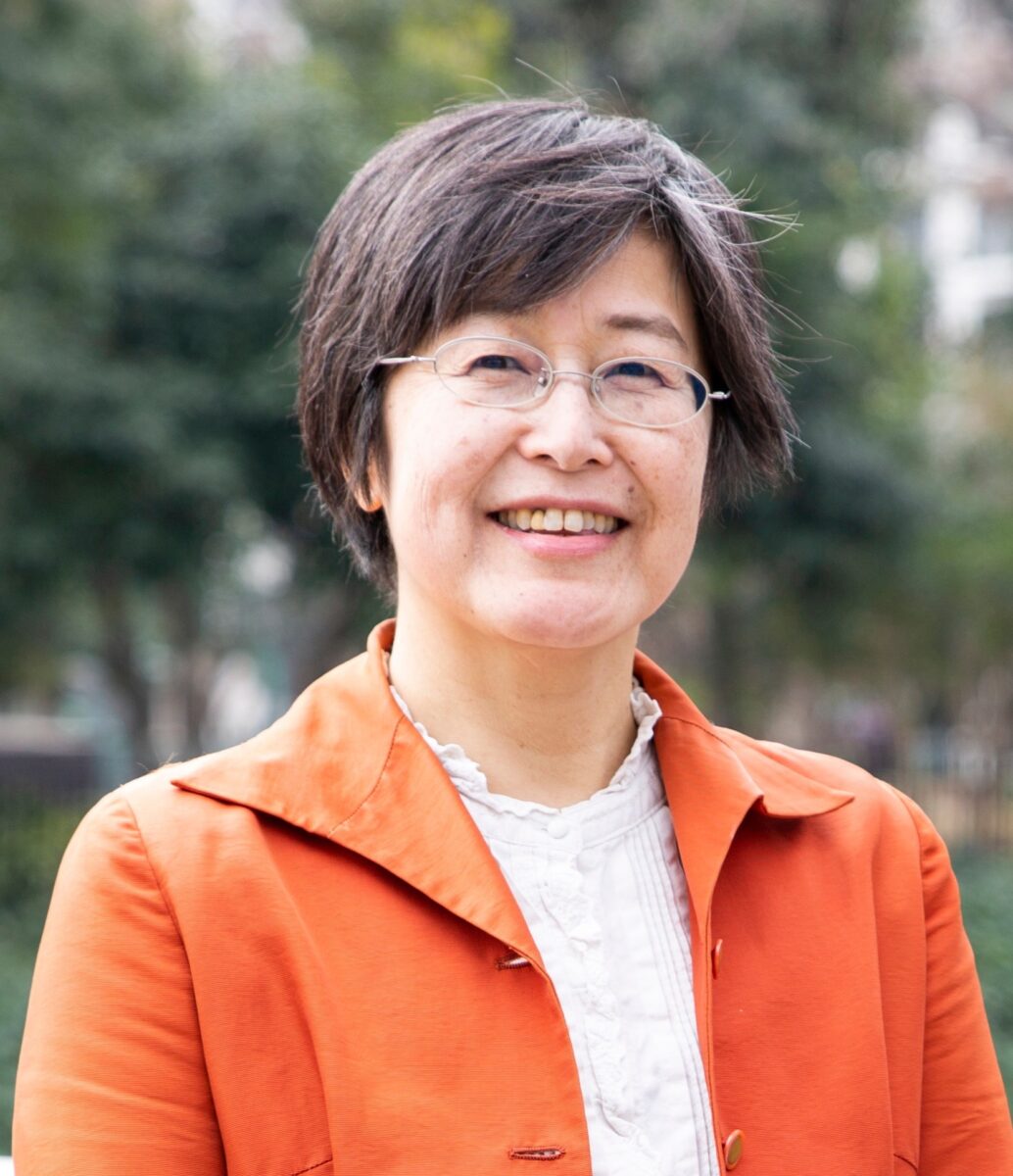
Climate and Energy, Kazue Suzuki
It’s already been four years since we founded the Zero Emissions Network, a grassroots, citizen-led movement to promote climate change initiatives. Members, who had no experience of activism and were uncertain about even making a phone call to a parliamentarian, are now successfully promoting climate change measures in municipalities all around Japan. Going forward, we plan to train organizers that can further support and assist citizens’ work as the network continues to grow and mature.
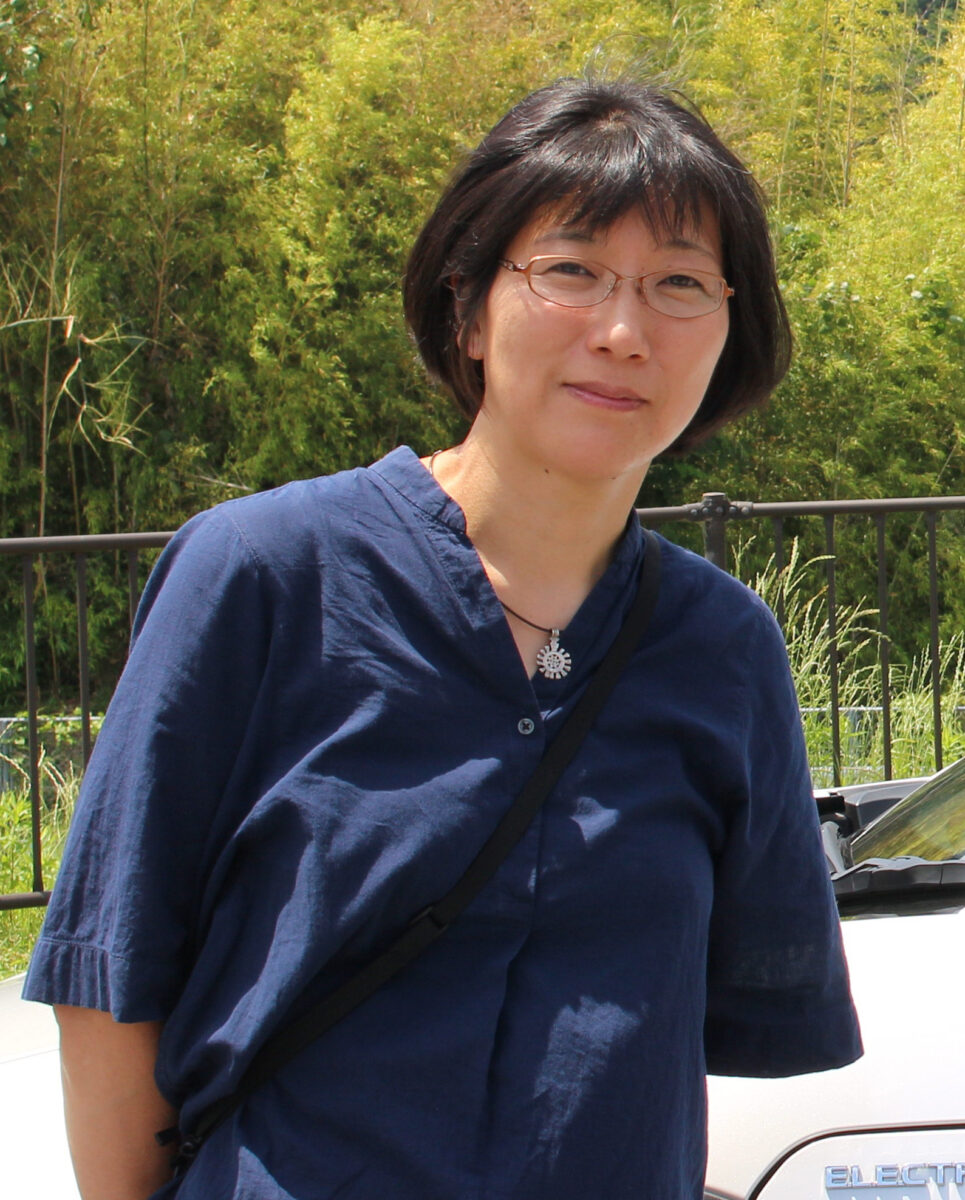
Climate and Energy, Mariko Shiohata
The news of the collapse of the Assad regime in Syria at the end of the year—this was quite an emotional moment for me as I was deeply involved in work with Syria at my previous job. Many people blame the crisis that started in Syria in 2011 on climate change, as the country was experiencing massive population displacement due to a drop in rainfall caused by climate change at the time. I pray for peace and stability in Syria.