
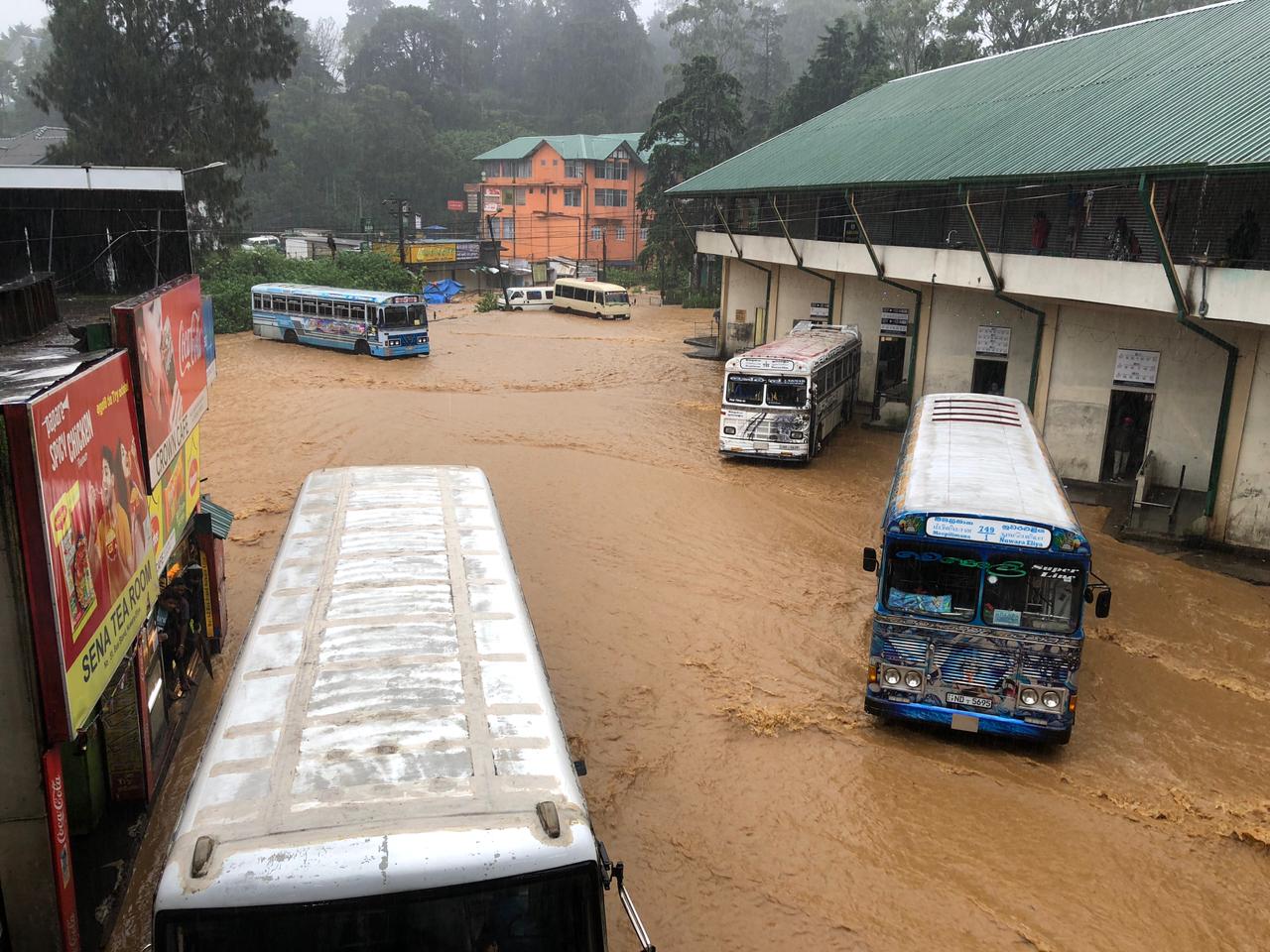
Colombo, 3rd March 2026: Greenpeace South Asia has released its new Issue Brief 4.0: Cyclone Ditwah’s Loss and Damage: A Case For Climate Accountability. The Brief details the extensive destruction caused by Cyclone Ditwah and emphasizes the urgent need for climate accountability, Loss and Damage financing, and justice for the communities affected in Sri Lanka.
While official assessments of Cyclone Ditwah have focused largely on destroyed homes, damaged roads, and economic losses, the issue brief reveals a deeper and largely unrecognised crisis including non-economic Loss and Damage. In several landslide-affected areas, bodies of loved ones remain unrecovered, denying families the ability to perform final rites and prolonging psychological distress. This unresolved grief represents a profound cultural and emotional loss that falls outside conventional disaster accounting systems.
Scientific evidence confirms that human-driven climate change significantly intensified Ditwah’s impacts. A recent analysis by World Weather Attribution found that the extreme five-day rainfall linked to Cyclone Ditwah was in between 28–160% more intense than it would have been without global warming.
Critical infrastructure, roads, bridges, railways, and utilities suffered extensive damage, slowing relief and recovery efforts. Over 114,000 homes were partially or fully damaged, with 6,000 completely destroyed. Agriculture and fisheries were heavily impacted, undermining food security and rural incomes. The World Bank Group estimates total economic damages at US$4.1 billion.
Yet, beyond visible destruction, the Issue Brief documents profound non-economic Loss and Damage, including psychological trauma, disrupted education, loss of cultural and ancestral land, erosion of social cohesion, and ecosystem damage. Entire villages in areas such as Kotmale, Walapane, and Ragala were destabilised by landslides that erased homes within seconds. Damage to culturally significant and archaeological sites further deepens this irreversible loss, representing not just physical erosion but the weakening of collective heritage and historical memory.
- Kew, S. et al., (2025): Increasing heavy rainfall and extreme flood heights in a warming climate threaten densely populated regions across Sri Lanka and the Malacca Strait (WWA scientific report No. 78) World Weather Attribution DOI: https://doi.org/10.25560/126259
- World Bank Group (2025): https://www.worldbank.org/en/news/press-release/2025/12/22/damage-from-cyclone-ditwah-in-sri-lanka-estimated-at-4-1-billion
Children have been especially affected. According to the United Nations Children’s Fund, hundreds of thousands of children have required urgent assistance, facing prolonged school disruption, trauma, and heightened health risks. Many families remain displaced, with temporary rental assistance insufficient to meet long-term needs.
Women, particularly in displacement camps and temporary shelters, shoulder disproportionate caregiving responsibilities under conditions of overcrowding, uncertainty, and loss of privacy. These layered burdens such as emotional, social, and gendered remain invisible in recovery metrics that prioritise infrastructure over human wellbeing.
“Every statistic from Cyclone Ditwah conceals a human story often ignored in official assessments; families unable to perform final rites for their loved ones, children whose education has been disrupted for years, and women bearing overwhelming caregiving burdens in displacement camps. These are losses that cannot be repaired with concrete or loans. This is why climate accountability is urgent and essential for Sri Lanka’s future.” said Anita Perera, Greenpeace South Asia Campaigner. “Any recovery model that only values economic loss will continue to fail those least responsible for climate change, yet forced to carry its heaviest social and environmental burdens.”
Sri Lanka contributes less than 0.1% of global greenhouse gas emissions, yet it is experiencing some of the most severe consequences of climate breakdown. The Issue Brief situates Cyclone Ditwah within a global pattern of injustice, where historical emissions from industrialised nations and fossil fuel corporations drive disasters in countries least responsible for the crisis.Greenpeace South Asia calls for the Polluter Pays Principle to be enforced, requiring major carbon-emitting countries and fossil fuel corporations to finance Loss and Damage from climate change as compensation, not charity. As Sri Lanka confronts a future of intensifying extreme weather events, Cyclone Ditwah stands as a warning and a demand for climate justice.
Media Contacts:
Melani Gunathilake
Consultant, Greenpeace South Asia
[email protected]
0773444257
Anita Perera
Greenpeace South Asia, Campaigner
[email protected]
+94 773925597
Available for Media:
– Full Issue Brief (PDF)
– High-resolution photographs (upon request)
– Community testimonies
- UNICEF (2025): https://news.un.org/en/story/2025/12/1166671
- Climate Change Tracker (2025): https://climatechangetracker.org/nations/greenhouse-gas-emissions/sri-lanka/historical-impact#share
- OECD (2008), The Polluter Pays Principle: Definition, Analysis, Implementation, OECD Publishing, Paris, https://doi.org/10.1787/9789264044845-en.