
Tides Arising. Witness the Evidence.
A human art installation by Subodh Kerkar · Keeri Beach, Mannar ·10th October 2026
ABOUT THE INSTALLATION
Tides Arising is a participatory performance installation conceptualised by internationally acclaimed ocean artist Subodh Kerkar and brought to life by the communities of Mannar, Sri Lanka.
Over 200 people will gather at Keeri Beach and become one living image, formed by human bodies, captured from above, and shared with the world.
This is Mannar’s story, told by Mannar.
This image will travel to the decision-makers, the policymakers, and the corporations most responsible for the climate crisis. It will say, simply and clearly: we are here. We are watching. We are the evidence.

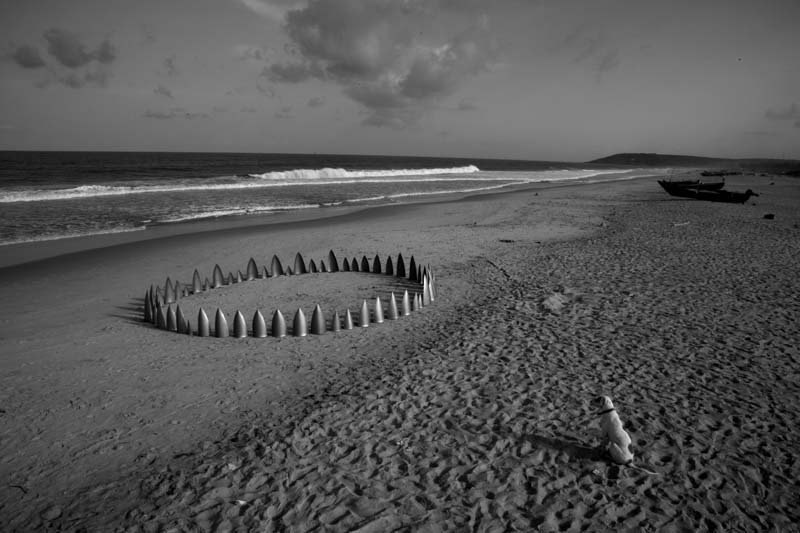
ABOUT SUBODH KERKAR
Subodh Kerkar is one of India’s most celebrated contemporary artists, known internationally for his pioneering work in performance installation – a genre he has developed over three decades at the intersection of land, sea, and people.
His installations have brought hundreds of people together on beaches and public spaces across the world to create images that are visible only from above – works that are as much about collective human action as they are about art.
Subodh is the founder and director of Museum of Goa (MOG), one of South Asia’s most significant privately-owned contemporary art spaces. His work has been presented across Asia, Europe, and the Americas.
Tides Arising is his first installation in Sri Lanka, and his most direct collaboration with a frontline climate community.
WHY MANNAR
Mannar Island sits on the northern coast of Sri Lanka, home to fishing communities, farming families, and one of the country’s most biodiverse coastal ecosystems.
It is also on the frontline of a crisis it did not create.
Mannar’s communities contribute less than a fraction of a percent of global greenhouse gas emissions. Yet they face sea-level rise, more frequent and more intense cyclones, groundwater turning saline, fish populations moving further from shore, and paddy harvests failing across the district. Cyclone Ditwah in November 2025 — Sri Lanka’s deadliest weather disaster since the 2004 tsunami — killed over 640 people and affected two million more. Scientists estimate the storm was made 160% more intense by climate change.
The world’s biggest fossil fuel companies have known for decades what their emissions would do.