| Taysir is an art student in her early twenties who feels out of step with her time, lost between eras she never lived except through the stories of others. She wishes she had lived in a time when Gabès was called “an earthly paradise,” before the noise of industrial change arrived. On the same land guarded by Uncle Saleh through his living memory, Taysir is trying to rewrite the scene. While Uncle Saleh lives in a time of regret over decline, Taysir lives in a time in which she seeks to transform this catastrophe into a cause for change, becoming the voice of her generation. |
A Lifetime’s Testimony: Memories on the Line Between Story and Reality
“Gabès… it was a paradise on earth,” said Uncle Saleh, his voice tightening as his eyes glistened with tears. “Whenever I remember my childhood here, I feel that my beautiful years have vanished forever.” Uncle Saleh, an eighty-year-old man and a farmer from the indigenous community of Chenini in Gabès, finds no solace today except in the memory of the past, repeating to us with deep sorrow: “When I recall my early days, I fall into bouts of crying over years of life that will never return.”
Uncle Saleh witnessed an era in which the title “paradise” was not merely a literary expression, but a unique geographical reality. Gabès is the only coastal oasis in the Mediterranean basin, where palm trees embrace the sea’s waves – a rare ecological balance that grants it exceptional fertility and economic abundance, based primarily on farming, agriculture, and fishing.
Historically, this description took root in the words of travelers and chroniclers. In the twelfth century CE, the geographer al-Idrisi described it as “a large city with many farms and abundant fruits.” In the fourteenth century CE, al-Tijani confirmed this image, calling it “a place that is a paradise on earth.”
Before the industrial decades, Gabès was a dynamic coastal region rich in oases, sustained by abundant freshwater springs of high quality in areas such as Ghannouch, Oudhref, and Chenini. This water stability supported plentiful production of dates, henna, pomegranates, peaches, grapes, and other fruits and vegetables. Gabès’ agricultural fertility created a sustainable society long before its development model was replaced by intensive industrialization.
Along the coast, the Gulf of Gabès (known as the Lesser Syrtis) contained the largest seagrass meadows (Posidonia oceanica) in the Mediterranean. These meadows formed a vital marine habitat for commercial fish species, on which artisanal fishing relied during the summer as a secondary activity alongside agriculture.
To recount the history of Gabès before the 1970s, Uncle Saleh welcomed us to his plot in the old oasis of Chenini. There stands his concrete house, which he turned into both a home and a refuge, fleeing the noise of the “industrial encroachment” that altered the city’s features, and seeking an isolation that reconnects him with his past and keeps it alive in memory, in the face of pollution that has choked the air of the oasis.
Uncle Saleh says, “My whole day is here, and even in my sleep I dream that I am tilling the land.” Those were years of abundance: fertile soil, fruits hanging from branches, and plentiful springs where the family gathered to work. Today, this man carries in his heart the unique taste of vegetables and fruits, standing as a guardian of the original seeds of the lost paradise, refusing to give up land that is no longer what it once was.
At the same time, Taysir, the young art student, sees herself as alien to her era, lost between times she knows only through others’ stories. She longs for an age when Gabès was called “an earthly paradise,” before the clamor of industrial transformations.
On the same land guarded by Uncle Saleh’s living memory, Taysir is attempting to rewrite the scene. While Uncle Saleh inhabits a time marked by mourning decline, Taysir lives in a time in which she seeks to turn this catastrophe into a cause for change, to become the voice of her generation.
Today, the cause brings together two generations separated by time and united by destiny, each of them using the tools of their own era as a path of resistance. In a step that breaks the wall between past and future, the young Taysir chose to join training workshops in the oases of Chenini, drawing the secrets of the land and the deep-rooted traditions of farming directly from Uncle Saleh’s hands. When we asked her about the secret behind this commitment, she replied: “I love Gabès, and I dream of seeing it one day return to being a paradise, as it once was.”
When Generations Meet: Different Tools, One Cause
The difference between generations does not lie in the degree of love for the land or the sense of loss, but in the mechanisms of action and response to crises. Each generation is shaped by the tools of its time, the limits of its influence, and the space available to its voice.
Uncle Saleh belongs to a generation that gave its best using the tools of its era: experience, patience, and inherited knowledge. A generation that learned directly from the land, instinctively protected natural balance, and worked in long, quiet perseverance, relying on inheritance, patience, and daily attachment to fields and seasons. For him, protecting Gabès was an act of life; safeguarding the land was not a slogan, but a way of living: respecting natural cycles of water and resources, diversifying crops, and avoiding soil depletion. What studies today call “sustainability” was, for him, simply an agricultural instinct.
By contrast, Taysir belongs to Generation Z – a generation often described today as aware, pragmatic, and capable of change, able to turn environmental anxiety into action. It is a transformative generation, not an idle one. A generation that treats environmental crises as social issues rather than natural occurrences. It does not settle for observation or nostalgia; instead, it seeks learning, organization, and the building of practical alternatives, from field workshops to community pressure and the crafting of digital narratives. It is a generation that sees the environmental crisis as a matter of justice and of the future, not merely as a loss of the past.
Despite their different approaches, the two generations meet at the same source: a deep love for the land and a shared desire to save what remains of it. Uncle Saleh guards memory and seeds. Taysir, in turn, transforms memory into action. He carries wisdom; she carries energy. He is a witness to what was, and she is the voice of what must be.
Gabès as Inherited by Generation Z: The Language of Numbers
What Uncle Saleh recounts through memory is now confirmed by figures and reports. The generation that inherited pollution confronts it with data, turning it into a tool for accountability.
- The Gulf of Treasures: Seagrass meadows (Posidonia) shrank from 1,300 km² in 1970 to less than 150 km² in 2014.
- Phosphogypsum: More than 500 million tons of toxic waste have been discharged into the gulf since the 1970s.
- Economic losses: Annual losses were estimated at €105 million in 2014, a figure exceeding the profits of local fertilizer plants by 115% in the same year. Artisanal fishers alone lost nearly €58 million, revealing a stark paradox: an industrial model that generates limited profits while accumulating far greater losses for society and the environment.
- Severe deterioration of agricultural activity and oases: Date and henna cultivation declined due to water scarcity, rising salinity, and pollution. Direct testimonies cited in the 2025 Environmental and Social Audit Report confirm reduced agricultural yields and withering crops as a result of airborne pollution from the plant.
The environmental disaster continues, this time in the air. Living in Gabès has become synonymous with inhaling a mix of acidic gases and heavy metals emitted by the chemical complex. This reality translated into more than 50 cases of suffocation among students at a single school in just two months in the autumn of 2025, with numbers continuing to rise in 2026. Despite a government decision in June 2017 to dismantle and relocate the polluting units, implementation remains stalled, and the cost of the corrective action plan is now estimated at 306 million Tunisian dinars.
This environmental destruction was not a passing accident, but the outcome of an industrial policy that persisted for decades without real accountability. Losses that were not calculated when decisions were made now fall entirely on a generation that had no part in them. For Generation Z, these figures are no longer mere environmental indicators, but a daily experience of living at risk.
In other words, what took centuries to form naturally was destroyed in just a few decades, before most members of Generation Z were even born, leaving them to bear a heavy cost, after prevention was replaced by expensive remediation.
Seeds of Hope in Taysir’s Hands
In the farming workshops at the oasis, Taysir does not only learn how to cultivate the land, but how to understand time itself. There, seeds pass from Uncle Saleh’s hand, the hand of memory, to Taysir’s hand, the hand of change and the future.
Thus, generations in Gabès do not clash; they complement one another. While Uncle Saleh safeguards wisdom and seeds, Taysir carries the energy and modern tools to claim the right to the land. With the launch of the “Save the Gulf of Gabès” petition on the “Sawt” platform, Generation Z begins writing a new chapter.
Hope lies in this smooth transfer of responsibility. As long as a young person is learning from an elder how to plant, and as long as there is a voice demanding the land’s rights, the “lost earthly paradise” is not merely a memory Uncle Saleh wept over; rather, it is a life project that Taysir and her generation insist on reclaiming.
Sources Referenced in the Report
- Marine economic and environmental studies:
- Audit reports and government plans:
- Environmental and Social Audit Report of the Tunisian Chemical Group sites (July 2025)
- Environmental rehabilitation projects for the production units of the Tunisian Chemical Group (government file)
- Historical and social studies (Persée):
- Persée: Industrie microlithique de la station de l’Oasis de Grenouch, près Gabès (Tunisie) (1909)
- Persée: Le pouvoir de l’eau dans le Sud-Tunisien (1980)
- Official fisheries statistics:
Expertise France (French international development agency)
Étude statistique de la Pêche en Tunisie (1966)
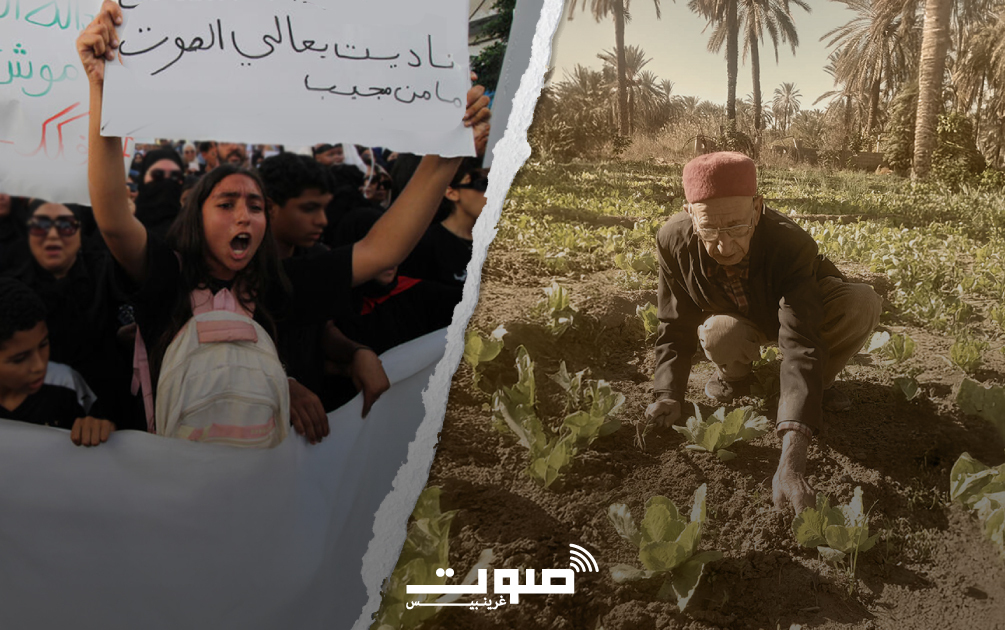
Stop environmental crimes in Gabès… We want to live with dignity!
Add your voice