
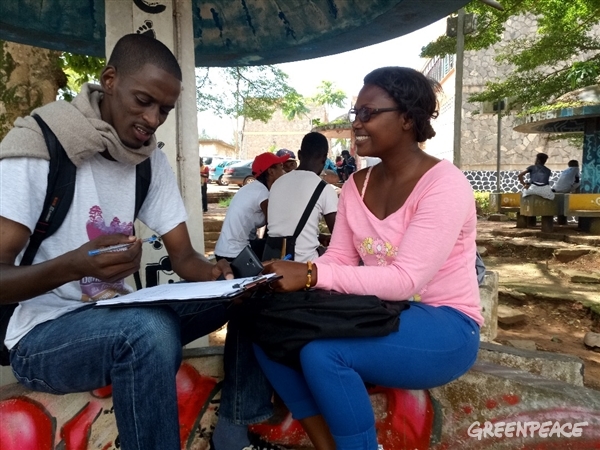
We started our survey at midday at the Charles Atangana garden in the heart of Yaoundé while city dwellers were relaxing under the shade of trees in the garden. Despite my fear of talking to strangers, I summoned a lot of courage and talked to people politely. Many of the respondents were very open in answering our questions but when I asked to take photos and videos during these exchanges, many became suspicious and refused.
You know, when you engage in a venture, you have two options – failure or success. But if you don’t try, you have already failed! The third person that I approached allowed me to take a video and it seemed like he gave me some luck because, after him, I did several videos of people answering our questions. I was impressed with the response we were getting from the public. But one respondent stood out from the rest!
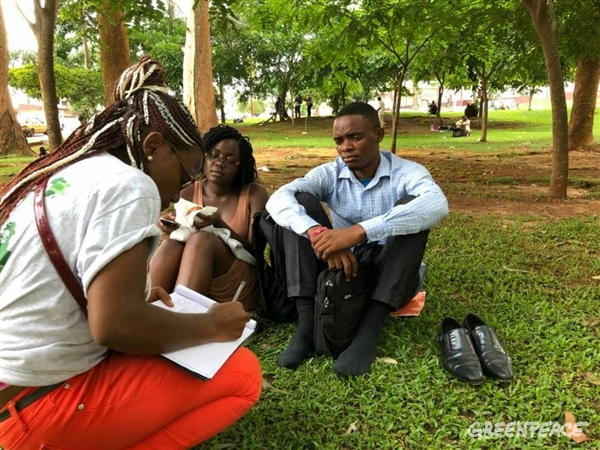
Mr Nouma III Aimé is in his late sixties and his hair was neatly cut with a well-trimmed moustache. He sat under a tree wearing dark glasses which made his expression unreadable. I was afraid to request his permission for a video. Surprisingly, when I asked, he accepted without any hesitation and at the end of our discussion, he asked to see the video. Mr Nouma III Aimé was very impressive with his answers and knowledge about forestry issues in Cameroon and the Congo Basin forest in general.
He talked about the broken promises of SG Sustainable Oils (SGSOC) to the Manyemen community in the South West Region. He also questioned the role of the Cameroon government in regulating land acquisition by SUDCAM in the the South Region of Cameroon We exchanged contact information while he expressed interest to participate in future Greenpeace Africa forest campaign initiatives.
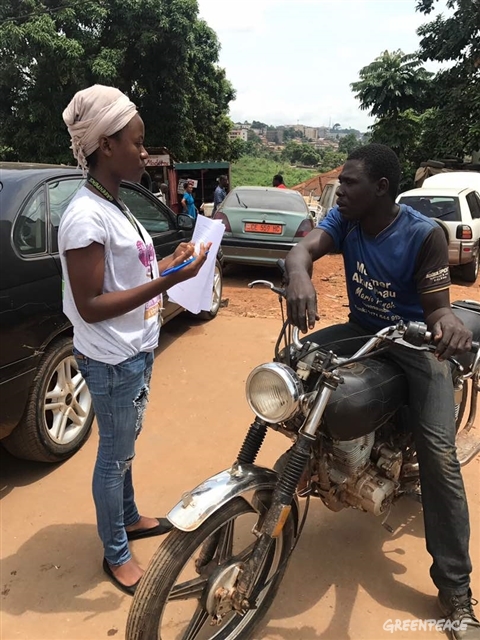
Another stand-out respondent during our survey was this pensive looking gentleman of about 35 in faded blue jeans and T-shirt. He was sitting at the bus stop when we approached him and he was very angry about the forest exploitation in his village. He said his village is situated around the National Airport of Nsimalen where a foreigner, with the complicity of the Mayor, had supposedly “bought” hundreds of hectares of forest and is allowed to log timber indiscriminately for the next six (6) years! He promised to get in touch with us with proof of this alleged illegality for Greenpeace Africa to raise the issues with competent authorities. Surprisingly that same evening while at home after the survey, the gentleman I met at the bus stop called me! I think he must have gotten my number from our Facebook page. He complained again about what is happening in his village. I was very surprised by the way people are attached to the environment, especially forests. Through this exercise, I’ve gotten connected with people in a manner I have never done before.
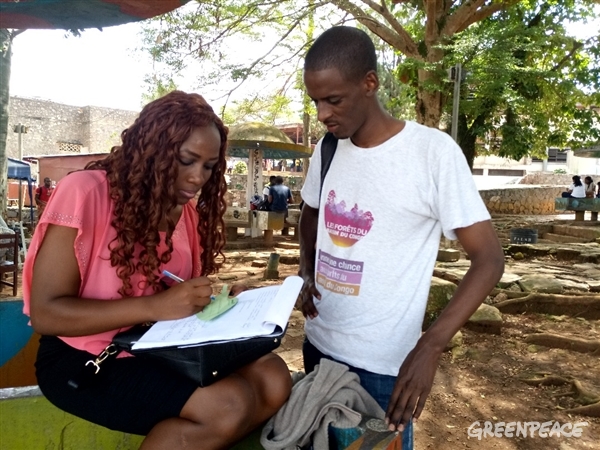
Although some city dwellers think that the Congo Basin forest is only in the Democratic Republic of Congo and doesn’t extend into Cameroon, others are very knowledgeable about the importance and the problems plaguing our forest. The Congo Basin forest is our collective heritage to protect and I’m so motivated to continue as an environmental ambassador because of the response we got from our survey.
Want to see more from Greenpeace?
 Add as a preferred source on Google