TOKYO (Sept. 17, 2026) — Days with crop-damaging temperatures across Japan’s key agricultural hubs have surged by up to 43 days over the past 50 years, posing risks to the growth and quality of four iconic autumn crops, according to a report published today by Greenpeace Japan.
The report, Climate Change as Told by Autumn Flavours, looks at 50 years of climate shifts by comparing decadal temperature averages between 1966-1975 and 2016-2025 across four major agricultural regions: Kagoshima (sweet potatoes), Chiba (Japanese pears), Yamanashi (grapes), and Niigata (rice). Researchers specifically tracked days when physiological heat thresholds disrupt vital growth stages, including fruit coloration and grain filling.
The findings indicate that crop heat exposure during critical growth periods has surged significantly, driven by hotter summers, warmer winters, and record tropical nights. Researchers warn these climate impacts threaten harvest stability, farm incomes, and retail food prices, compounding structural risks for an agricultural workforce where 69.5% of core workers are aged 65 or older [1].
This crop damage coincides with intensifying nationwide heat extremes driven by climate change. In 2025, Japan recorded its hottest summer since 1898—marking its third consecutive record-breaking year [2]. Temperatures reached or exceeded 40°C across 25 locations, making kokushobi (“intense heat days”) a household phrase [3]. As the Intergovernmental Panel on Climate Change (IPCC) warns, these extremes directly threaten food security and farm livelihoods [4].
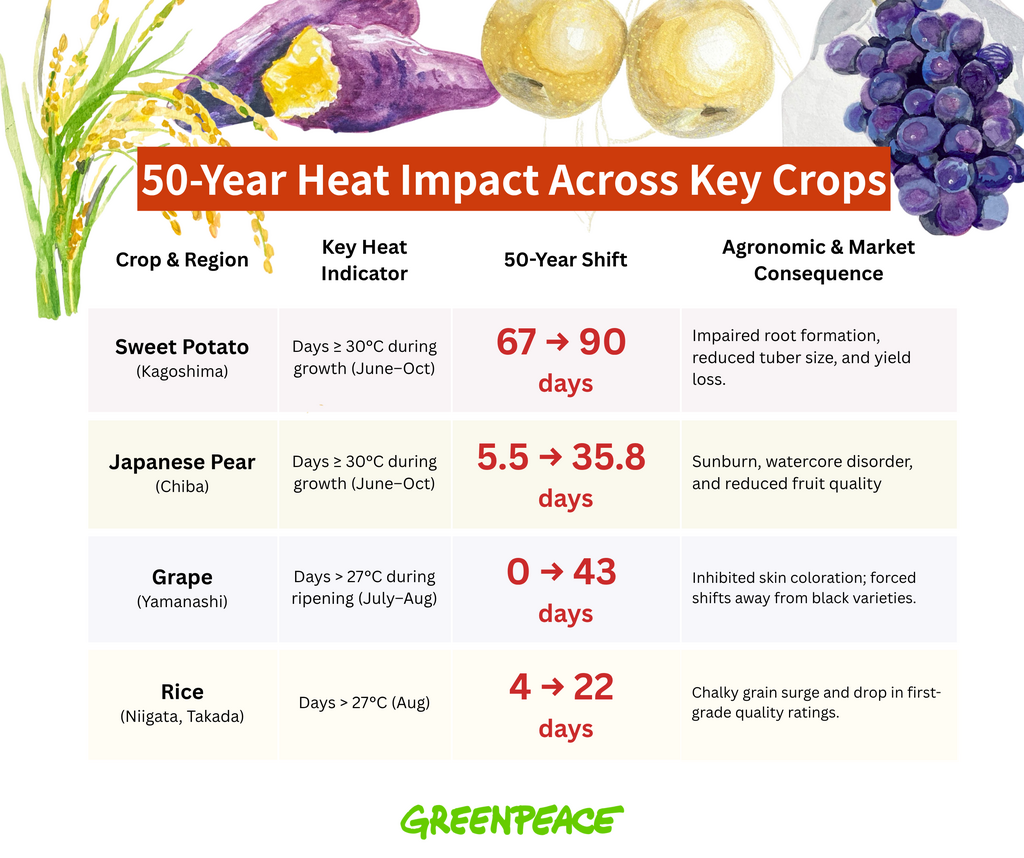
Key Findings: 50-Year Heat Impact Across Key Crops
- Sweet Potatoes (Kagoshima): Days at or above 30°C during main growth from June to October rose by 23 days, from 67 to 90 days. Warm nights stunt root growth, resulting in smaller tubers and lighter harvests.
- Japanese Pears (Chiba): Midsummer heat days at or above 30°C during fruit growth from June to October rose by 30.3 days, from 5.5 to 35.8 days. Mild winters disrupt spring budding, while summer heat leads to severe sunburn and watercore damage.
- Grapes (Yamanashi): Days above the 27°C quality threshold during the July to August ripening period surged from 0 to 43 days. Extreme heat blocks color development, causing widespread skin failures in popular black grapes like Kyoho.
- Rice (Niigata): August days exceeding 27°C in Takada increased by 18 days, from 4 to 22 days. Post-heading heat accelerates chalky grain formation, reducing rice quality and the proportion classified as first grade.
Field interviews included in the report show that the crisis goes far beyond temperature charts: local farmers are battling a storm of extreme heat, water shortages, shifting seasonal windows, and sudden pest surges. Although producers are doing everything they can, such as shifting planting dates and testing heat-tolerant crops, farm-level adaptations are no longer enough to offset systemic climate shocks.
Ikumi Toyota, Climate and Energy Campaigner at Greenpeace Japan, said:
“Over 50 years of accelerating heat waves have pushed Japan’s most iconic agricultural hubs past their thermal limits, placing both crop viability and supermarket prices on the line. While farmers are showing incredible ingenuity to adapt, single operations cannot outrun systemic climate disruption. When the people who feed us run out of options, national food security becomes everyone’s crisis.”
Greenpeace Japan calls on the government to act swiftly on four key fronts:
- Support Farmers and Agricultural Resilience: Conduct detailed field assessments of climate damage and strengthen structural, long-term support to help farmers adapt, maintain stable livelihoods, and keep farming.
- Accelerate Energy Efficiency: Enforce strict energy-saving measures across agriculture and industry, alongside modern building insulation standards.
- Expand Local Clean Power: Scale up solar sharing on farms (agrivoltaics) and commercial rooftop solar to build resilient, local energy systems.
- Phase Out Fossil Fuels: Commit to an immediate phase-out of coal power, followed by oil and gas, to target climate change at its source.
ENDS
Notes:
The full report in Japanese, Climate Change as Told by Autumn Flavours, is available here.
[1] Ministry of Agriculture, Forestry and Fisheries (MAFF). Statistics on Agricultural Workforce.
[2] Japan Meteorological Agency (JMA). (March 11, 2026). Climate Change Monitoring Report.
[3] New York Times. (July 23, 2026). It’s So Hot That Japan Needs a New Word for It.
[4] Intergovernmental Panel on Climate Change (IPCC) Special Report on Climate Change, Land, and Food Security.
Media Contacts:
Yujie Xue, International Communications Officer, Greenpeace East Asia, +852 5127 3416, [email protected]
Kahoko Sato, Communications Officer, Greenpeace Japan, +81 70 1228 7611, [email protected]