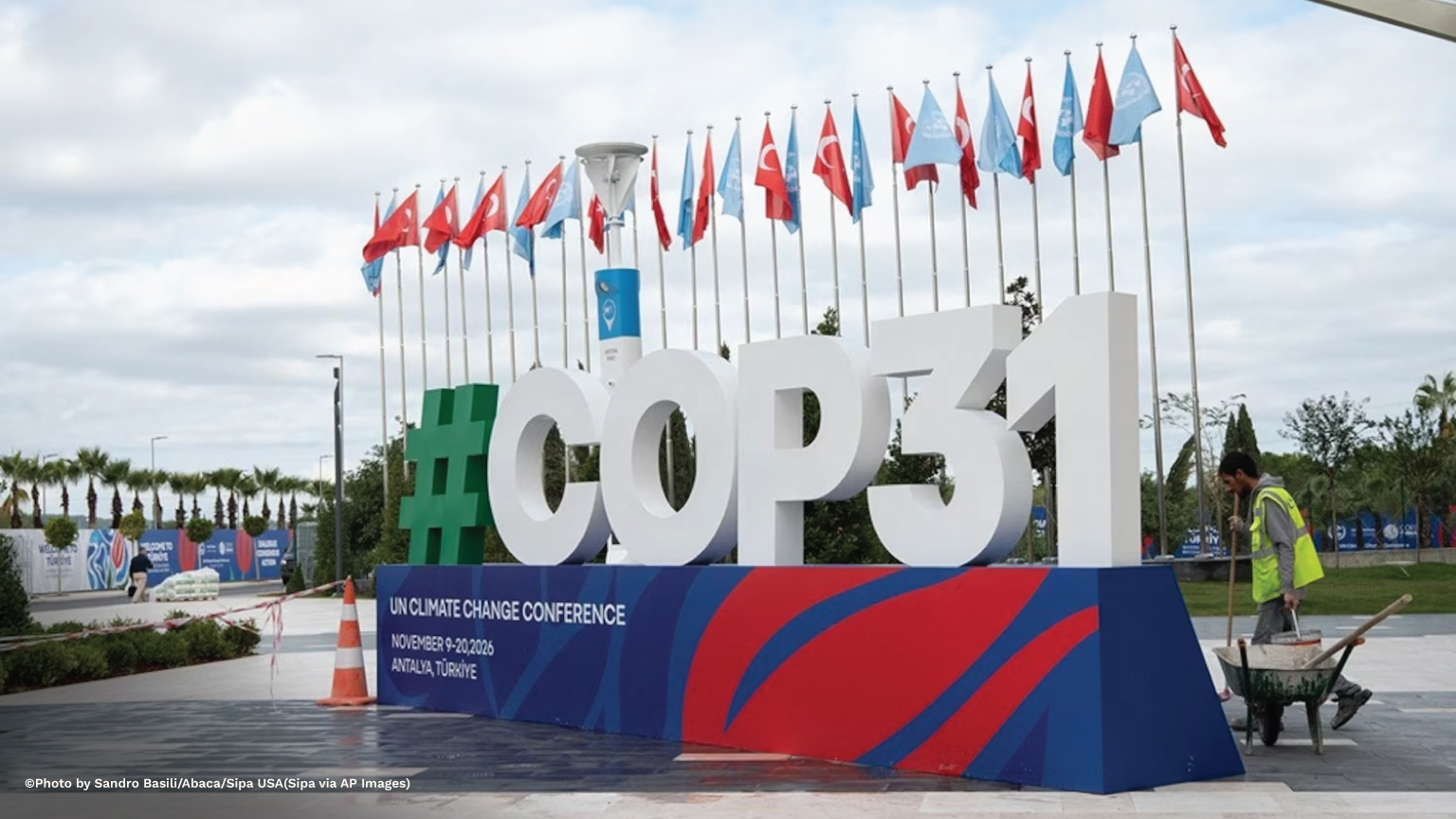
| Greenpeace MENA issues a statement ahead of Finance and Trade Day (November 13, 2026) at the climate summit. |
Antalya, Türkiye, 12 November 2026: At COP31, developing countries have sent a clear message: climate ambition requires climate finance. The Climate Finance Work Programme, a COP31 agenda item, must deliver on developed countries’ obligations under Article 9.1 of the Paris Agreement and turn the commitment to triple adaptation finance by 2035 into action.
Article 9.1 establishes developed countries’ obligation to provide financial resources for climate action in developing countries. Delivering that obligation requires predictable public finance, primarily through grants and without adding to the debt burden of developing countries. It cannot be outsourced to private investors.
Yet pressure from developed countries to spread the climate finance work programme across the entirety of Article 9 and move the emphasis onto creating ‘enabling environments’ for investment in developing countries risks diluting this responsibility and creating more burdens for developing countries. This is at a time when the gap between the finance provided by Global North countries compared to the real needs of Global South countries is wider than ever, following cuts in finance provision from developed countries.
Developed countries are holding finance hostage to the very ambition that finance is needed to deliver. This undermines trust and holds back the needed ambitious global response the climate crisis demands, including on advancing a just and equitable transition away from fossil fuels. Climate plans cannot protect communities, strengthen food and water security or deliver a just energy transition without resources. Across the Middle East and North Africa, this is a question of people’s lives and livelihoods.
Greenpeace MENA stands with developing countries calling for a climate finance work programme centred on Article 9.1, tripling adaptation finance, and reinforcing developed countries’ requirements to provide high quality, grant-based public finance for mitigation, adaptation and loss and damage to meet, at a minimum, the US $300 billion a year goal by 2035 under the New Collective Quantified Goal for climate finance. COP31 must bring agreement around clear scope and implementation modalities, including agreeing that the tripling of adaptation finance must align with meeting $120 billion per year before 2035, and establishing a dedicated workstream on equitable and additional sources of international climate finance, in line with obligations under Article 9.1 of the Paris Agreement.
Dr. Hanen Keskes, Political Campaigns Lead at Greenpeace MENA, said:
“The provision of public climate finance by developed countries is a commitment under the Paris Agreement, not charity. At COP29, a US $300 billion climate finance goal was agreed, and at COP30, countries agreed to triple adaptation finance. But we still have no assurances that developed countries will actually provide grant-based public finance for either of these, or that adaptation finance will meet the scale of needs. Developed countries must stop shifting responsibility onto countries already carrying the costs of a crisis they did least to cause. They must deliver the resources they owe, and despite arguments about fiscal space constraints, they can easily unlock new public funds through progressively taxing international fossil fuel corporations. Trust in this process will be rebuilt through money reaching communities, not empty promises and distraction tactics in negotiating rooms.”
END
For media requests and interviews, contact: