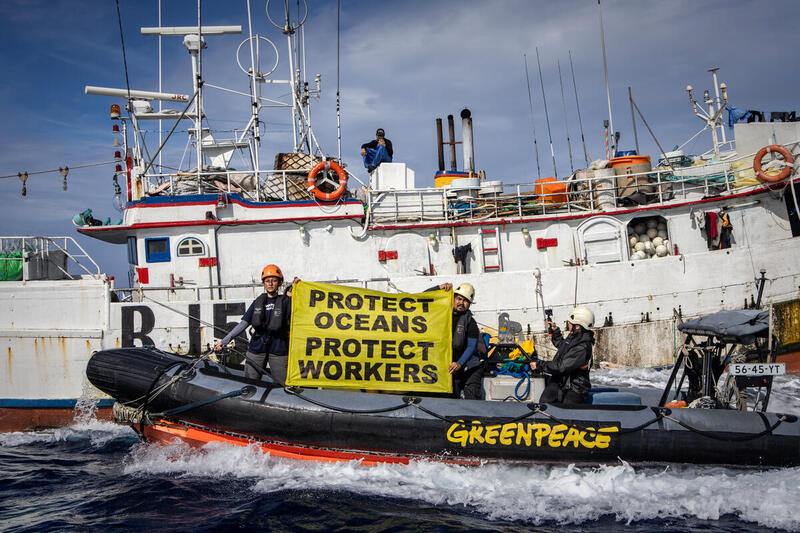
Ranong – Chumphon, May 15, 2026 – On May 10-11, 2026, Greenpeace Thailand, the Green South Foundation, the Beach For Life, and the ENLAWTHAI Foundation (EnLAW), alongside marine researchers from Prince of Songkla University, held an event to disclose research findings on benthic animals to local communities in Ranong and Chumphon. These areas face potential impacts from the deep-sea port construction, under the Ranong-Chumphon Land Bridge project. The event also featured discussions on resource-based development strategies with local fishermen, entrepreneurs, the Rak Ranong Network, the Moken community, the Rak Phato Network, and the Pak Nam Lang Suan coastal community.
The sampling was part of a citizen science initiative conducted in November 2025 across the proposed sites for the Land Bridge deep-sea ports, including Don Ta Phaeo, an area identified by the local community as rich in marine life. Although Don Ta Phaeo falls outside the project’s EHIA (Environmental and Health Impact Assessment) boundary, it remains a critical area for the livelihoods and fishing practices of Ranong’s local communities. This research collected benthic fauna samples across three key locations: Laem Ao Ang and Don Ta Phaeo in Ranong Province, and Laem Riw in Chumphon Province. To ensure data reliability, samples were gathered from five sampling stations per location, with three replicates at each station.
The results reveal that the study areas host a diverse range of benthos, reflecting the richness of the coastal ecosystem and highlighting the critical role that these bottom-dwelling organisms play as the foundation of the marine food web. This data is vital for assessing the impacts of the Landbridge project, as benthic fauna serve as a primary food source for numerous marine species, directly linking them to the productivity of local fishing grounds.
However, comparing the data between the draft of EHIA reports [1][2] and this citizen-led survey requires careful consideration. Since the two datasets differ in the number of sampling stations, methodology, and coordinates of sampling stations, a direct comparison of total numbers should not be made. Nonetheless, when examining data from closely situated sampling points, the citizen survey demonstrates a higher species richness and density of benthos than the values presented in the EHIA draft across several locations. This discrepancy underscores the urgent need to review, verify, and conduct additional biodiversity assessments before moving the project forward.
Key findings
- The benthos research conducted across Laem Ao Ang, Don Ta Phaeo, and Laem Riw demonstrates that the areas potentially impacted by the Land Bridge project are ecologically critical environments. These zones serve as vital habitats for numerous microorganisms and small organisms, which form the foundation of the marine food web and sustain the richness of the coastal ecosystem.
- On the Ranong side, which covers Ao Ang and Don Ta Phaeo, a total of 10 phyla comprising 447 species of benthos were recorded. Notably, Don Ta Phaeo exhibited the highest biodiversity and density in this research, hosting 10 phyla with a total of 333 species.
- At Laem Riw in Lang Suan District, Chumphon Province, the target site for the project’s Gulf of Thailand side, a total of 8 phyla comprising 107 species of benthic fauna were documented. Furthermore, the diversity index here ranges from moderate to high, confirming that the marine environment around Laem Riw remains highly hospitable and suitable for benthic life.
Sakanan Plathong, a marine researcher from Prince of Songkla University and the head of this research team, stated:
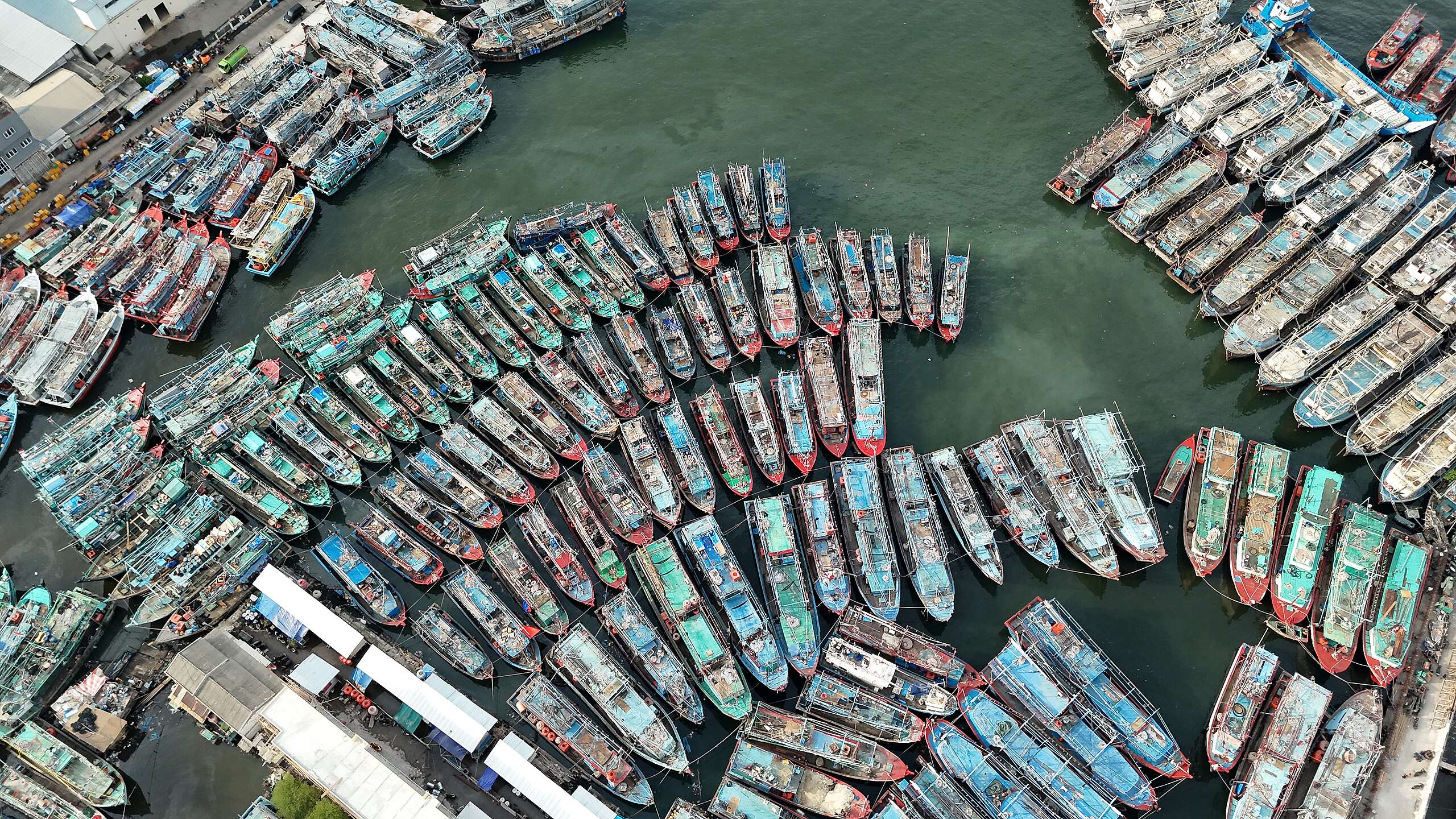
“On the days I went to conduct the survey, there were hundreds of fishing boats out there. Even though that area doesn’t have seagrass beds, the seabed is a muddy floor teeming with benthic fauna. The mangrove and estuarine ecosystems serve as breeding grounds for a vast array of species. Every year, marine life migrates in and out to spawn in these mangroves. These organisms within this ecosystem act as both a food source and a livelihood for fishermen, while driving various economic activities throughout Ranong.”
Sakanan added that the findings from this survey suggest that larger, offshore marine animals from beyond Don Ta Phaeo also enter this area to forage.
As for Chumphon, Sakanan explained that the fishing patterns differ from Ranong. Most fishers in Chumphon target pelagic species in open water, such as king mackerel and mackerel, whereas Ranong focuses more on coastal fishing, which aligns with the higher volume of benthic fauna found there. However, he noted that if further research were to be conducted around the Pak Nam Lang Suan rocky reefs, a critical fishing ground for Chumphon, they might uncover an ecosystem even richer than the areas documented in this research.
Paiboon Sawathanan from Ban Hat Sai Dam, Ranong Province, expressed concern that the budget invested over the past several years to preserve natural abundance and conduct collaborative research with local communities in Ranong could go to waste, as the protected environment faces destruction by the Land Bridge project.
“Various agencies went through all the effort to restore the mangroves, co-manage the Ranong Biosphere Reserve, and do everything else, who knows how much money was spent. All those research projects conducted alongside the communities were meant to make Thailand wealthy, prosperous, and a better country. Those budgets were massive, but in the end, it will all be destroyed by this state development project. It’s like pouring money down the drain.”
Nattapong Laemphet, a seafood restaurant entrepreneur from Chumphon Province, stated: “Benthic fauna sit near the very base of the marine food chain. I can see how shrimp, for instance, serve as food for pelagic fish in open water. I truly sense the link of these bottom-dwelling organisms. This data is incredibly useful for cross-checking against the Land Bridge’ EHIA. In reality, when it comes to the richness of the seabed, we, fishers, already know how abundant it is. For example, when we set our blue swimmer crab nets, we set them over the shallow shoals, and we are confident that the shoals in our area are highly productive.”
Apisak Tassanee from Beach for Life stated: “This research, conducted jointly by academics and local communities, was designed to verify the EHIA. The EHIA claims that the marine areas within the Land Bridge project site lack biodiversity and harbor very low levels of benthic life. However, the findings from the civil society and academic research show the exact opposite. We discovered some of the highest benthic biodiversity in the country, such as at Don Ta Phaeo, where numbers exceeded 3,000 individuals per square meter. This reflects that the impact assessment for a mega-project like the Land Bridge may be fabricated. We want to call on the government to show sincerity and integrity by conducting an entirely new study.”
Following the disclosure of the research findings, the communities collaborated to design an area-based development plan based on this biodiversity information. For Ranong, the community envisions potential as a city of learning and wellness tourism, driven by its outstanding ecological features and expansive multicultural identity. This could be achieved by integrating classroom knowledge with the local social fabric, culture, natural hot springs, and pristine air quality. For Chumphon, residents want to see development that builds upon the area’s existing strengths, including enhancing transportation infrastructure to support agricultural products and community-based tourism, alongside collaborating with coastal communities to restore marine nurseries and habitats.
Kadesiree Thossaphonpaisan, an Oceans Campaigner, Greenpeace Thailand, stated:
“The core purpose of citizen science is to empower communities. Connecting local knowledge with scientific data and translating it into policy backed by both community insights and academic principles is what true grassroots development looks like. The benthos research results and our discussions with the community further reinforce that local knowledge is invaluable. The species richness and density of benthic fauna at Don Ta Phaeo serve as hard proof validating the local community’s ancestral knowledge regarding ocean currents, wind directions, and the tracking of mountains, islands, and channels to locate fishing grounds for generations.”
This benthos research is not merely scientific data about marine organisms; it serves as crucial evidence reflecting the richness of the coastal ecosystem and the vital link between these resources and the livelihoods of local fishermen and coastal communities. Greenpeace Thailand and civil society organizations call upon the relevant agencies to review and completely redo the EHIA report. This process must ensure transparent data disclosure, utilize comprehensive and verifiable study methodologies, and provide opportunities for meaningful public participation at every stage, especially for the communities that rely on these resources and stand to be impacted by the project, before any decision is made to move forward with these industrial development projects.
Notes:
[1] Draft of Final EHIA Report, Land Bridge Deep-Sea Port Project, Ao Ang, Ranong Province
[2] Draft of Final EHIA Report, Land Bridge Deep-Sea Port Project, Laem Riw, Chumphon Province
[3] Summary of Findings from Benthos Research
For more information, please contact:
Somrudee Panasudtha, Greenpeace Thailand
Email. [email protected], Tel. 66+ 81-929-5747