HONG KONG — As Nvidia reported its highest quarterly revenue last month and its market valuation neared US$5 trillion, a new analysis from Greenpeace East Asia reveals the hidden environmental cost behind the US semiconductor giant’s financial success.
The analysis, titled “Nvidia’s Green Illusion,” finds that while the world’s most valuable company enjoys unprecedented profits amid the global AI boom, its unchecked growth is driving a significant rise in greenhouse gas emissions and creating a dangerous “fossil fuel lock-in” in its East Asian supply chain.
Greenpeace East Asia’s analysis examined Nvidia’s 20 largest suppliers, which together represent over 50% of its cost of goods sold (COGS), and identified a significant “decarbonization deficit” across the company’s East Asia supply chain.[1] Despite its financial capacity, Nvidia has not made direct investments in renewable energy in its East Asian manufacturing hubs.[2] Instead, the company has shifted the emissions burden onto suppliers in Taiwan and South Korea, leaving local communities reliant on coal and gas to power the production of the world’s most advanced chips.
Katrin Wu, Greenpeace East Asia Supply Chain Project Lead, said:
“In contrast to Nvidia’s soaring valuation, its escalating electricity consumption and emissions in East Asia have largely gone unnoticed. As a leading company, Nvidia has both the responsibility and capability to decarbonize its supply chain. Profit should never come at the expense of our planet, nor should local communities in East Asia bear this burden.”
Key Findings:
- Emissions Surge: Nvidia’s supply chain emissions have more than doubled in the past three years, rising from 2,975,189 tonnes of CO₂ equivalent (tCO₂e) in Fiscal Year 2023 to 6,036,105 tCO₂e by Fiscal Year 2025, equivalent to the total annual emissions of over 125,700 US households.[3] Despite this rise, the company has yet to set a clear emissions-reduction goal or a renewable energy transition target for its supply chain.
- Regional Concentration: East Asia accounted for 83% of Scope 1 and Scope 2 emissions and 78.8% of electricity use among Nvidia’s top suppliers in 2023 (Figure 1).[4] This concentration underscores the urgent need for targeted decarbonization efforts in the region.
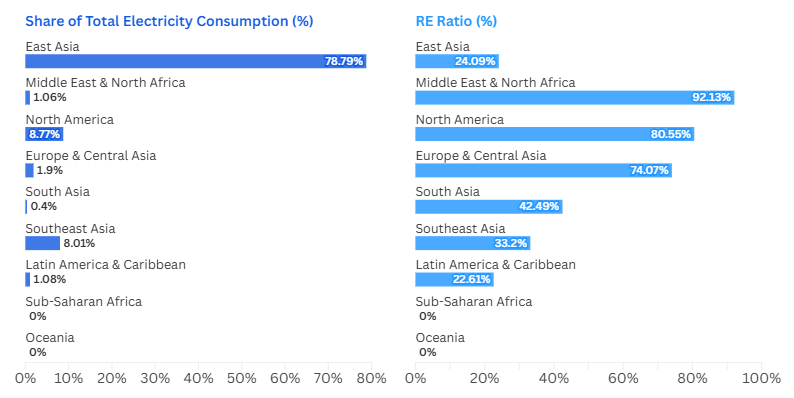
- Renewable Energy Gap: The renewable electricity ratio among these suppliers in East Asia is only 24.09%, far behind North American suppliers at 80.55% (Figure 2). This places East Asia among the lowest-ranking regions globally for renewable energy adoption by these suppliers, alongside Sub-Saharan Africa (0%), Oceania (0%), and Latin America & the Caribbean (22.61%), highlighting the urgent need for progress in the region.
- Supplier Stagnation: TSMC, Samsung, and SK Hynix, three of Nvidia’s major suppliers, have seen electricity consumption rise by up to 16% from 2022 to 2024. Despite this, their adoption of renewable energy has been sluggish, with ratios rising by less than 4% over the past three years.
Figure 1: Regional distribution of the emissions and electricity consumption of Nvidia’s top 20 suppliers in 2023
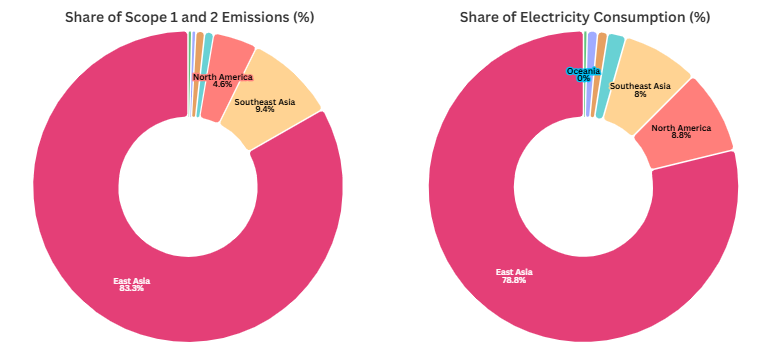
Figure 2: Regional comparisons of the shares of electricity consumption and the ratios of renewable electricity by Nvidia’s top 20 suppliers
Recognizing the low renewable energy ratio and the risk of fossil fuel lock-in, Greenpeace urges Nvidia to:
- Reduce its supply chain emissions, move beyond buying offsets, and invest directly in new renewable energy infrastructure near its manufacturing hubs in East Asia.
- Set a 2030 deadline for all major suppliers to switch to 100% renewable energy, ending the region’s reliance on coal and gas.
- Disclose transparent, site-level energy data for its top suppliers to prove its sustainability claims are more than just marketing.
“Decarbonizing the supply chain is a complex challenge, but Nvidia is uniquely positioned to lead given its abundant resources and substantial market influence. While local renewable resources may be limited, Nvidia has the opportunity—and the obligation—to invest in renewable energy infrastructure near its suppliers. Companies like Apple and Google have already demonstrated the benefits of such investments,” said Wu.
“Nvidia must move beyond just buying offsets and start investing directly in renewable energy infrastructure near its manufacturing hubs. We need a ‘Green AI’ mandate that ensures the chips of the future aren’t powered by the fuels of the past.”
A multimedia webpage detailing the environmental impacts of Nvidia’s top suppliers in East Asia is available here.
A video about the Greenpeace East Asia analysis is available here.
END
Notes:
[1] Nvidia employs a fabless, contract-manufacturing strategy, partnering with key suppliers across all phases of the manufacturing process, including wafer fabrication, assembly, testing, and packaging. Greenpeace East Asia identified Nvidia’s top 20 suppliers using the Bloomberg database, which provides Cost of Goods Sold (COGS) percentages as an indicator of the goods supplied, as of June 18, 2025. To focus on suppliers directly contributing to manufacturing emissions, the research excluded entities not engaged in physical production—such as software providers, consulting firms, and fabless companies. The analysis focuses on the overall environmental performance of Nvidia’s key suppliers, not on Nvidia-specific production activities. The figures presented reflect the manufacturing footprint of these key partners and the energy environment in which Nvidia operates.
[2] Nvidia has made no public disclosure of any direct investment in renewable energy in East Asia to date.
[3] Nvidia’s Scope 3 emissions figure is taken from its Sustainability Reports (FY2023–FY2025). The estimate of an average US household’s annual carbon footprint—48 tonnes CO₂e—comes from the University of Michigan Center for Sustainable Systems factsheet, “Carbon Footprint Factsheet”.
[4] Emissions, electricity consumption, and renewable electricity data for the selected companies were collected from their 2023 Carbon Disclosure Project (CDP) questionnaire responses. Greenpeace East Asia aggregated the reported Scope 1 and Scope 2 (market-based) emissions, electricity use, and renewable electricity consumption of the selected companies at a regional level, using the World Bank’s regional classification to analyze the spatial distribution of environmental impacts.
Media Contact
Yujie Xue, International Communications Officer, Greenpeace East Asia, [email protected]