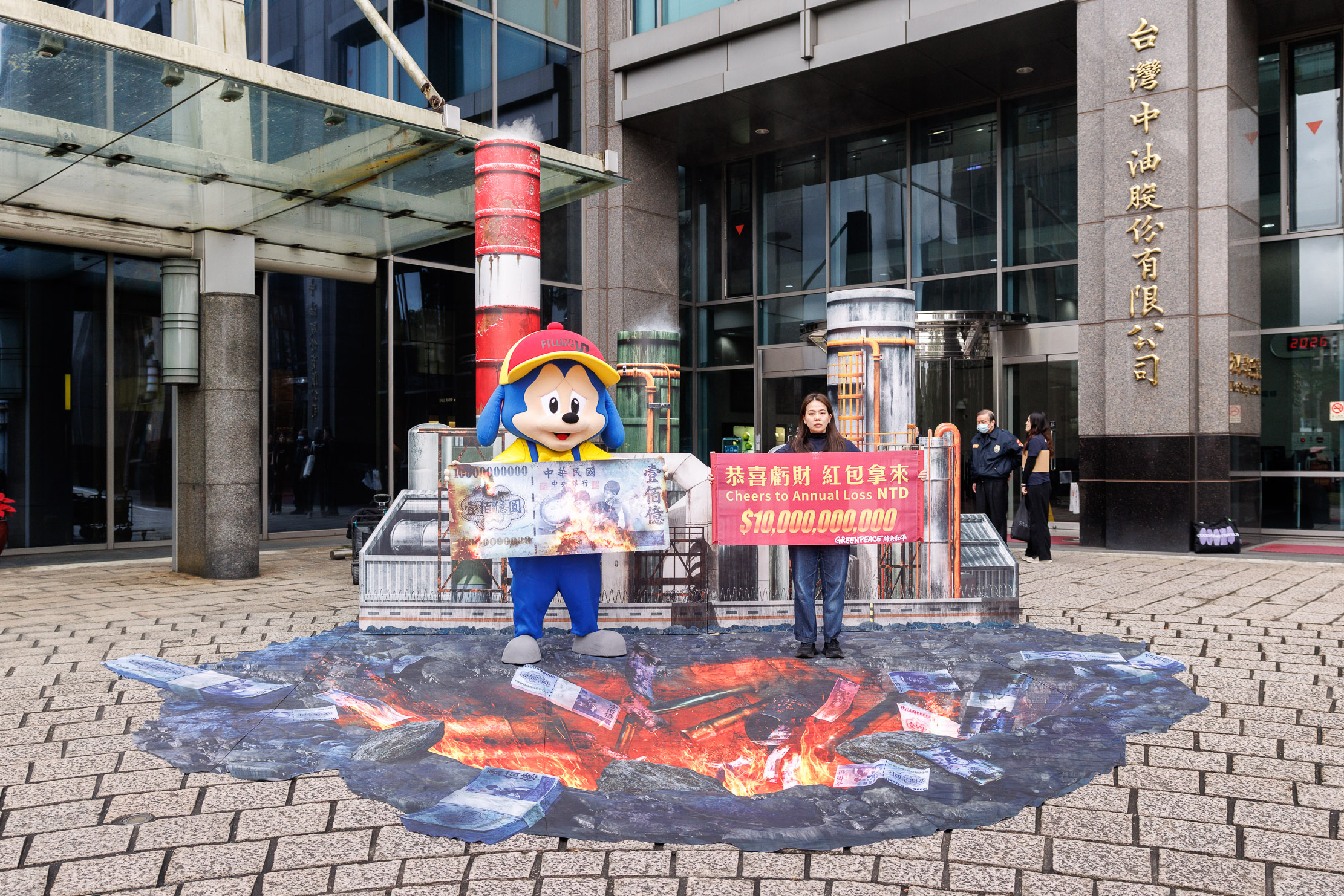
Taipei, November 26, 2025 — Greenpeace and allied environmental groups today call on lawmakers to reject CPC Corporation’s proposed TWD106.2bn expansion of its 4th Naphtha Cracker (“NC4”), warning that state-owned company’s feasibility is built on inflated financial assumptions and ignores Taiwan’s worsening petrochemical overcapacity.
After cross-checking CPC’s FSR with publicly available industry data [1], Greenpeace identified 3 major risks:
- Taiwan already faces severe ethylene overcapacity, yet CPC plans to triple NC4’s capacity.
- Prices and revenue forecasts are significantly inflated –projected ethylene prices are 70% higher than CPC’s historical average.
- Substantial increase in greenhouse gas emissions would be raised by 930,000 tonnes/year following the expansion, against Kaohsiung’s emission cut requirements and Taiwan’s net-zero goals.
Gustav Pan, Plastic Campaigner at Greenpeace East Asia Taipei, pointed out: “CPC’s FSR assumes unrealistically high ethylene price and projected revenue that is inconsistent with historical data and projected maximum annual production capacity. Such an inflated forecast appears to conceal financial risk, misleading lawmakers and relevant government agencies and undermining public trust in a state-owned company. Lawmakers should reject this TWD106.2bn investment.”
CPC’s FSR projects domestic ethylene prices averaging TWD49,845 per tonne between 2030 and 2039. Yet CPC’s own internal financial statements show actual sale prices between 2015 and 2024 averaged TWD29,322 per tonne—meaning the projected price is roughly 70% higher than the historical average.[2]
Taiwan’s ethylene production fell from 3.3mt in 2022 to 2.6mt in 2024, pushing utilization rates to approximately 65%. Despite falling demand, CPC plans to raise NP4’s output from 350,000 to one million tonnes per year.
Furthermore, Greenpeace found that CPC’s projected ethylene revenue for 2040–2044 is overstated by 170% [3] when compared against the FSR’s own price assumptions and the cracker’s maximum production capacity of one million tonnes per year.[3]
Pan added, “The projected revenue for NC4 appears significantly inflated. If the Executive Yuan and Legislative Yuan approve this project based on embellished financial forecasts, CPC’s already-strained finances will deteriorate further.”
Post-expansion emissions rise sharply, contradicting net-zero goals
Greenpeace noted that CPC’s own projections show emissions from the expanded cracker rising to 1.6 million tonnes of CO₂ per year, an increase of 930 thousands tonnes compared with today. This would violate Kaohsiung City’s requirement for the Linyuan complex to cut emissions by 680 thousand tonnes by 2030 from 2005 levels, and run directly counter to Taiwan’s net-zero goal.
Civil groups: Expansion goes against global petrochemical shifts
Hsu Po-Jen, Deputy Executive Director of the Environmental Rights Foundation, said that petrochemical industries worldwide—particularly in China, South Korea and Japan—are scaling down production due to long-term overcapacity.
Hsieh Ho-Ling, Secretary-General of Taiwan Watch Institute, warned that global petrochemical markets have become a “cut-throat red ocean.” He said “ Taiwan should instead focus on reducing single-use plastic and building a circular economy.”
Huang Chia-Ying, Habitat Conservation Officer at The Society of Wilderness, added that “CPC’s expansion would worsen virgin plastic overproduction, depress recycling economics, and exacerbate ecological and waste-management pressures. The project even assumes continued growth in single-use plastics—directly contradicting government reduction policies.”
Worker safety cannot be used to justify expansion
Greenpeace emphasized that improving worker safety requires proper maintenance, not building new facilities in an oversupplied market. Expanding basic petrochemical capacity does not guarantee stable employment—if anything, it increases long-term career risks for workers as global industries shift toward value-added production.”
The coalition urges the CPC to withdraw the proposal, and call on the Economic Committee and legislators from Kaohsiung to closely scrutinize this case from the standpoint of fiscal oversight and sustainable development.”
Notes
[1] ] Greenpeace’s analysis cross-referenced the Petrochemical Industry Yearbook, Formosa Petrochemical’s annual reports, CPC’s internal and statutory budget documents, self-compiled financial statements and audited reports.
[2] According to CPC’s FSR (page 7-4 and 7-5), projected ethylene prices between 2030 and 2039 average TWD49,845/tonne. CPC’s 2015–2024 actual sale prices averaged TWD29,322/tonne—around 70% lower.
[3] Using CPC’s projected 2040–2044 ethylene price (page 7-5) multiplied by one million tonnes yields the theoretical annual revenue. CPC’s projected figures in page 7-7 exceed this by 170%, indicating major inconsistencies in revenue forecasting.
Contact
Chi Lo, Communications Officer, 0975-238-051, [email protected]
Gustav Pan, Plastic Campaigner, (02)2361-2351#248, [email protected]