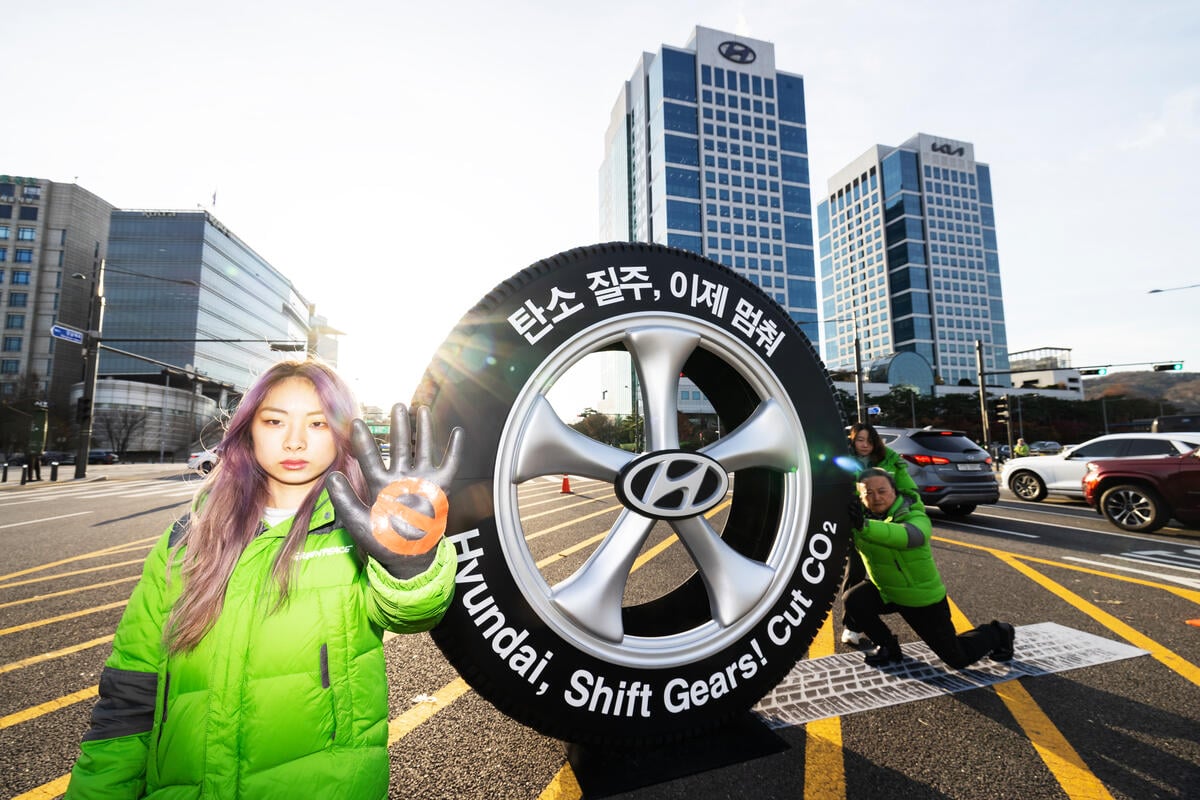
HONG KONG – Greenpeace East Asia expresses deep concern over the European Commission’s December 16 (local time) announcement to weaken its commitment to end the sale of new internal combustion engine (ICE) vehicles in 2035. Under the revised proposal, automakers would be allowed to continue producing ICE and plug‑in hybrid vehicles beyond 2035 if they cut fleet emissions by 90% and offset the remaining 10% through measures such as using European-made low‑carbon steel, e‑fuels, or biofuels.
This policy reversal has raised serious alarm across Greenpeace offices in Europe and Asia, as it threatens to slow global progress toward transport electrification and climate action.
Martin Kaiser, Executive Director of Greenpeace Germany, said:
“This plan is an early Christmas present for Chinese electric car manufacturers, putting millions of European lives and jobs at risk. It may generate short-term returns for the automotive industry, but no long-term future. European car companies would continue to waste money and technology well into the next decade by flogging a dead horse called the combustion engine, while the rest of the world moves further ahead. This backward industrial policy is bad news for jobs, air quality, the climate, and would slow down the supply of affordable electric cars. It would undermine any effort to bring transport CO₂-emissions back on a reduction pathway to limit dangerous climate change. Governments and the EU Parliament must stick to their commitments, give the European car industry a future within a sustainable mobility sector, and reject this plan.”
From Korea, Eunseo Choi, Campaigner at Greenpeace Seoul, stated:
“We express deep regret over the European Union’s move to retreat from its long-standing and clear policy direction of phasing out internal combustion engine vehicles by 2035. This decision represents a de facto capitulation to industry pressure, including from automakers in Germany and Italy, at the expense of the shared goals of climate action and transport decarbonization.
This decision sends misleading and confusing signals across the global automotive industry and introduces unnecessary uncertainty into the direction and pace of a transition that is already underway. During the process of setting its Nationally Determined Contribution (NDC), the Korean government acknowledged that a 2035 phase-out of internal combustion engine vehicles is unavoidable and expressed its policy commitment. What is now required of the Korean government and the international community is not a retreat to protect short-sighted industrial interests, but clear and responsible policy decisions that can simultaneously drive climate action and industrial transformation.”
From Japan, Mariko Shiohata, Climate and Energy Campaigner at Greenpeace Japan, commented:
“For years, the EU has struggled to strike a balance between protecting its domestic auto industry and staying true to its climate‑neutrality goals. While this revision reflects pressure from parts of the automotive sector, strong voices—such as the Spanish government—continued to defend the original 2035 phase‑out. Given Europe’s significant investments in electric vehicle (EV) development, this decision could put companies that have been leading EV innovation at a disadvantage.
Although some policy fluctuation was always expected when transitioning away from ICE vehicles, the overall direction toward electrification remains unchanged, especially as the climate crisis intensifies. Japanese automakers must not interpret this policy revision as a signal that ICE vehicles can remain on the roads indefinitely. Instead, they should accelerate technological innovation and focus on achieving zero emissions as quickly as possible.”
Greenpeace East Asia urges governments, automakers, and international partners to remain steadfast in their commitments to decarbonizing the transport sector. Electrification is essential to tackling the climate crisis, and this is a moment that calls for clear leadership—not steps backward. Consistent, ambitious policy is crucial to ensuring a fair, competitive, and sustainable transition for workers, industries, and communities across Asia and around the world.
END
Media Contact:
Yujie Xue, International Communications Officer, Greenpeace East Asia (Hong Kong), +852 5127 3416, [email protected]