

| Oil and gas-dependent economies are currently facing mounting risks. Increasingly competitive renewable electricity and electrification are reshaping energy markets. Meanwhile, demand uncertainty, price volatility, financing constraints and geopolitical disruptions challenge long-term fossil-fuel investments. Amid such conditions, a new Greenpeace MENA report revealed that Saudi Arabia and the United Arab Emirates (UAE) have significant opportunities to strengthen their long-term economic resilience by 2040 through energy transition pathways that prioritize diversification, renewable energy investment and targeted electrification, rather than through fossil fuel expansion. |
Launched ahead of COP31 and amid growing calls for a just and equitable energy transition, the report, “Rethinking Long-Term Economic Development: Comparative Pathways for Saudi Arabia and the United Arab Emirates,” examines how different development strategies could strengthen public finances and reduce exposure to changing global energy markets, while recognising the distinct economic circumstances of both countries.
The research findings challenge the assumption that further fossil-fuel expansion is necessary to secure fiscal stability or finance energy transition. While existing hydrocarbon revenues may provide resources for transition, this does not establish that additional production capacity is the most effective use of national capital. A strategy that relies on continued expansion to finance diversification may preserve the very dependence that diversification is intended to reduce.
The report compares pathways that maintain hydrocarbon expansion with those pursuing transition with various speeds, testing their performance across seven different economic environments.
The findings suggest that, while continued fossil fuel expansion can generate substantial revenues in the near term, by 2040, transition pathways perform better in six of the seven environments, with continued expansion retaining a small advantage only in a scenario in which oil prices are high.
Under the study’s severe downside scenario (which applies 40% oil-price reduction and a 15% revenue-volume reduction) in 2040, a faster managed decline in fossil fuel production and use improves the annual fiscal balance relative to continued fossil fuel expansion by approximately 5.3 percentage points of GDP in Saudi Arabia and 5.1 percentage points in the UAE.
The research also highlights the vulnerability of hydrocarbon-dependent revenues to adverse market conditions. In a severe downside stress test for 2030, Saudi Arabia’s hydrocarbon government revenues fall from approximately US 162 billion in 2025 to US85 billion, despite continued production expansion. In the UAE, corresponding revenues decline from approximately US71 billion to US37 billion.
Economic diversification is central to a resilient transition
The report emphasises that the economic benefits of a faster transition pathway are conditioned upon early and meaningful fiscal diversification alongside fossil fuel production reduction.
It also underscores the importance of tailoring transition strategies to national circumstances. Saudi Arabia’s greater dependence on hydrocarbon revenues creates more direct exposure to changes in oil prices and export earnings, making durable alternative government revenues particularly important. The UAE benefits from greater recent fiscal-flow flexibility, but still faces choices around capital allocation, liquid buffers and the coordination of investment across public institutions.
For both countries, the findings point to the importance of using existing hydrocarbon wealth to support productive economic activity and a managed transition, rather than treating dependence on fossil fuel revenues as a justification for indefinite production expansion.
Renewable energy presents a competitive economic opportunity
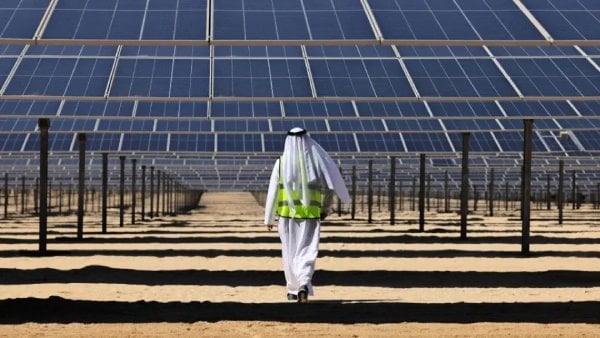
Beyond fiscal policy, the report identifies competitive renewable electricity as an opportunity to strengthen both economies, finding that utility-scale solar power offers a lower-cost new-build generation option than gas under the selected assumptions.
Utility-scale solar photovoltaic power is the lowest-cost new-build electricity generation option in both countries; and in order for both countries to reap the economic benefits of renewable energy, policies and measures must be put in place to invest in grid infrastructure, flexibility and storage, the study shows.
The research additionally finds significant opportunities for targeted electrification, based on verified economic and climate benefits, rather than uniform electrification across all sectors, with transport being the leading near-term electrification application.


