

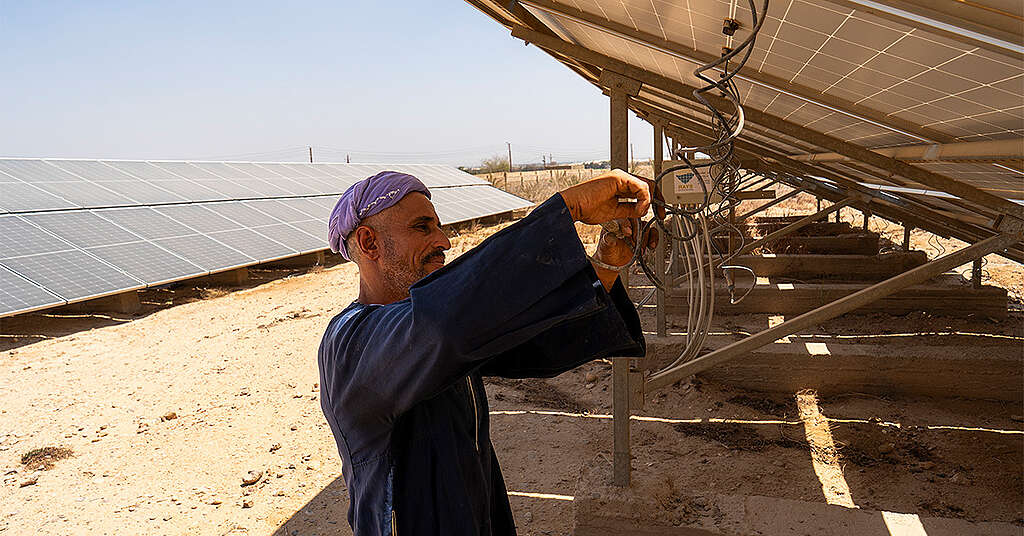
| Egypt has made progress in developing legal and regulatory frameworks for renewable energy and in facilitating investment in the sector. Building on these advances, decentralized renewable energy offers opportunities to accelerate the achievement of climate goals, reduce reliance on imported fuels, and enable farmers, small businesses, and local communities to generate electricity from renewable sources. |
How Can Decentralized Renewable Energy Benefit the Economy and Local Communities?
Egypt is taking important steps to expand its renewable energy capacity as part of its efforts to strengthen energy security and achieve its strategic goals. Alongside large-scale solar and wind projects, there is a promising opportunity to expand electricity generation close to the point of consumption, serving a range of sectors and economic activities.
Decentralized renewable energy can support Egypt’s efforts to achieve a just energy transition. Its applications include rooftop solar panels, solar-powered irrigation systems, and solutions that can serve farms, commercial and industrial facilities, and residential and rural areas.
For farmers, solar-powered irrigation systems can help meet their energy needs and support their productive activities. These solutions can also expand energy options for small businesses and local communities. However, realizing these benefits still depends on access to appropriate financing, clear regulatory procedures, and readily available solutions and technologies.
Beyond diversifying sources of electricity generation, these solutions can open up new opportunities for investment and market development while reducing exposure to imported fuel price volatility. They also offer opportunities for more users to participate in energy production and benefit from the energy transition.
This presents an opportunity to accelerate the shift to renewable energy sources and strengthen energy security through clear policies, appropriate financing mechanisms, grid upgrades to accommodate decentralized generation, and an investment environment that encourages the adoption and expansion of these solutions.
From Dialogue to Practical Recommendations for Scaling Decentralized Renewable Energy
Developing this sector requires a shared understanding of the available opportunities and the identification of policies that can help turn them into viable projects. Against this backdrop, a roundtable was convened in February 2026 by Greenpeace Middle East and North Africa, the Pathways Beyond Neoliberalism program at the American University in Cairo, and the Social and Cooperative Economy Network MENA (SCEN MENA). It brought together representatives of government institutions and parliamentary bodies, experts and researchers, civil society representatives, and farmers to discuss opportunities for decentralized renewable energy in Egypt and what is needed to expand its use.
The discussions highlighted the potential of decentralized solar energy to support energy security and local economic activity. They also identified priorities for expanding its use, including access to concessional finance, clearer grid-connection procedures, stronger coordination among stakeholders, and information and technical advisory support for users and investors.
Building on these discussions, Greenpeace MENA, in partnership with Pathways Beyond Neoliberalism at the American University in Cairo and SCEN MENA, produced the report Powering a Just Energy Transition in Egypt: Policy Pathways for Scaling Decentralized Renewable Energy. The report reviews the existing legal and regulatory framework and international experience, identifying five policy pathways to create a more favorable investment environment and enable more users to generate and benefit from renewable electricity.
Five Pathways for Scaling Decentralized Renewable Energy in Egypt
1. Concessional Finance and Incentives to Support Investment
Appropriate financing is essential to expanding the use of decentralized renewable energy. The paper proposes long-term concessional loans with flexible repayment schedules that reflect seasonal agricultural income, alongside credit guarantees to reduce risks for lenders. It also calls for additional support for lower-income groups, support for energy storage solutions, and measures to promote self-consumption.
These measures are particularly important for smallholder farmers and groups that may be unable to afford the upfront cost of installing solar energy systems.
2. Clear and Stable Regulatory Frameworks
Clear regulations help reduce uncertainty and enable investors and users to plan more effectively for the long term. The paper recommends fixed seven-year net-metering contracts, protection for existing users against retroactive changes, and measurable targets for expanding rooftop solar and solar-powered irrigation systems.
It also calls for clear information on the capacity of local electricity grids to accommodate new systems and simpler operational procedures for grid connection, helping turn interest in decentralized solutions into viable projects.
3. Market and Supply Chain Development
Growing the decentralized renewable energy market requires reliable information to identify opportunities and guide investment. The paper proposes publicly accessible maps of agricultural areas suitable for solar-powered irrigation systems and updated building regulations to ensure suitable space for solar panel installations on residential, commercial, and industrial buildings.
Setting well-defined targets for expanding these systems can also provide a clearer outlook, helping businesses, suppliers and investors plan and develop the services and solutions the market needs.
4. Broadening Participation and Ensuring Equitable Access
A just energy transition requires opportunities for a wide range of groups – including farmers, households and small producers – to benefit from clean energy, rather than limiting opportunities to those who can afford to install their own systems.
To achieve this, the paper calls for support for agricultural cooperatives and Water Users Associations, greater participation by civil society and energy users in decision-making, and expanded awareness and technical advisory programs. It also proposes expanding shared solar energy systems in social housing and rural areas so that the benefits of these solutions reach more people.
This approach can encourage local cooperation, support productive activities, and broaden participation in the energy transition.
5. Grid Modernization and Stability
Electricity grids provide the essential infrastructure that enables decentralized generation to operate efficiently alongside large-scale energy projects. The paper therefore recommends modernizing grids to accommodate diverse sources of electricity generation and investing in energy storage.
It also proposes developing microgrids in remote areas where extending the conventional grid is difficult, as well as improving institutional coordination to ensure that the electricity sector benefits from the potential savings from reduced natural gas imports.
Developing this infrastructure helps create the conditions needed to expand decentralized renewable energy projects and better integrate them into Egypt’s electricity system.
Advancing Toward a More Sustainable and Just Energy Future for Egypt
Decentralized renewable energy complements large-scale energy projects by expanding clean electricity generation, opening up new investment opportunities, and aligning the energy transition with the needs of productive sectors and users.
Expanding these opportunities depends on policies that ensure the benefits of the energy transition are shared equitably and broaden the use of renewable energy among farmers, households, small businesses and local communities.
To support these efforts, developed countries must fulfill their commitments to provide adequate, predictable public climate finance in the form of grants that do not add to debt burdens, in line with their historical responsibilities and the principle of common but differentiated responsibilities and respective capabilities (CBDR-RC).
The report Powering a Just Energy Transition in Egypt: Policy Pathways for Scaling Decentralized Renewable Energy presents five policy pathways to help policymakers, experts, and stakeholders expand these opportunities and strengthen local communities’ participation in the energy transition.