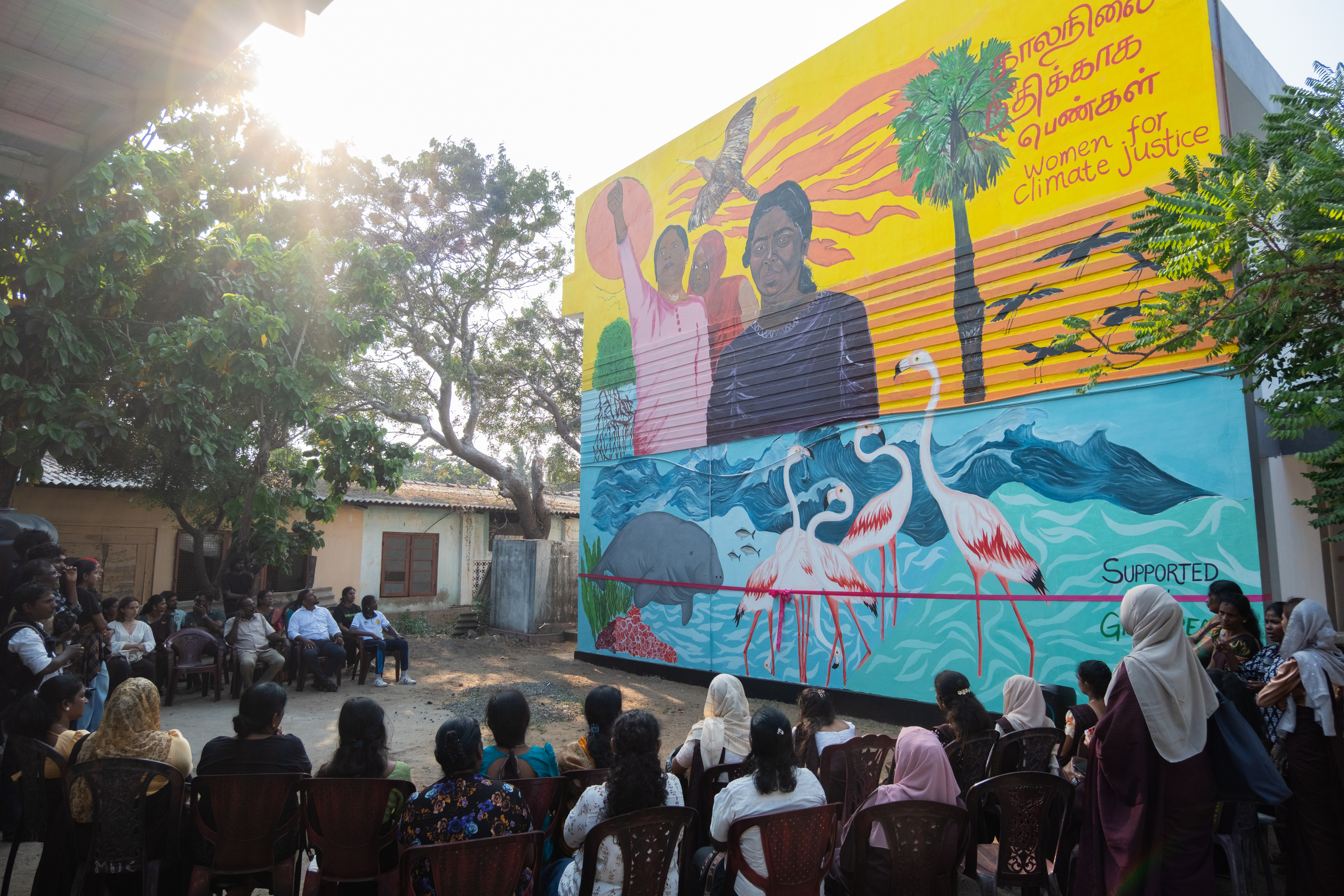
On the island of Mannar, where the ocean whispers to the shore and migratory birds trace ancient paths across the sky, a different kind of migration took place this International Women’s Day 2026, with Greenpeace South Asia. With the theme of “Women for Climate Justice”, Greenpeace South Asia volunteers, including myself, joined hands with the vibrant team from Happy Voice Hub and locals to create a massive mural on the community wall at the center of the town. What began as brushes, paint and white walls became a powerful testament to women’s resilience, hope, and vital role in protecting our shared planet in the end.
The mural was no solo endeavour. It was born from collective sweat and laughter of local women from Mannar’s diverse communities, Greenpeace volunteers from near and far, and the inspiring young groups of Happy Voice Hub. We spent long hours, days stretching into sleepless nights and under the relentless sun, getting sunburns and lifelong memories in equal measure. Paint-splattered hands passed tools, shared stories, and bridged divides. Language barriers faded, religious differences dissolved, and educational gaps vanished as we focused on one shared canvas. New friendships bloomed amid cultural exchanges, songs, and shared meals. Every stroke was a conversation, every colour a commitment.
The design itself told Mannar’s layered story. Bold figures of women stood tall at the center made a symbol of strength, courage, and unyielding hope, surrounded by the island’s iconic ecosystems of graceful migratory birds soaring over wetlands, gentle dugongs gliding through seagrass meadows, vast oceans teeming with life, as well as the hardworking fisheries that sustain families. These elements were not mere decoration, they were a call to action. Mannar’s sensitive coastal and marine environments face rising threats from climate change, such as rising seas, warming waters and habitat loss, and women, often the frontline strength of these resources, are key to building resilience and demanding justice.
As a volunteer for Greenpeace, I witnessed firsthand how this collaboration went beyond boundaries that we often believe are beyond reach. We laughed together, cared for one another during exhausting moments, and celebrated small victories, perfectly blending all of us as friends that knew each other for longer. Community participation was the heartbeat of the project. Local women, many new to activism, art or any such kind, stepped forward with confidence, and we witnessed their voices growing louder as the mural took shape. It was a space where every participant felt seen, valued, and empowered, which inspired many more.
We unveiled the mural on Women’s Day evening, as the sun dipped into the sea and a crowd gathered. The wall now stands as a vibrant landmark, a daily reminder that women are not just affected by climate crises but are essential to solutions. It sparks conversations, passersby pause, reflect, and connect the dots between equity and environmental protection. For Mannar, a place that has cultural and religious diversity yet is also a home to diverse ecosystems, this mural matters deeply. It highlights how women’s involvement can unite communities, foster stewardship, and drive change from the ground up.
This experience reshaped my understanding of volunteerism, not just because of the work but also because of the understanding that we got. Greenpeace and Happy Voice Hub showed that true impact comes from listening, sharing, and showing up without barriers. Appreciation for nature and each other becomes the foundation for protection. In Mannar, where the ocean thrives with all living beings and stories of survival never die, this mural speaks as loud as the oceans. When women lead with courage and creativity, we don’t just paint walls, we paint a more just, resilient future for generations to come.
E.M. Gayathri P.B. Ekanayaka
Ocean University of Sri Lanka
Greenpeace Volunteer