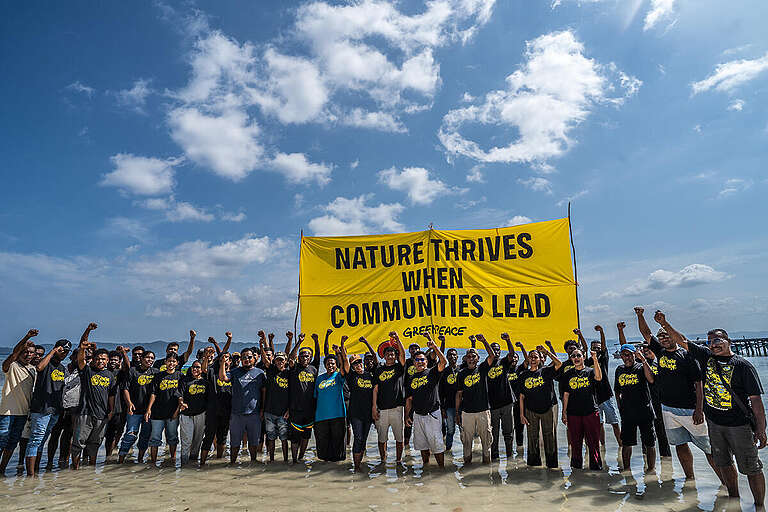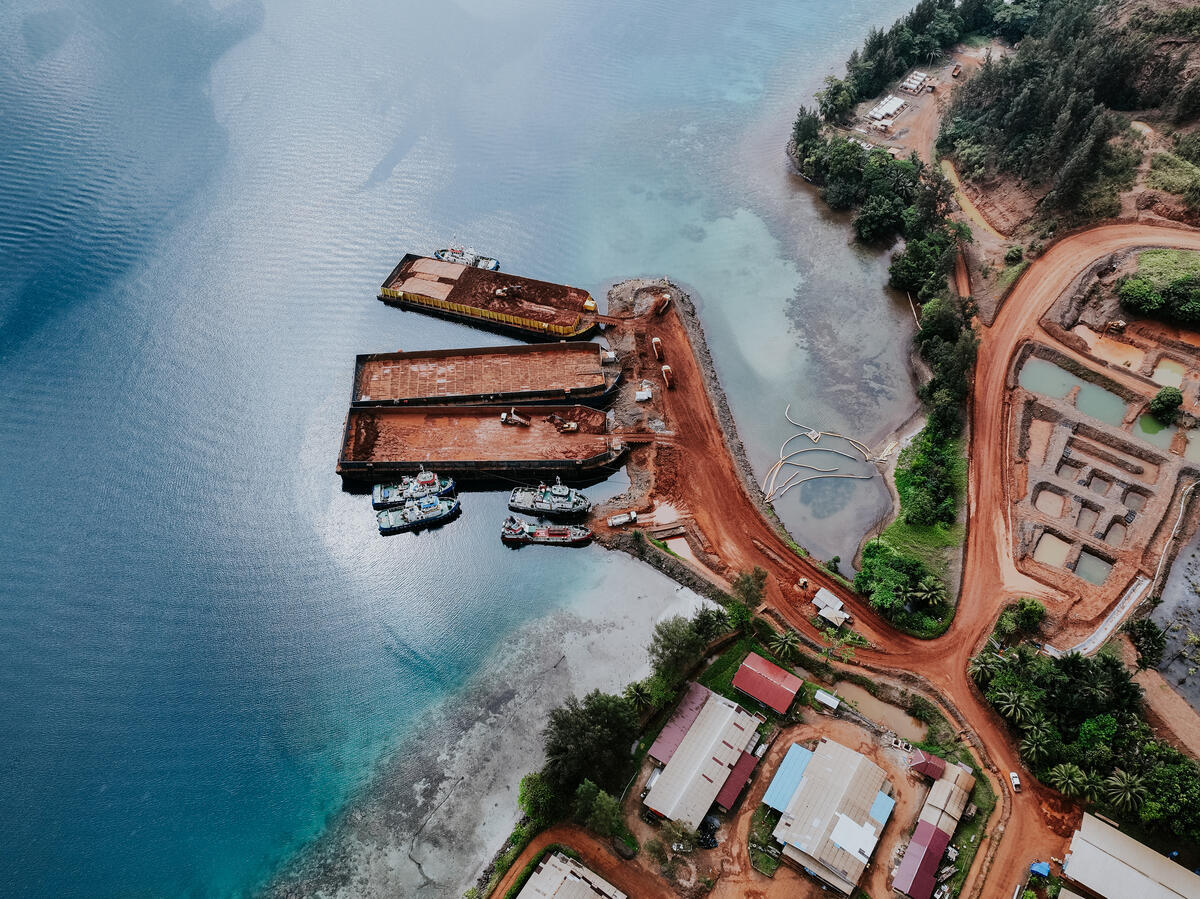
Jakarta, 30 July 2026. A Greenpeace Indonesia research report released today reveals that one year after public outcry over nickel mining in Raja Ampat through the #SaveRajaAmpat campaign, there is little evidence to suggest that the Indonesian government is working toward full and permanent protection of the area known as the ‘last paradise on Earth’.
The ‘Unprotected Paradise’ report finds that three nickel mining licenses are in process, with mines planned for the eastern part of Waigeo, Raja Ampat’s largest island. One of the nickel companies has also been trying to activate a coal mining license in Misool, an island in the south of Raja Ampat, and two oil and gas companies produce oil and gas in and around Salawati Island–indicating the extent of dirty energy threats in the archipelago.
“The Indonesian government’s move last year to revoke 4 nickel mining licenses in Raja Ampat was a welcome step, but it fell far short of providing protection for an area that is the most biodiverse marine ecosystem in the world, which is also the territory of Indigenous Peoples and islanders of Raja Ampat,” said Greenpeace Indonesia’s forest campaign team leader, Arie Rompas.
The Unprotected Paradise report also finds that:
- The UN has designated Raja Ampat as a UNESCO biosphere reserve, but maps exclude Kawe Island from the core zone, as well as the areas now threatened by nickel mining.
- Areas in Raja Ampat that are within the Biosphere Reserve and the earlier Geopark boundaries are still mapped by Indonesia’s Ministry of Energy and Mineral Resources as areas which could be licensed for coal or other mining activities.
- One of the most outspoken local politicians against nickel mining is a commissioner of a nickel mining company planning to start operations in East Waigeo.
- PT Gag Nikel continues operations despite an environmental audit identifying serious failings, including unmitigated coastal sedimentation and inadequate erosion control.
- Nickel from PT Gag Nikel is supplied to PT Indonesia Weda Bay Industrial Park (IWIP)[1], where it enters domestic and global supply chains.
Large parts of the Raja Ampat archipelago, which was already designated as a UNESCO Global Geopark, became a UNESCO biosphere reserve in September 2025. Strangely, the later designation excluded Kawe Island from the core zone of the biosphere reserve, suggesting that lobbying on behalf of the nickel mining industry may have influenced map boundaries.
Kawe Island was licensed to PT Kawei Sejahtera Mining before the Indonesian government revoked the permit last year. It is an area identified by conservation experts as an important site for manta rays[2], whose global population is vulnerable according to the International Union for Conservation of Nature (IUCN).
Apart from the risks of new licenses, there are existing environmental threats from PT Gag Nikel operations. The Environment Ministry-mandated audit found several deficiencies, according to then-Minister of Environment Hanif Faisol Nurofiq. Greenpeace has obtained a copy of the letter from the Ministry to PT Gag Nikel, which outlines the extent of the company’s violations, including the ongoing risk of increased sediment loading to the coastal and marine environment, particularly during heavy rainfall, and failure to apply biodiversity protection principles when mining.
Public disclosure from PT Gag’s parent company PT Antam indicates that some of its nickel ore is processed by a company owned by the Tsingshan group.
PT Tsingshan, a major shareholder of PT IWIP, has established a joint venture company, Youshan Nickel Indonesia, together with Huayou Group. Youshan Nickel makes battery components for electric vehicles in Indonesia. PT Huayou supplies nickel to battery supply chains linked to a number of major EV makers including Toyota, Honda, Nissan, Hyundai, BMW, Mercedes, Tesla and BYD. It is therefore possible that any of these vehicle supply chains could be linked to nickel ore coming from Raja Ampat. However, a lack of supply chain transparency makes this impossible to confirm at this time.
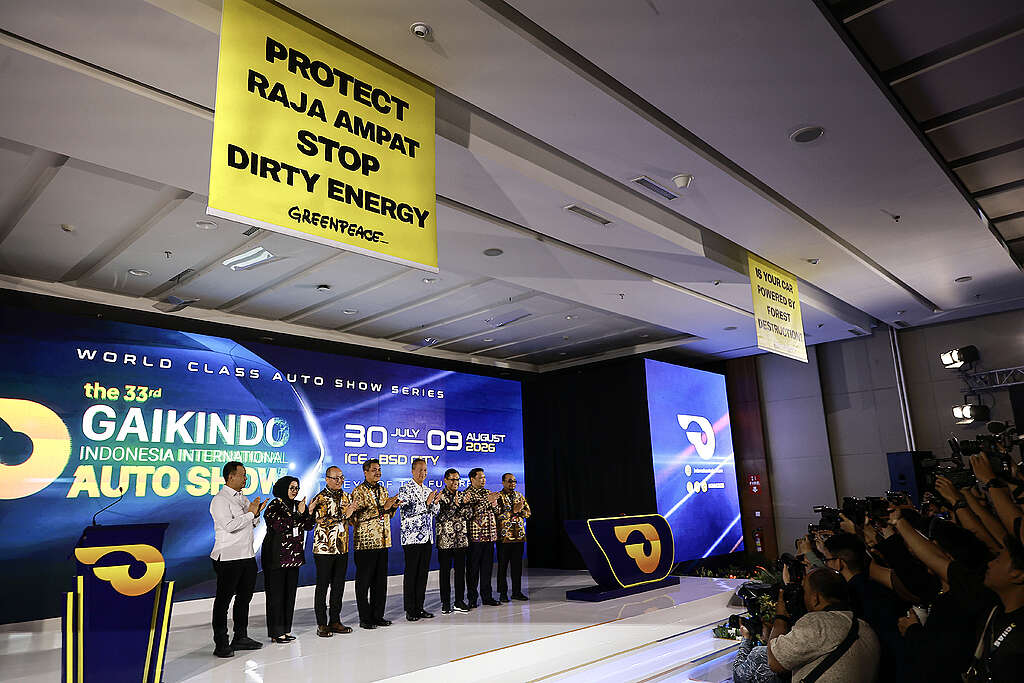
To shed light on the dirty energy threatening the Raja Ampat archipelago, either from nickel, coal, and oil and gas, Greenpeace activists unfold banners with a main message “Protect Raja Ampat, Stop Dirty Energy” at the opening ceremony at GIIAS 2026, the largest annual automotive exhibition in Indonesia today.
“Greenpeace is calling for the full protection of Raja Ampat from industrial activity and for the enforcement of existing laws which are supposed to protect small islands and conservation areas on land and at sea. Important areas for biodiversity and Indigenous Peoples must be off-limits to mining,” said Kiki Taufik, Greenpeace’s global head for Indonesia forest campaign.
Arie Rompas added, “Supply chain actors, including battery producers, must investigate their supply chains and clearly and publicly reject the supply of nickel that originates from any mines in Raja Ampat or other important areas for biodiversity and Indigenous Peoples.” Greenpeace and other NGOs have developed a Global Restricted Areas Map[3] of areas that should be off-limits to mining.
Note to Editor:
Read the report ‘Unprotected Paradise: One year on from the Indonesian Government’s decision to stop some of the nickel mining in Raja Ampat”
Photos and videos of nickel mining impacts in Raja Ampat in this link.
[1] PT Indonesia Weda Bay Industrial Park, located in Halmahera, North Maluku, houses a number of nickel and stainless steel processing facilities. Its operations has led to development of new industrial off-grid captive coal power plants, exacerbating climate and health impacts to the surrounding environment.
[3] The Global Restricted Areas Map is an interactive tool released by Greenpeace International, Rainforest Foundation Norway, Mighty Earth, and Fern. It highlights global “no-go zones” that should remain completely off-limits to transition and critical minerals mining to protect biodiversity, climate stability, and human rights. See the link https://maps.greenpeace.org/maps/gpint/restricted-areas/?lang=en
Media Contact:
Arie Rompas, Greenpeace Indonesia’s Forest Campaign Team Leader, [email protected]
Budiarti Putri, Greenpeace Indonesia’s Communication Campaigner, [email protected]