Right now, a miracle is happening just off our coasts. Thousands of humpback and southern right whales are wrapping up an epic journey from the freezing waters of the Antarctic, traveling thousands of kilometers north to breed, give birth, and nurse their young.
It’s a time of year that usually brings pure joy. Coastal communities are kickstarting annual whale festivals, celebrating these gentle giants with art, music, and eco-tourism. We look out at the horizon with awe.
But this year, the celebration carries a heavy, heartbreaking shadow.
The tragedy at Muanda
Just as the migration season was kickstarting, a devastating scene unfolded on the shores of Muanda, in the Democratic Republic of Congo (DRC). A massive whale, a traveler of the open seas, washed ashore. It was trapped, stranded, and ultimately died on the beach.
The images and videos shared across social media are a painful sight. A creature built for the vastness of the deep ocean, left helpless on the sand, surrounded by onlookers. While the exact cause of death for this specific whale is unclear it highlights the fragile nature of marine life, it serves as a stark, undeniable symbol of a larger crisis: our oceans are no longer a safe haven.
The contrast is jarring. In one part of the continent, we are singing songs of welcome; in another, we are witnessing a funeral on the sand.
The invisible gauntlet
A whale stranded like the one in Muanda is rarely just bad luck. It’s a symptom of an ocean under immense, human-made stress.
When we look at the ocean, we see a beautiful, blue expanse. But for a migrating whale, it’s a terrifying gauntlet. They are swimming through heavy traffic lanes with massive cargo ships. They are navigating an underwater maze of discarded ghost fishing nets and plastic waste that can entangle them, leading to a slow, agonizing drowning.
And then there’s the noise. Industrial shipping, military sonar and oil exploration fill the deep ocean with a deafening racket. For a creature that relies entirely on sound to navigate and communicate, this acoustic pollution is deafening. It drives them off course, panics them and can push them straight onto the beaches.
Why this is our fight
At Greenpeace Africa, we don’t just see the Muanda tragedy as a sad news headline. We see it as an urgent alarm bell.
Whales aren’t just beautiful creatures we love to watch through binoculars. They are the ultimate guardians of our climate. By circulating nutrients, they feed the phytoplankton that absorbs about 40% of the world’s CO2 and generates over half of the oxygen we breathe. To protect whales is to protect our own climate.
The tragedy in the DRC reminds us why marine protection is so critical. We cannot in good conscience celebrate a “whale festival” if we allow the oceans they call home to remain a hazardous industrial zone.
From mourning to movement
We can’t undo the tragedy at Muanda, but we can ensure it isn’t in vain. Turning our grief into actual protection means demanding immediate action from global leaders. To give these whales a fighting chance, we are pushing for major shifts right now.
- Ratify the Global Ocean Treaty: We need governments around the world to stop dragging their feet and fully ratify the UN Global Ocean Treaty. This will allow us to create massive ocean sanctuaries, strictly off-limits to industrial fishing, DSM oil drilling, and heavy shipping, covering 30% of our oceans by 2030.
- Turn Off the Plastic Tap: We must secure a legally binding Global Plastics Treaty that tackles the crisis at the source by cutting global plastic production by at least 75% by 2040. We cannot keep treating our oceans as a dumping ground for single-use plastics and expecting marine life to survive the deluge.
- Enforce Stricter Shipping Regulations: We need mandatory speed limits and altered shipping lanes in areas known to be heavy whale migration routes, forcing cargo giants to slow down or reroute during peak migration seasons to prevent fatal ship strikes.
- End the Age of Fossil Fuels: We must halt the expansion of offshore oil and gas exploration. Seismic blasting for oil surveys deafens and panics marine mammals, while the resulting climate crisis disrupts the ocean temperatures and food sources they rely on to survive.
Join the pod
As the whale festival season reminds us of the beauty and majesty of these incredible creatures, let the loss at Muanda remind us of our responsibility. Whales don’t have a voice to protest the plastic in their bellies or the ships cutting through their homes. We have to be that voice.
This migration season, let’s turn our awe into action. Don’t just watch the whales, help us protect them.
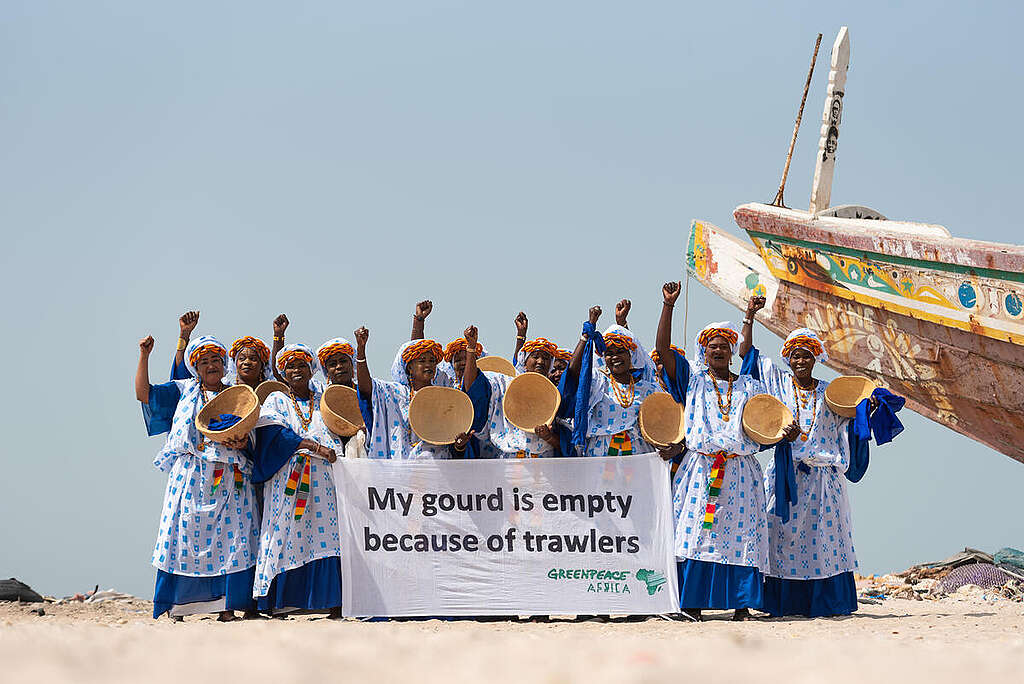
The industrial fishing lobby is powerful, and West Africa’s fishing communities can’t fight this battle alone.
Get Involved