
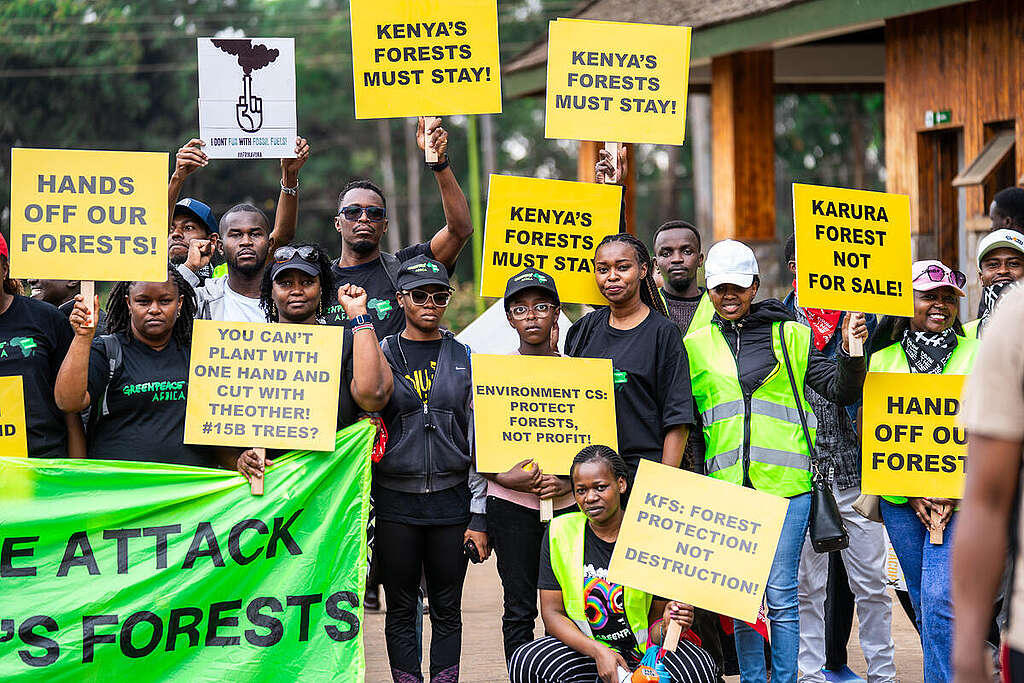
In August 2025, a Kenyan court handed down a landmark ruling. The government had sought to excise 51.64 hectares of Karura Forest to expand Kiambu Road. The Environment and Land Court said no, allowing only 0.1233 hectares, a fraction of what was requested. It was a victory for every Kenyan who has ever walked under Karura’s canopy, breathed its air, or understood what it means to have a forest in the middle of a city of five million people.
After that, courts intervened at Ngong Road Forest, where a luxury hotel and commercial developments had been quietly facilitated through administrative permits and early entry licences, without public participation, without environmental impact assessments, without accountability. The courts again said no.
After that, there were the NYS barracks at Karura. Same playbook.
The pattern is consistent and deliberate: identify a forest, find an administrative route around the law, move quickly before anyone notices, and if challenged, fight it in court. It has worked often enough to keep trying. When it has not worked, the losses have been absorbed and the approach refined.
Now something has changed. On 29 April 2026, Kenya’s National Assembly passed the Forest Conservation and Management (Amendment) Bill, 2025. It has been received by the Senate. And buried inside a Bill that contains several genuinely progressive provisions is a single clause, Section 15 of the Amendment Bill, which amends Section 56(2) of the principal Act, that threatens to make the administrative land grab not just possible, but legal.
What the bill actually says
To be clear about what this Bill does, it is worth separating its provisions.
There is much in the Amendment that environmental advocates have long called for. A new Directorate of Forest Regulation will act as an independent watchdog over the Kenya Forest Service, with powers to audit compliance, investigate complaints, and report annually to Parliament. Buffer zones of up to 100 metres are now mandatory around public and community forests, a direct legal tool against the kind of encroachment Karura has repeatedly faced. Penalties for forest offences have been sharply increased. The Kenya Forestry Research Institute has been given a stronger, dedicated legal foundation. Dryland forests, long neglected in national forest policy, receive specific attention for the first time.
These are meaningful gains. They deserve acknowledgement.
But Section 15 of the Amendment Bill proposes to amend Section 56(2) of the principal Act by adding two new permitted uses within public forests: easements for public roads and other public installations, and wayleaves for public utilities.
In plain terms, this means roads, power lines, pipelines, and other infrastructure could be routed through public forests under a process administered by the Kenya Forest Service – without the full constitutional and legal safeguards that currently apply to such decisions.
This is not a minor technical amendment. It is a structural shift in how Kenya’s forests can be accessed for development.
Why this clause is unconstitutional
Kenya’s Constitution is unambiguous on this point. Article 62(1)(g) classifies all government forests as public land. Article 62(2) vests management of public land in the National Land Commission. The allocation of easements and wayleaves constitutes an interest in land – and that power belongs constitutionally to the NLC, not to the Kenya Forest Service.
The Land Act 2012 already provides a comprehensive framework for exactly this kind of situation. It requires public notice, compensation, and due process before any interest in public land can be granted. The proposed amendment creates a parallel, less rigorous process under KFS, which has no constitutional mandate to allocate interests in public land. It does not complement existing law. It conflicts with it.
The Green Belt Movement, in its submission to the Senate on 7 May 2026, makes this argument with precision and force. GBM points directly to the Karura Kiambu Road ruling as evidence of what happens when forest land is allocated through administrative processes rather than constitutional ones – and argues compellingly that this amendment would legitimise the very practices that court found unlawful.
Greenpeace Africa stands fully behind that position. Forest destruction for development projects must stop. The courts have been saying so. The law should reinforce that verdict, not reverse it.
What the Senate must do
We are calling on the Senate to:
- Reject the proposed amendment to Section 56(2) of the principal Act, the easements and wayleaves clause, in its entirety.
- Uphold the constitutional mandate of the National Land Commission as the only body with authority to grant interests in public land.
- Require that any infrastructure development near or within a forest goes through the National Land Commission, complies with the Land Act, undergoes a full Environmental Impact Assessment, and is subject to genuine public participation.
- Strip the Kenya Forest Service of any unilateral power to grant interests in public forest land.
Retain and strengthen the genuinely progressive elements of the Bill: the buffer zones, the increased penalties, and the new regulatory oversight framework. Kenya’s forests need better governance, not less.
Iconic Kenyan forests making up almost 10 times the size of Nairobi are under threat.
Get InvolvedSherie Gakii, Communications and Story Manager