While some natural factors play a minor role, human activities, especially since the Industrial Revolution, have become the primary driver of this accelerating global crisis.
The extreme cold waves and devastating wildfires we are witnessing today are not isolated events; they are clear reflection of the extreme weather events exacerbated by Climate Change. According to the Intergovernmental Panel on Climate Change, both the intensity and frequency of extreme weather events are projected to rise at unprecedented rates, with far-reaching environmental, social, and economic consequences that threaten both humanity’s present and future.
This raises key questions: What exactly is climate change? What drives it? This article explores these questions and the underlying forces behind this crisis.
What Is Climate Change?
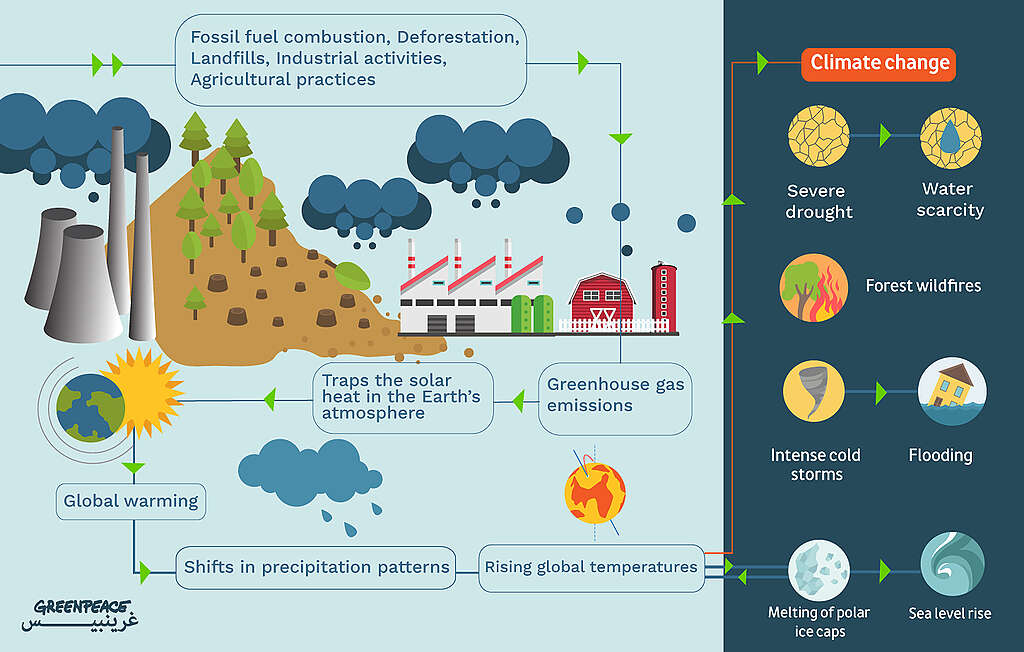
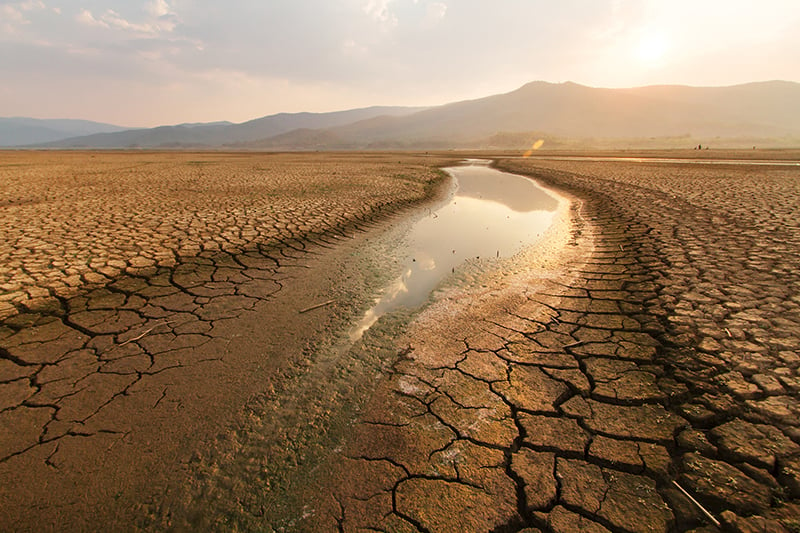
Under natural conditions, weather patterns fluctuate and temperatures vary with the changing seasons. However, when these fluctuations become more intense, persistent, and outside historical norms, they signal the phenomenon known as climate change. This shift leads to rising global temperatures and disrupted rainfall patterns, with far-reaching consequences such as polar ice melt, rising sea levels, severe droughts, and destructive storms. While the impacts of this crisis are now being felt worldwide, people living in small island states and developing countries — including those in the Middle East and North Africa — remain among the most exposed and vulnerable.
It is true that somedrivers of climate change are natural, such as variations in the solar cycle and volcanic activity. However, the influence of these factors is very limited. Since the Industrial Revolution — and particularly since the mid-20th century — human activities have become the dominant force accelerating climate change, primarily through the emission of greenhouse gases that drive global warming. As a result, natural factors account for only a very small share of the overall causes, and neither their speed nor their impact comes close to matching the scale and intensity of the warming we are witnessing today.
What Is Global Warming?
Human activities — particularly the burning of fossil fuels such as coal, oil, and gas — have heated the oceans, the atmosphere, and the Earth’s surface at an unprecedented pace. According to the State of the Global Climate report published by the World Meteorological Organization, 2024 is likely to be the first year in which global surface temperatures exceed 1.5 °C above pre-industrial levels, making it the hottest year recorded in 175 years of observations.
Global warming is defined as the long-term rise in the Earth’s average surface temperature, driven by increasing concentrations of greenhouse gases in the atmosphere. The most significant of these gases include carbon dioxide, methane, and nitrous oxide, along with certain fluorinated gases and nitrogen oxides. Emitted primarily through the combustion of fossil fuels, these gases trap heat from the sun and re-radiate it back toward the Earth, preventing it from escaping into space and causing global temperatures to rise.
The growth in greenhouse gas concentrations is not limited to fossil fuel use alone. Other human activities — such as deforestation, industrial operarions, waste disposal in landfills, and agricultural practices — also play a significant role in driving these increases. As a result, atmospheric greenhouse gas levels have reached record highs. For example, carbon dioxide concentrations rose from approximately 278 parts per million (ppm) in 1750 to over 420 ppm in 2023, representing an increase of 51%.
Why is COP30 a pivotal opportunity?
Against this stark reality, the need for urgent action to curb the climate crisis and confront its impacts has never been clearer—if we want to safeguard the future of humanity and life on Earth. The Middle East and North Africa region stands among the regions most severely affected, with temperatures rising at nearly twice the global average.
This is precisely why the 30th Conference of the Parties (COP30), set to take place in Belem, Brazil, represents a critical opportunity to become a genuine turning point—one that corrects the deep injustices we witnessed at COP29 in Baku. While the climate finance commitments announced in Baku were presented as progress, the stated goal of mobilizing USD 300 billion annually by 2035 remains far below what is actually needed, particularly once inflation is taken into account. Equally troubling is the lack of clarity regarding the nature of this financing, raising serious concerns that it may rely on loans rather than grants—further burdening already vulnerable countries with debt.
Once again, COP29 revealed a persistent disconnect between the priorities of the Global North and the urgent needs of the Global South. By sidelining justice and equity, our region continues to shoulder the consequences of a crisis it played little role in creating.
How is climate change affecting our region?
The Middle East and North Africa is a climate hotspot, despite its relatively small contribution to global carbon emissions.
In a region already grappling with acute water scarcity, climate pressures are intensifying rapidly. Since the 1980s, average temperatures have risen by approximately 0.4°C per decade—double the global rate—according to the “Living On the Edge” report by Greenpeace Research Laboratories at the University of Exeter UK. Today, hundreds of millions of people across the region—home to some of the world’s largest oil and gas exporters—are on the frontlines of climate impacts, facing worsening water shortages, extreme heatwaves, and increasingly destructive floods.
This accelerated warming translates into more frequent and prolonged droughts, faster and more dangerous depletion of water resources, and an agricultural sector struggling to survive. Given the region’s heavy dependence on food imports, drought poses a dual threat: it undermines local agricultural production while simultaneously exposing global food supply chains—on which MENA countries rely—to severe disruptions. The result is mounting pressure on food and agricultural security and a direct threat to the livelihoods of millions who depend on the land as their primary source of income.
The report further warns that 80% of densely populated cities in the Middle East and North Africa could experience heatwaves lasting for at least half of the warm season by the end of the century.
With emissions continuing to rise in parts of the Middle East and the Gulf, future extreme heatwaves could push peak temperatures beyond 56°C, posing an existential threat to communities, public health systems, and ecosystems—and making parts of the region increasingly uninhabitable.
What are the effective solutions to climate change?
Despite the scale of the challenge, the path forward is clear. The most decisive solution lies in relentless pressure on governments and major corporations to phase out fossil fuels once and for all. All countries must transition toward fossil-free economies as quickly as possible. At the same time, large-scale investment in renewable and clean energy—such as solar, wind, hydropower, tidal, and geothermal energy—is absolutely essential.
Since climate change is one of the most serious threats facing the Middle East and North Africa, and as part of our awareness project to combat and adapt to its impacts, we want to hear from you, and from citizens across the region who are witnessing the changes around them caused by global warming.
Join Us