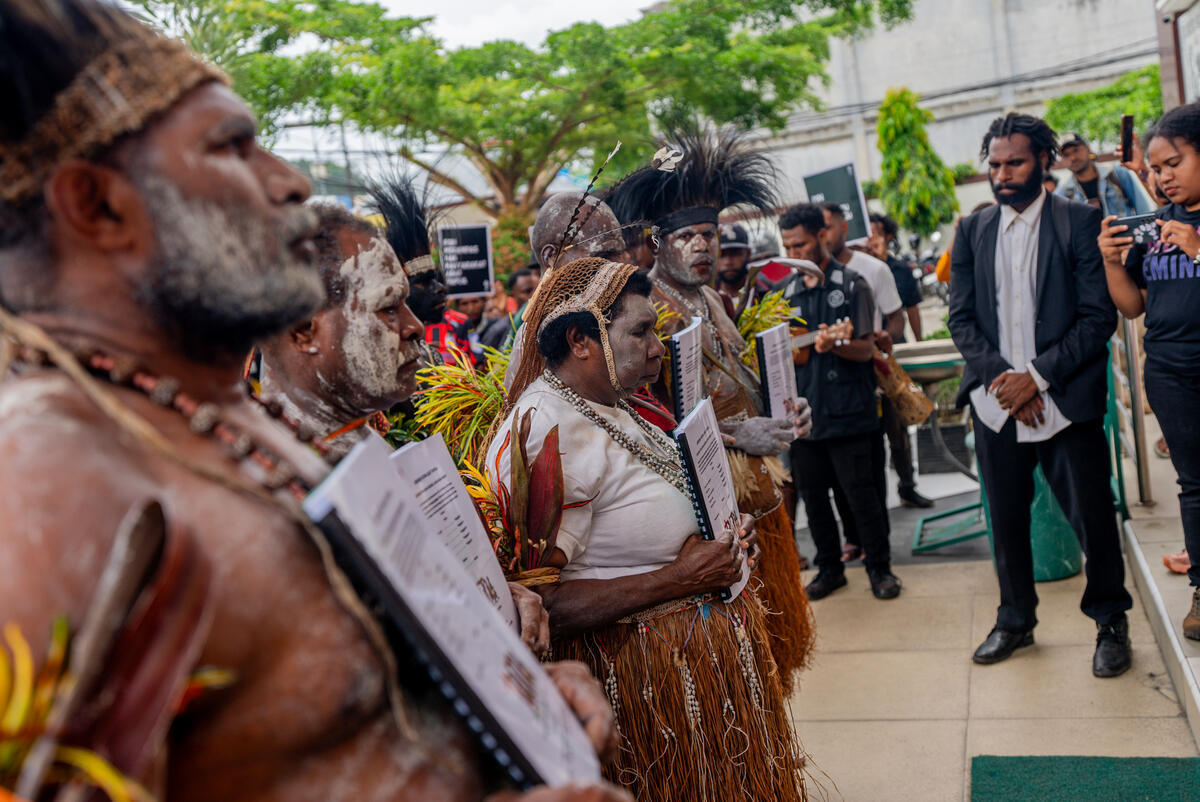
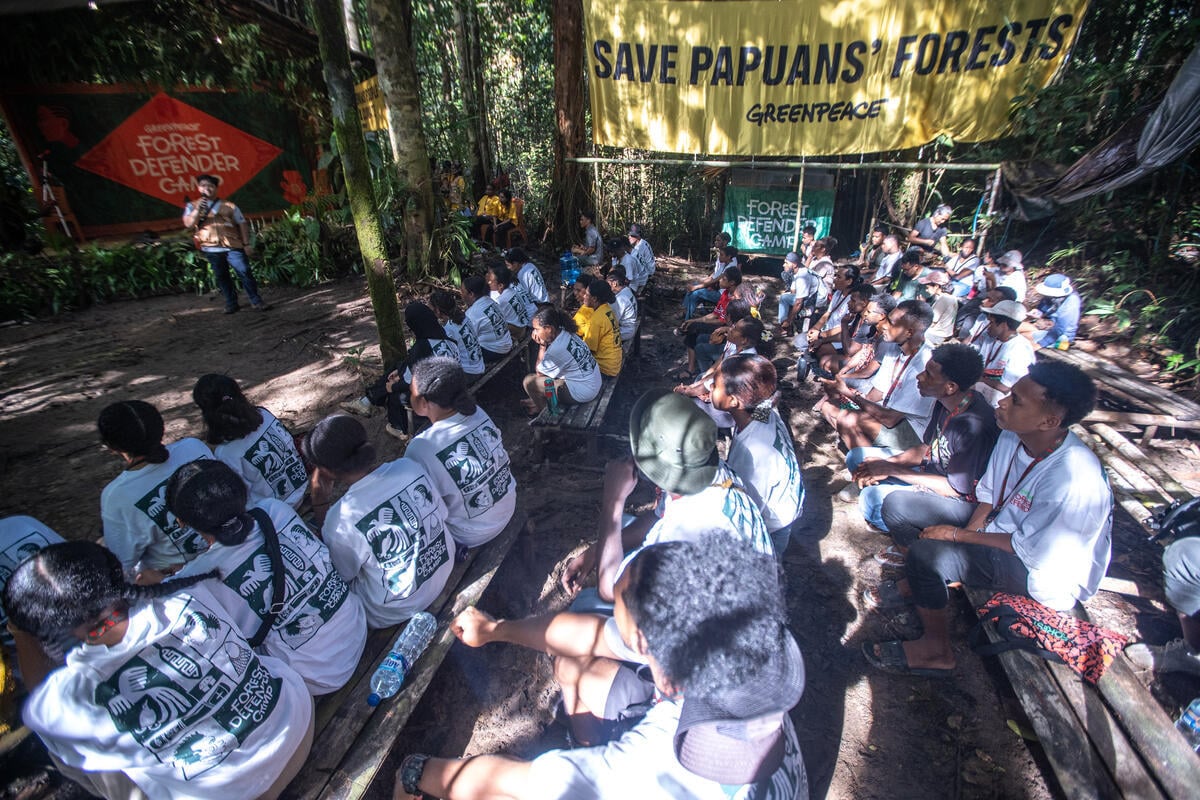
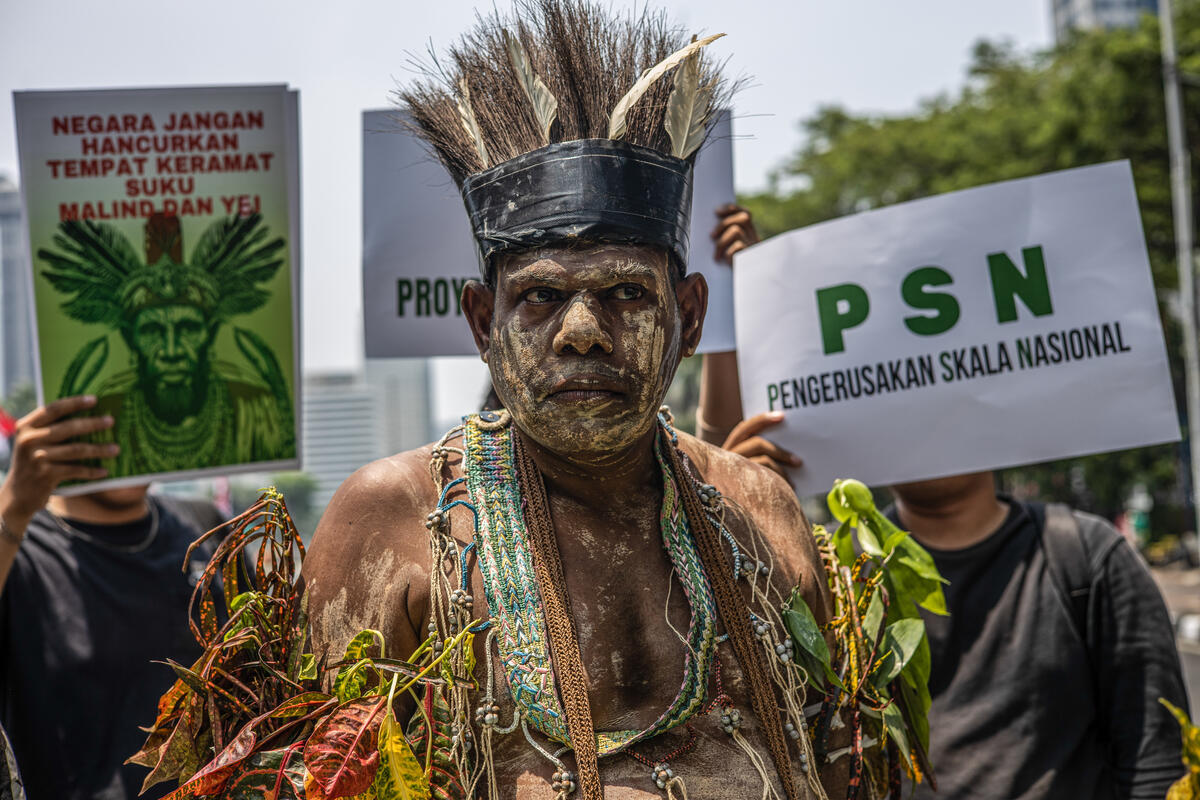
Jakarta, 18 December 2025 – Greenpeace Indonesia today brought the voices of West Papuan environmental protesters to the Coordinating Ministry for Economic Affairs. Through creative performance, West Papuan youth and impacted landowners portrayed the struggle of Indigenous Peoples whose ancestral lands are being seized for the Merauke Sugarcane National Strategic Project (PSN) that the ministry is overseeing. Activists also erected an art installation crafted from sugarcane stalks reading “STOP PSN”.
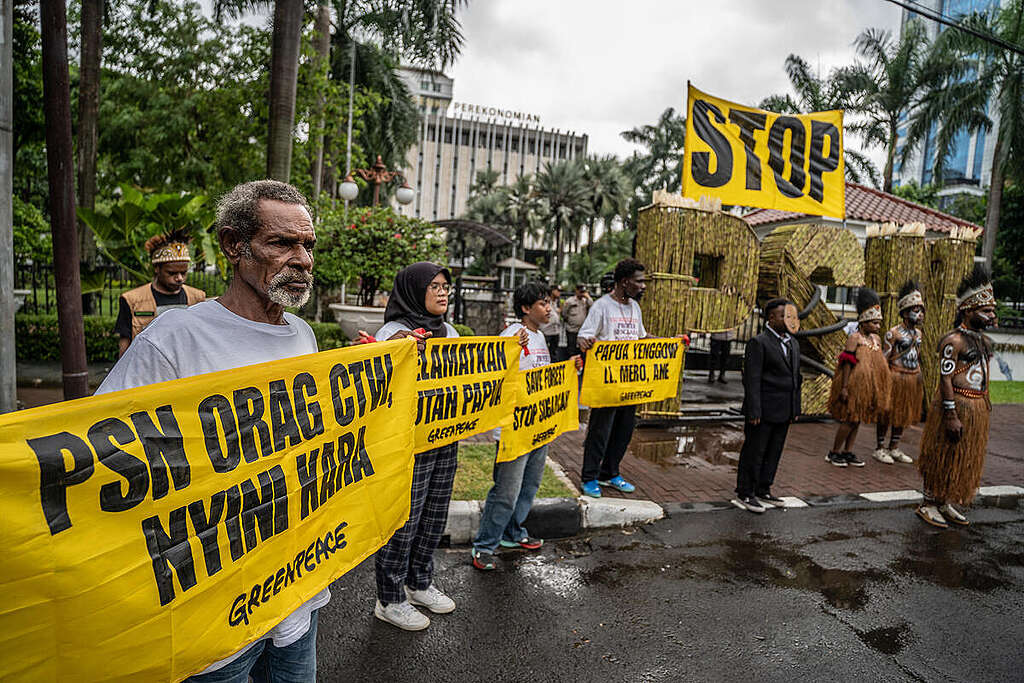
Alongside messages in Indonesian and English, protesters carried banners in the Yei language, spoken by one of several Indigenous Peoples in the south of West Papua threatened by the sugarcane project. Slogans included “West Papua is Not an Empty Land”, “PSN Out of Our Lands” and “Save Forests, Stop Sugarcane”.
The action highlighted massive deforestation looming over Merauke, a threat promoted this week by President Prabowo Subianto during a meeting on the government’s plans for West Papuan development. Addressing regional heads from across West Papua, with the heads of the Indonesian Armed Forces, National Police, and State Intelligence Agency in attendance, Prabowo revealed plans to expand oil palm, sugarcane, and cassava plantations to secure fuel and bioethanol supplies.
The President’s statements are deeply ironic, delivered as parts of Sumatra remain paralyzed by a deadly ecological disaster that has claimed over a thousand lives, driven by climate change and decades of industrial deforestation. The devastation in western Indonesia has evidently failed to dampen the government’s ambition to pursue “false solutions” that would sacrifice pristine landscapes in the east of the country.

Belgis Habiba, Forest Campaigner at Greenpeace Indonesia, stated that the Merauke Sugarcane PSN is currently the largest deforestation project in the world, with the potential to inflict catastrophic damage on key ecosystems in the West Papua southern lowlands ecoregion. “We have just witnessed the terrible impact of the climate crisis and ecological destruction in Sumatra due to massive deforestation over recent decades. Similar disasters are poised to hit West Papua if the government persists in its obsession with food and energy ‘security’ through environmental destruction,” said Belgis.
Joining the protest was Vincent Kwipalo, a Yei man from the Merauke area. Last week, Vincent was summoned for questioning as a complainant in a case regarding alleged plantation crimes and the seizure of the Kwipalo Clan’s ancestral territory by PT MNM, one of the companies carrying out the Merauke Sugarcane PSN. “The government claims it wants to focus on development, but it ignores the fate of Indigenous Peoples whose lands are being bulldozed. Where do they expect us to go? The presence of these companies in our villages triggers conflict, yet the government turns a blind eye, chasing ‘development’ without considering the impact on us. This government-branded development only brings suffering to Indigenous communities,” Vincent said.
The stories of Vincent and other Merauke residents impacted by the PSN are documented in Greenpeace Indonesia’s latest report, “Sweet Promises, Bitter Reality: Inside the Merauke Sugarcane Project.” The report reveals that the government has allocated 560,000 hectares – an area the size of the holiday island of Bali – for industrial sugarcane concessions in Merauke. Of this total, 419,000 hectares are natural forests, while the remainder includes 83,000 hectares of sensitive wetlands and 34,000 hectares of rare savanna ecosystems.
Refki Saputra, Forest Campaigner at Greenpeace Indonesia, labeled the mega-project, which is promoted as a shortcut to sugar self-sufficiency and renewable energy (bioethanol), as a false solution. “Sourcing bioethanol from Merauke will drive large-scale conversion of natural forests. This ambition for ‘renewable’ energy will actually increase emissions and shift focus away from improving smallholder farmers’ sugar production. In short, the Sugarcane PSN is a modern manifestation of colonial ‘terra nullius’ (empty land) politics in West Papua, trading biodiversity and Indigenous living spaces for biofuels,” Refki said.
Notes to Editors:
- Photos and videos of the action are available for download.
- Read the full investigative report.
Media contacts:
Igor O’Neill, Greenpeace Indonesia, [email protected] +61 414-288-424
Refki Saputra, Greenpeace Indonesia, +62 852-6351-5392