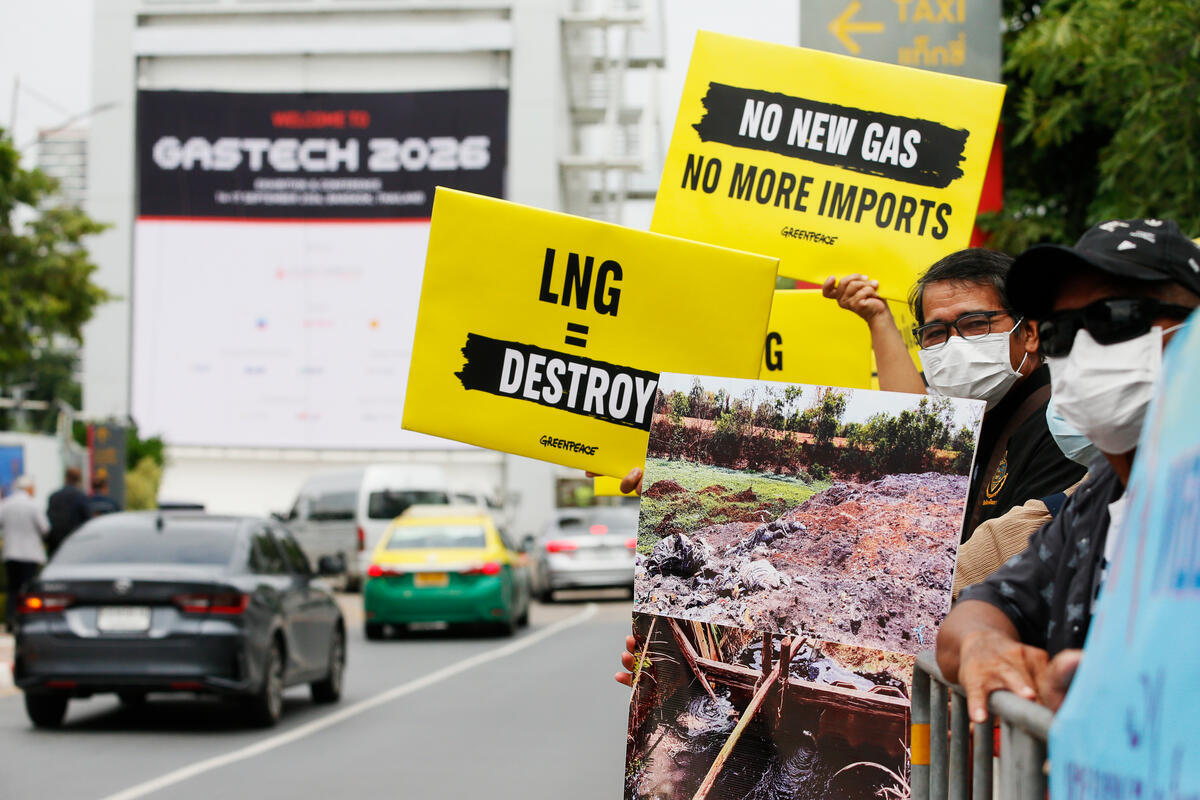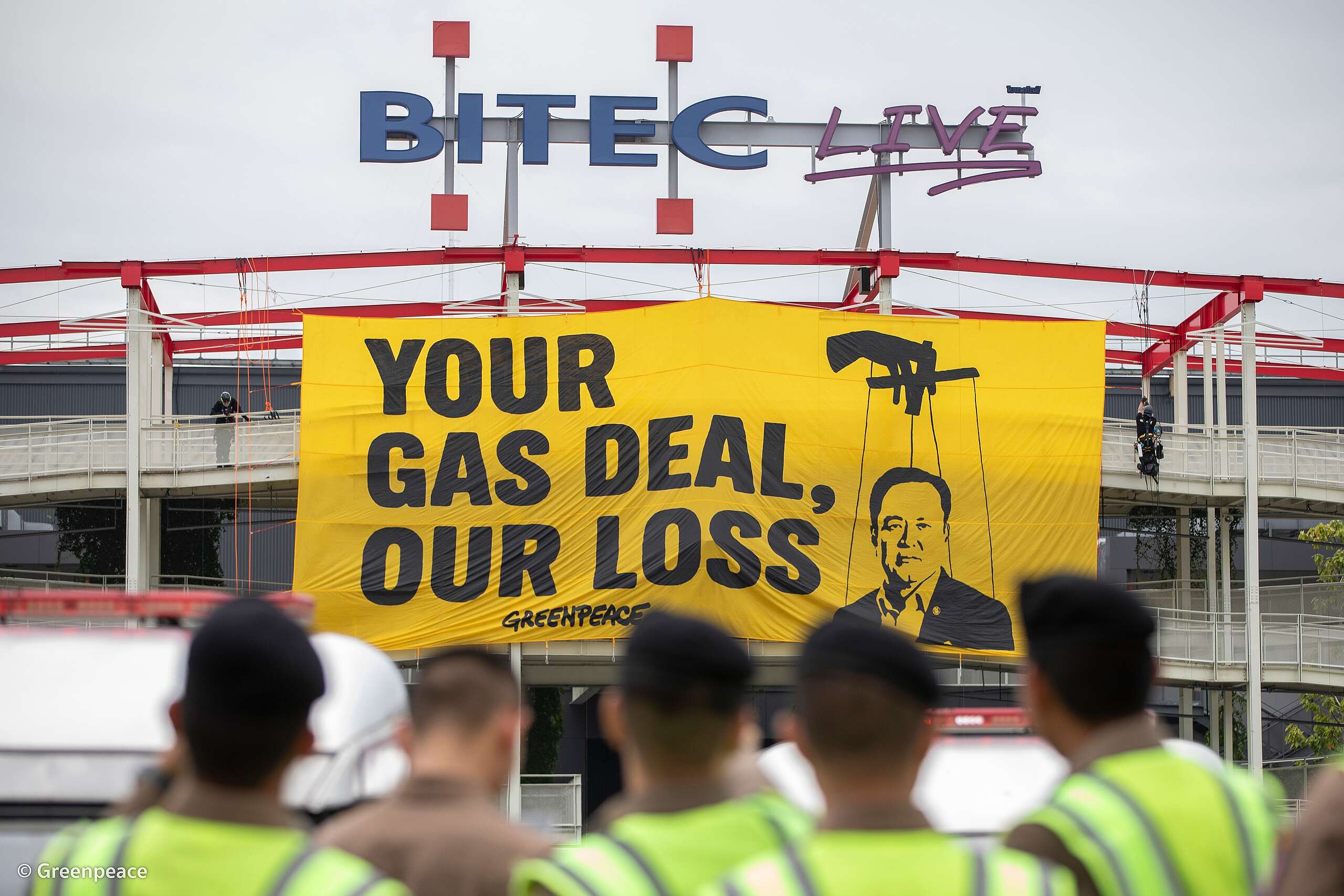
BANGKOK, THAILAND, 16 September 2026 – As fossil gas companies, investors and governments gather for Gastech 2026 in Bangkok to promote new gas deals and infrastructure, civil society groups and frontline communities from across Asia gathered at the Foreign Correspondents’ Club of Thailand (FCCT) to bring another perspective to the discussion, exposing the corporate and financial interests behind continued fossil gas expansion and the costs borne by communities across the region.
Under the theme “The Fossil Illusion: Uncovering Corporate Power, Financial Trails, and Hidden Costs at Gastech 2026”, Fossil Free Thailand Network and its alliance, including Greenpeace Thailand, Solutions for Our Climate, Accountability Counsel, and community representatives from Nepal, Thailand, the Philippines, and Indonesia, gathered to examine the corporate, political, and financial power driving the fossil gas expansion agenda across Asia and its links to the climate crisis.
The discussions took place as communities across Asia are already living with the consequences of a warming world. Recent landslides and flash floods along the Nepal and Tibet border devastated families and communities, sweeping away homes, schools, markets, roads, and hydropower infrastructure. The disaster is a stark reminder of how extreme weather can devastate lives and livelihoods, with frontline communities often bearing the heaviest burden.
Meanwhile, the fossil fuel industry continues to extract and sell fossil gas, whose burning drives global heating and increasingly extreme weather. At Gastech 2026, major fossil gas companies, investors, and governments are pursuing partnerships and infrastructure projects. Just days into the event, Thailand’s Energy Minister announced that Gastech 2026 in Bangkok had generated more than US$17 billion worth of energy business agreements, describing this as a sign of Asia’s growing potential as a global energy business hub. Continued investment in fossil fuel infrastructure risks locking Asia into fossil fuel dependence for decades, while leaving communities to bear the environmental, social, and economic costs.
Public finance plays a critical role in enabling continued fossil gas expansion across Asia. Gas infrastructure requires significant upfront capital and can carry substantial long-term financial risks making some projects difficult to finance on commercial terms alone. Export credit agencies and state backed financial institutions can step in with loans, guarantees and insurance that reduce these risks and help make projects bankable. Their involvement can also encourage private capital to follow.
South Korea illustrates the scale of this financial backing. Between 2020 and 2024, 74.5% of the country’s public export finance for overseas energy projects went to fossil fuels, with natural gas alone accounting for 58.1% of the total. By absorbing or reducing risks that the private investors may otherwise be unwilling to take, public finance can help move fossil gas projects from plans to reality and shape energy systems for decades to come.
The role of public finance also raises a fundamental question of accountability. When state backed financial institutions enable fossil gas projects, responsibility for their impacts cannot end with the companies developing them. The UN Guiding Principles on Business and Human Rights underline the responsibility of businesses to identify, prevent and address human rights impacts linked to their activities, while the International Court of Justice has affirmed the legal responsibility of states to ensure that state-backed financing protects the climate system from greenhouse gas emissions. Civil society groups stressed the need for stronger human rights and environmental due diligence, greater transparency in financing decisions, meaningful participation of affected communities, and effective accountability and remedy mechanisms when harm occurs.
Across Asia, communities affected by fossil fuel development are already seeking accountability through community mobilisation, legal action, climate litigation and grievances mechanisms linked to financial institutions. In South Korea, for example, concerns over environmental and human rights due diligence have led to an Organisation for Economic Co-operation and Development (OECD) complaint concerning public financial institutions’ support for LNG shipping. Their experiences highlight that the costs of fossil gas expansion extend beyond financial risk to impacts on livelihoods, health, ecosystems, land and natural resources.
These realities challenge the promise of fossil gas as a pathway to energy security and economic growth. Continued gas expansion can deepen dependence on volatile global fuel markets, tie public and private finance to long term fossil fuel infrastructure, and shift environmental, social and economic risks onto communities. As governments, energy companies and investors pursue new gas partnerships and infrastructure at Gastech 2026, the question is not only what these investments promise, but who benefits from them, who finances them, and who is ultimately left to bear their costs.
Civil society groups called on governments, fossil fuel companies, investors and financial institutions to end support for new fossil fuel projects and redirect finance towards renewable energy and community led solutions – ensuring a just transition that respects the community rights and leaves no one behind. They also called for financial institutions to adopt stronger human rights and environmental safeguards, incorporate greater transparency and accountability in financing decisions, ensure meaningful participation of affected communities, and commit to effective and robust implementation of remedial actions when harm occurs.
END.
Notes:
[1] Asian Civil Society Joint Statement for Gastech 2026
[2] Thailand Local communities statement for Gastech 2026
Media contacts:
Nattanicha Phuklai, Climate and Energy Associate Communications Campaigner, Greenpeace Thailand, +66 61 232 4596, [email protected]
Notes from panelists
Manun Wongmasoh, Climate and Energy Campaigner, Greenpeace Thailand, on corporate and political power behind Thailand gas lock-in
“Communities are increasingly losing control over decisions that shape their livelihoods, household economies, and futures. Too often, those decisions are made by policymakers and major fossil fuel companies whose interests can align around continued industrial expansion. In Thailand, the Draft Power Development Plan 2026 (PDP2026) projects as much as 9,100 MW of new gas-fired power capacity within just the first 12 years of the plan (2026–2037). The planned expansion of fossil gas infrastructure may also be enabled by financing from overseas. We are here today to call on those with the power to shape our energy future to put people and communities at the centre of decision-making, rather than corporate profits.”
Dawon Hwang, Solutions for our Climate, explained the public finance behind fossil gas expansion
“Every gas terminal and power plant begins with a financing decision made far from the communities that live with the consequences, and a significant share of that finance comes from South Korea. Korean public financial institutions and energy companies are backing gas expansion across Southeast Asia, from the Map Ta Phut terminal in Thailand to gas-fired power plants in Vietnam, even as every one of them has pledged carbon neutrality by 2050. A climate pledge without a clear timeline to stop financing fossil fuel expansion risks becoming an empty promise. We call on Korea’s public institutions to stop financing new fossil gas expansion.”
Chiraphat Chamket, Chachoengsao Repower, Chachoengsao Repower, Thailand, on two decades of community resistance to fossil gas infrastructure
“For decades, communities in Chachoengsao have lived alongside expanding industrial development. We have fought against the pollution and environmental impacts affecting our home for just as long. After communities successfully opposed coal, we are now seeing fossil gas promoted in its place, bringing another set of concerns for our health, environment and livelihoods. As industrial areas continue to expand, we are watching mango trees die on the farms our parents passed down to us, and wondering whether we will still be able to pass this land on to the next generation.”
Phwat Kanchawong, The Rayong Artisanal Fisheries Association and EEC Watch, on the impacts of LNG infrastructure on coastal livelihoods.
“Communities in Rayong were still dealing with the impacts of a crude oil spill when a massive LNG terminal was built along our coast, involving land reclamation into the sea. Since then, we have seen changes in ocean currents, while dredging for the shipping channel has made the seawater murky throughout the year, with fewer krill and other marine animals. Small-scale fishers who used to catch around 20 to 40 kilograms of blue swimming crab in one night now report catching as little as one kilogram. With less catch and less income, younger generations are increasingly turning away from traditional fishing. What we are losing is not only our income, but also a way of life that has supported our communities for generations.”
Sumet Rianphongnam, Strong Prachinburi Community Network, Thailand, on the impacts of industrial expansion
“Prachinburi used to be known for its agriculture, especially fresh and high-quality fruits. We are proud farmers. But for the past decades, industrial areas have expanded, along with more waste sorting, disposal, and recycling facilities. Waste is brought into our province from across Thailand and even from overseas, putting more pressure on our environment and communities. People who speak out about these problems have also faced threats, harassment, and SLAPP lawsuits. Now there have been proposals to bring Prachinburi into the Eastern Economic Corridor. Looking at what communities in other EEC provinces have experienced, we are concerned that further industrial expansion will only add to the problems we already face. We therefore continue to oppose the proposal and call on the government to protect our communities, livelihoods and natural resources.”
Siti Aminah, Indonesia Legal Resource Center / Coalition for Monitoring Infrastructure Development in Indonesia, on the impacts of the ADB-financed Jawa-1 CCGT Power Project and communities’ struggle for remedy
“Communities in Karawang have reported serious environmental and social impacts from the construction and operation of the Jawa-1 CCGT Power Project. Fishers have seen changes at the river mouth, damage to the marine ecosystem, declining fish catches, and damage to their boats and fishing nets, making it harder for them to earn a living. Farmers have also reported flooding in rice fields and a greater risk of crop failure following changes to irrigation channels, while people living near the project have raised concerns about noise, cracks in their homes and falling water levels in their wells. When efforts to resolve these problems at the project level did not provide adequate remedy, fishers brought their complaints to the Asian Development Bank’s Accountability Mechanism. As a bank that financed the project, ADB must ensure that its environmental and social safeguards are followed, use its influence to prevent further harm, and ensure that affected communities have access to effective remedy “.
Trestito Fiel, Philippines Movement for Climate Justice Mindanao, on community resistance to fossil gas expansion
“For decades, our communities have borne the costs of fossil fuels development. Continued expansion reflects the blatant disregard for the lives, livelihoods, health, and the very future of frontline communities forced to live with the impacts of these dirty projects. While big corporations and their investors reap the profits, they evade accountability for the harms they inflict in our communities and the accelerating climate crisis. Our victory against the proposed LNG plant in Kauswagan, Mindanao demonstrates the power of community resistance. But our fight does not end there. We demand real accountability, meaningful remedies for affected communities, and an end to the financing that prolongs our fossil fuel dependence.”
Sutharee Wannasiri, Accountability Counsel, demands more effective accountability channels for the communities affected by harmful fossil gas projects.
“Financial institutions must offer stronger accountability channels for local communities across Asia affected by the fossil gas projects they finance. Communities have raised serious concerns about lack of consultation and access to project information, displacement, environmental harm, biodiversity loss, pollution, and human rights impacts, yet many still struggle to access meaningful remedy. If countries supporting gas expansion, including Japan and South Korea, are serious about their commitment to accountability, they must make their accountability mechanisms tied to financial institutions more independent, transparent, and responsive to local community needs.”
Yujung Shin, Climate Advocate Lawyer and a head of Legal Team at Solution For Our Climate, on the growing legal scrutiny of fossil fuel finance
“In Korea, we have fought for years over public financiers’ accountability for fossil fuel investments, and the practice still has not changed. In December 2025, the UK and Dutch export credit agencies withdrew from Mozambique LNG; Korea did not, despite the legal challenges brought against it here. That is why our fight has not ended. But there are real signs of hope: on 23 July 2025 the International Court of Justice held unanimously that fossil fuel subsidies granted without due diligence may amount to an internationally wrongful act, and on 9 September 2026 a Dutch court allowed a case against a bank’s fossil fuel financing to proceed. The law is converging on a single point — financing fossil fuel expansion carries legal consequences. Our task in Asia is to turn that principle into cases.”