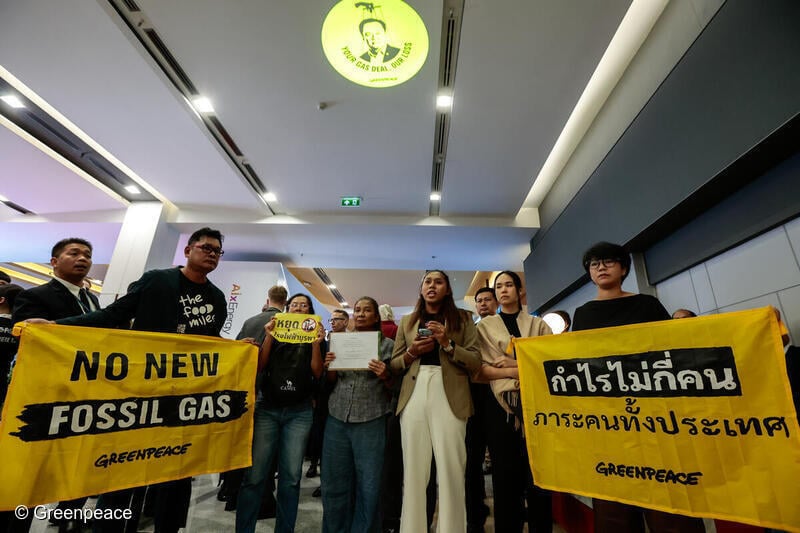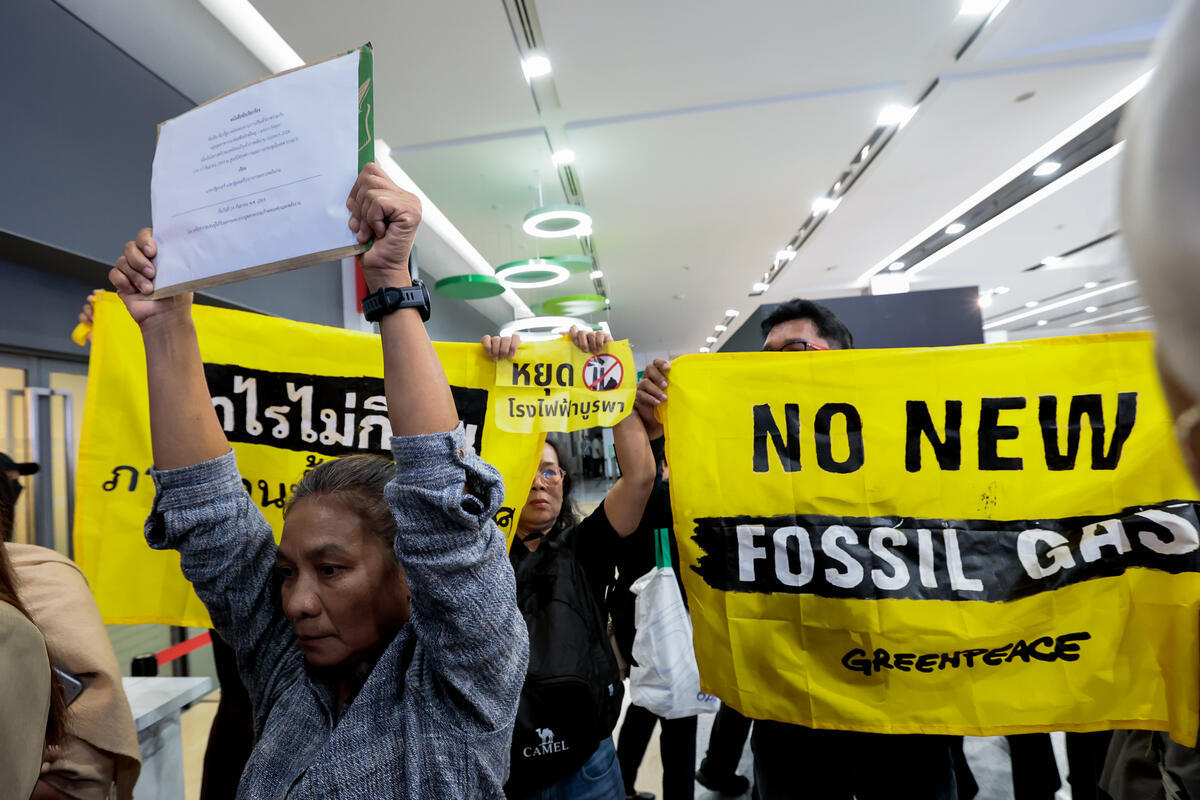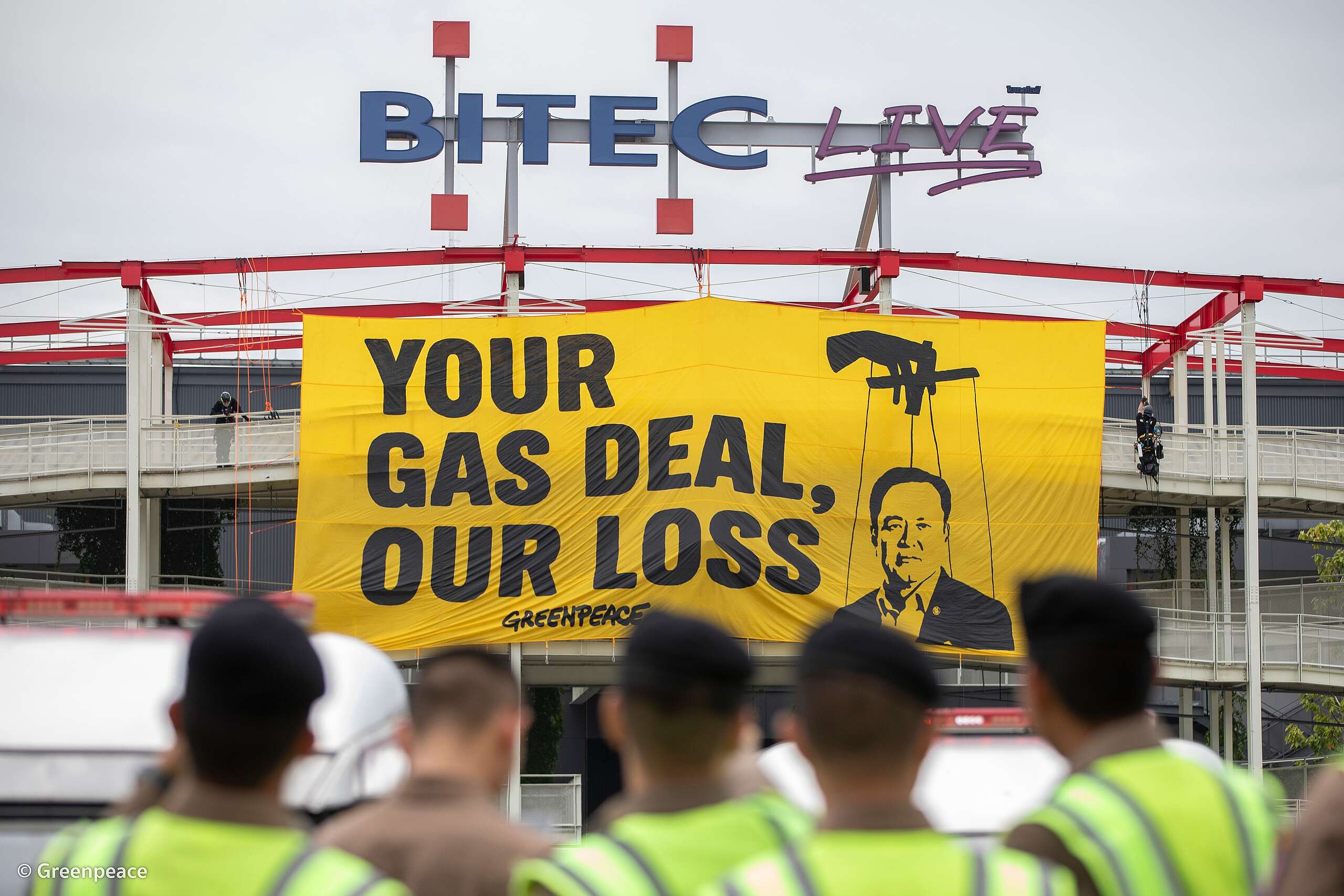
BANGKOK, THAILAND (15 September 2026) — Reacting to speeches delivered today by Japanese government officials, including Tetsuya Azuma, Director at Japan’s Ministry of Economy, Trade and Industry (METI), at the Japan Energy Summit during Gastech 2026 in Bangkok, Greenpeace East Asia condemns Japan’s push to position fossil gas and fossil-fueled vehicles as drivers for regional growth and energy security.
Greenpeace warns that this strategy, anchored in initiatives like Prime Minister Sanae Takaichi’s “POWERR Asia” (Partnership on Wide Energy and Resources Resilience Asia) and the continued subsidization of polluting internal combustion engine (ICE) vehicles, represents a dangerous climate trap that threatens global decarbonization targets and undermines international commitments under the Paris Agreement.
During the summit, government officials admitted to severe energy vulnerabilities, noting Japan’s extreme 93% reliance on crude oil passing through the Strait of Hormuz, severe market disruptions in downstream products like naphtha, and the need to subsidize transport costs to bypass Middle Eastern supply bottlenecks. Yet, rather than accelerating a shift toward clean energy and zero-emission electric vehicles (EVs), the Japanese government reaffirmed its commitment at Gastech to using “POWERR Asia” to expand overseas oil stockpiles and fossil gas infrastructure. At the same time, despite acknowledging the global EV surge sweeping China, Southeast Asia, and Europe, officials defended the government’s decision to push dirty combustion engines in Japan and the U.S. while promoting biofuels as a false climate solution.
Greenpeace asserts that Japan’s strategy, combining overseas fossil fuel expansion with a slow-walk on EV electrification, is a politically driven decision rather than one grounded in environmental science or economic reality. Driven by short-term industrial politics and vested corporate interests, Japan is choosing to export fossil reliance and delay auto decarbonization by propping up high-emitting, obsolete vehicle technology. In doing so, it risks driving up global emissions, locking developing economies into stranded asset risks, and setting back the worldwide transition away from fossil fuels.
Japan remains one of the world’s largest public financiers of fossil fuels, funneling US$93 billion in public finance for overseas oil and gas projects from 2013 to 2024, nearly four times the US$24.5 billion directed to clean energy, while gas-only projects accounted for 60% of that total [1]. Public agencies like the Japan Bank for International Cooperation (JBIC) generate attributable emissions exceeding 400 million metric tons of carbon dioxide equivalent annually, larger than the national emissions of the UK or France [2].
Domestically, Japan’s extreme fossil fuel dependence creates severe economic vulnerability. As the world’s fifth-largest energy market and second-largest LNG importer, Japan imported almost 65 million tonnes of LNG in 2025 [3]. Around 90–95% of Japan’s crude oil comes from the Middle East, with roughly 70–93% of those shipments transiting the Strait of Hormuz, leaving the economy hyper-exposed to supply shocks, currency depreciation, and imported inflation [4].
Despite attempts by government officials to frame regional oil stockpiling, downstream subsidies, and unproven solutions like biofuels as paths to resilience, Greenpeace asserts that doubling down on imported fossil fuels, nuclear restarts, and polluting combustion vehicles is an unsafe, globally damaging policy.
Kazue Suzuki, Climate & Energy Campaigner at Greenpeace Japan, said:
“METI’s vision locks Japan and the entire Asia region into expensive, imported gas at the exact wrong time. With supply routes through the Middle East becoming increasingly unstable, the plan raises energy bills and multiplies risk for households and businesses. Gas is not a bridge to growth but a financial trap. Nuclear power is costly and unsafe, and technologies like ammonia co-firing and CCUS are distractions. Japan needs to stop financing fossil gas overseas and put its money into solar and wind that actually deliver energy independence. Ultimately, the country needs a swift, decisive phaseout of all fossil fuels, starting with coal.”
Manun Wongmasoh, Climate and Energy Campaigner at Greenpeace Thailand, said:
“Southeast Asia does not need more fossil gas or Japanese financing for new gas infrastructure. Thailand and Japan should end their LNG cooperation MOU and avoid locking the region into decades of fossil fuel dependence. Our region has abundant renewable energy potential. What we need is investment in renewables, not new pipelines and LNG terminals that lock countries into volatile fossil fuel prices and risk becoming stranded assets. Doubling down on gas and nuclear, including Small Modular Reactors (SMRs) in the name of ‘energy security’ is reckless. It makes energy more expensive and leaves countries exposed to global market shocks, and leaves people across Southeast Asia to pay the price ”
Greenpeace East Asia calls on the Japanese government and financial institutions to immediately end all public financing for overseas fossil gas and oil infrastructure, phase out support for internal combustion engines, and commit to a just, renewable- and EV-led energy transition worldwide.
ENDS
More materials:
- Greenpeace Asia Pacific Joint Statement: Gastech 2026: Asia’s Growing Energy Needs Cannot Justify Fossil Gas Expansion
- Greenpeace & Thai Local Community Gastech Opening Press Release: Greenpeace Thailand Calls Out Anutin’s Government at Gastech 2026: Stop Prioritizing Carbon Majors Over People’s Lives
Notes:
[1] Solutions For Our Climate, “Billions Off Course: Japan’s Oil and Gas Financing Fueling Climate Breakdown” (3 August 2026).
[2] Friends of the Earth Japan, “New Report on Climate Impacts of Japan’s Public Finance” (5 November 2025)
[3] Energy Connects, “The market outlook for gas and LNG in Asia” (8 June 2026)
[4] International Energy Agency (IEA), “Strait of Hormuz” (10 July 2026)
Media Contact:
Yujie Xue, International Communications Officer, Greenpeace East Asia, +852 5127 3416, [email protected]