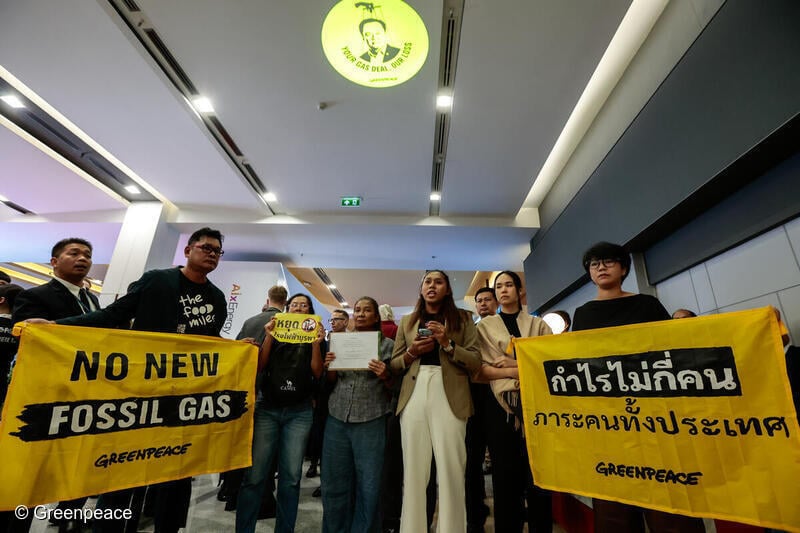
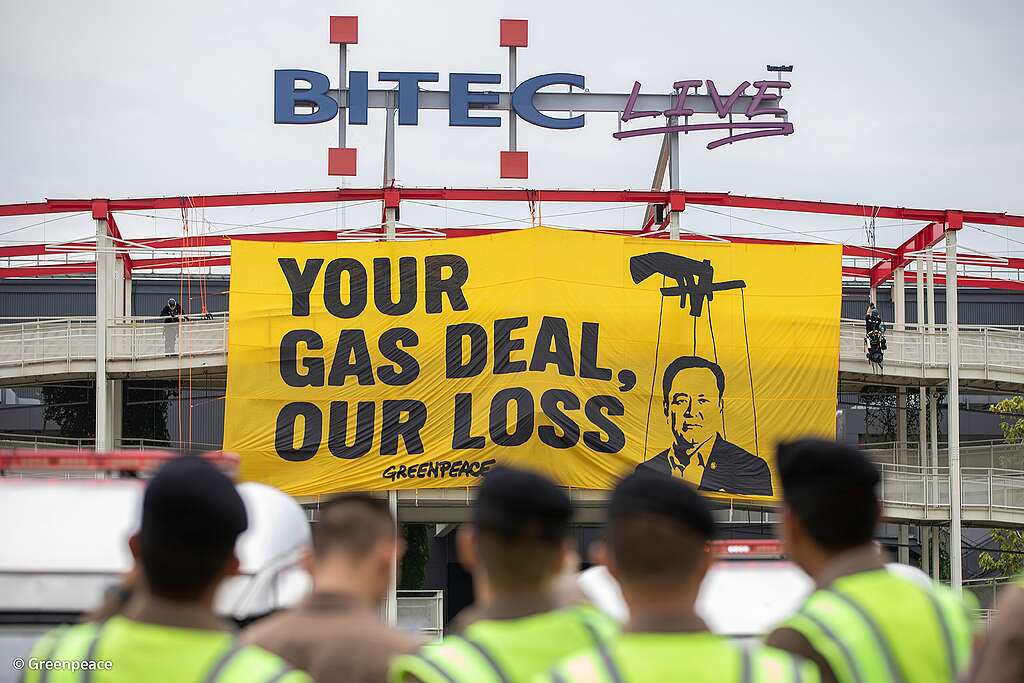
BANGKOK, THAILAND, 14 September 2026 – Greenpeace Thailand activists unfurled a 17-by-7-meter banner with the message “YOUR GAS DEAL, OUR LOSS” at the opening of Gastech 2026 in Bangkok, calling out the Thai government and fossil fuel industry while challenging their promotion of fossil gas and LNG expansion as a solution for energy security, economic growth and the climate crisis.
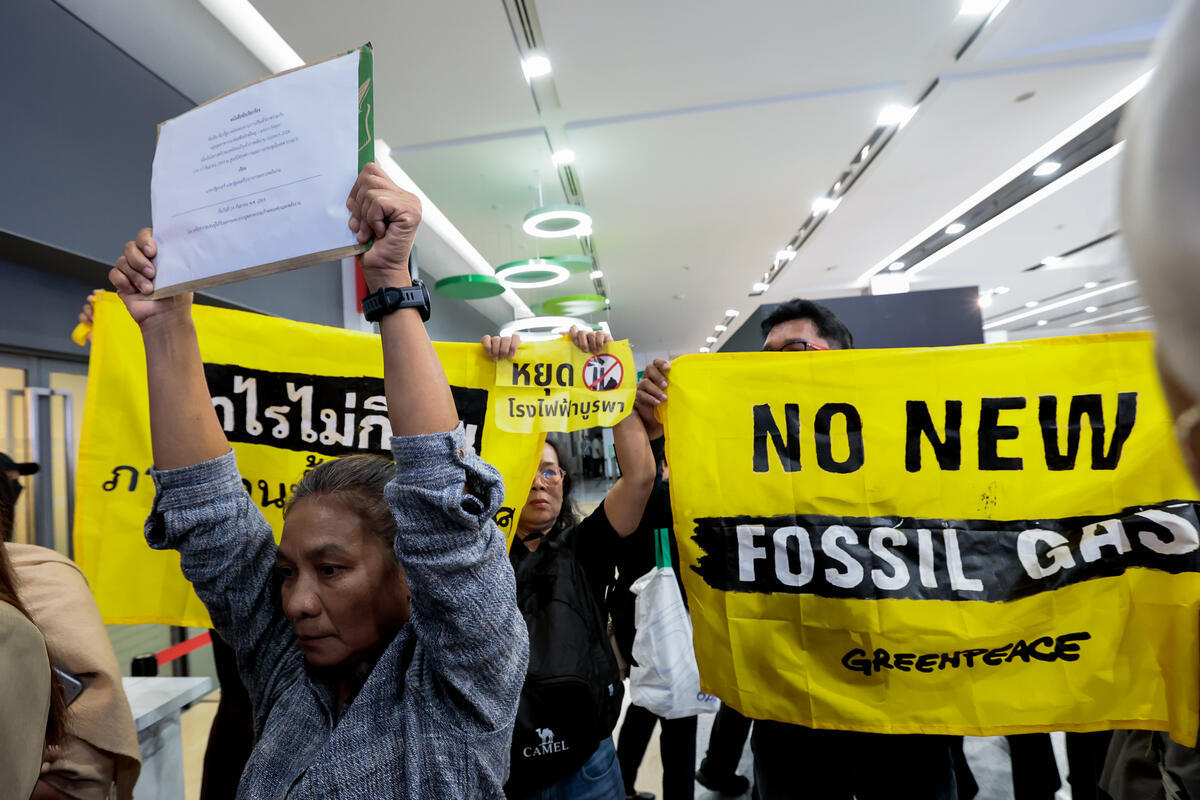
At the same time, Greenpeace Thailand campaigners and representatives from communities in Chachoengsao, Prachinburi and Rayong provinces attempted to deliver an open letter directly to Prime Minister Anutin Charnvirakul, calling on the Thai government to reconsider its approach to fossil gas expansion. The communities have previously raised their concerns with the authorities, the communities have yet to see meaningful dialogue or response. At Gastech 2026, they were again not given the opportunity to hand the letter directly to the Prime Minister.
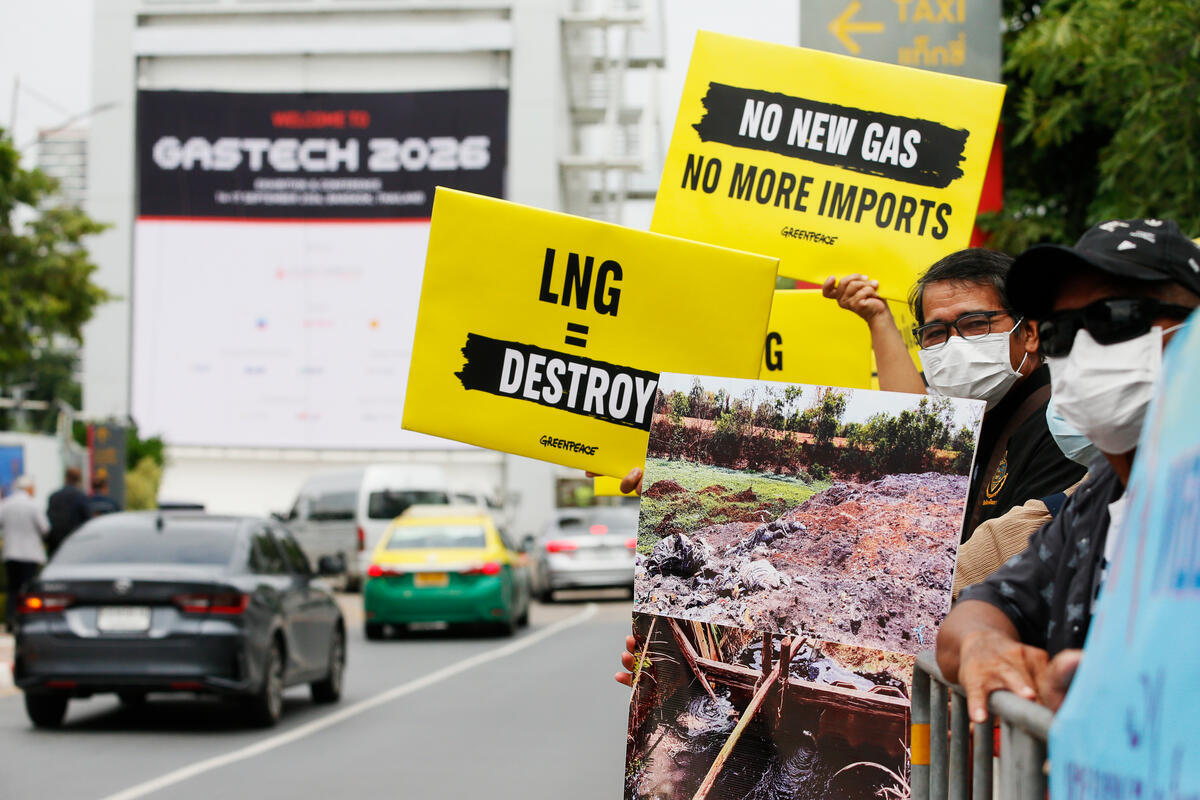
More than 200 community members from the three eastern provinces gathered in front of BITEC Bangna to highlight environmental and social impacts they have experienced from fossil gas development, and demanded a just transition towards clean and renewable energy.
As the host of Gastech 2026, the Thai government, led by the Ministry of Energy, alongside major state-owned and major energy companies, has brought together global fossil fuel executives, investors and policymakers. At the conference, fossil gas and LNG are being promoted as essential to meeting growing energy demand, including emerging demand from AI and data centres, strengthening energy security and driving economic growth, while technologies such as Carbon Capture and Storage (CCS) are presented as part of the response to the climate crisis.
Greenpeace organisations across Southeast Asia, East Asia and Australia Pacific together with their allies, reject this framing, warning that false climate solutions such as CCS could prolong fossil gas expansion rather than delivering a genuine just energy transition. New gas infrastructure and long-term contracts would deepen reliance on fossil gas and expose Thailand and other Asian economies to volatile global markets, while delaying investment in renewable energy and resilient power systems.
This comes as Thailand itself is confronting the risk of dependence on imported LNG. Recent geopolitical disruptions and LNG price volatility have prompted the government to accelerate renewable energy, including a major rooftop solar initiative aimed at reducing exposure to global fuel price shocks. Fossil gas still provides more than 60 % of Thailand’s electricity, and the government is also pursuing new domestic gas supplies and long-term LNG contracts.
For communities in eastern Thailand, these impacts are already a lived reality. Across Rayong, Prachinburi, and Chachoengsao, residents face the expanding footprint of LNG terminals, gas transmission pipelines, and gas-fired power plants. These developments have sparked widespread concerns among local communities about the impacts of fossil gas development on the environment, natural resources, safety, livelihoods, and quality of life. Their experiences expose the disconnect between the benefits of fossil gas promoted at Gastech 2026 and the environmental and social impacts experienced by communities on the ground.
The impacts of fossil gas extend beyond Thailand. Across the Asia-Pacific, the fossil gas industry is exposing communities to serious health impacts, rising energy bills, and climate disasters like heatwaves and floods. A vast amount of this gas comes from Australia, where fossil gas companies like Woodside Energy and Santos are pushing for new destructive projects, like the Browse project that would see up to 57 oil and gas wells drilled at Scott Reef, which risks a pristine marine ecosystem, and would emit 1.6 billion tonnes of climate pollution over its lifetime. These multinational gas corporations use exports to Asia as a key justification to pursue their destructive drilling.
As major gas financiers across the Asia-Pacific, Japan and South Korea continue to prop up regional fossil fuel markets through extensive public and private investments, long-term LNG commitments, and bilateral fuel-swap frameworks. Public finance from Japan remains a dominant driver of regional gas expansion, locking in fossil infrastructure under the guise of energy security. Meanwhile, in South Korea, surging electricity demand from AI data centers and semiconductor manufacturing is straining an overstretched power grid. Across the region, this rapid growth in AI-driven energy demand is increasingly weaponized as a pretext to expand gas-fired power, deepening fossil gas dependence and delaying the urgent shift to renewable energy.
Greenpeace organisations across the Asia-Pacific are calling on governments and energy companies attending Gastech 2026 to stop further fossil gas expansion and accelerate a just transition to renewable energy, directing investment towards renewable power, energy efficiency, storage and modernised power grids while ensuring that affected communities have a meaningful role in decisions about their energy future.
END
Quotes from Greenpeace and Local Communities Across the Asia Pacific:
Manun Wongmasoh, Climate and Energy Campaigner at Greenpeace Thailand, said:
“This conference could pave the way for even more Fossil Gas deals. Thailand’s draft power development plan 2026, presented by the Thai government just ahead of Gastech, clearly proposes 9,100 MW of new gas-fired power capacity within the first 10 years, partly to meet growing electricity demand from data centers and AI. This would inevitably drive further expansion of fossil gas infrastructure and long-term LNG import contracts, risking locking Thailand into fossil fuels and volatile global fuel markets for decades to come. Real energy security means reducing dependence on imported fossil gas and accelerating investment in renewable energy, storage and modernised power grids, in line with Thailand’s transition towards net zero. The government has a choice to make: it must choose a clean and just renewable energy future that puts people at the center and prioritises the public interest over the interests of the fossil fuel industry.
Yeonho Yang, Senior Climate & Energy Campaigner at Greenpeace East Asia, said:
“Exploiting global geopolitical instability to push long-term gas contracts is a false security trap. We’re now seeing AI-driven energy demand used to make the same case for more gas, but that’s a shortcut, not a fix. True regional energy security across Asia Pacific cannot be built on imported, volatile fossil fuels that drive climate breakdown. When investors and energy companies from South Korea and Japan finance and lock in LNG expansion across Southeast Asia, they compound climate risks and delay our collective transition to cheap, local renewable energy grids.”
Joe Rafalowicz, Head of Climate and Energy at Greenpeace Australia Pacific, said:
“From toxic chemical emissions to climate pollution and nature destruction, Australian gas exports threaten the lives and livelihoods of communities along the supply chain. While the world is clearly ready to move away from volatile, expensive, dirty gas, multinational gas corporations like Woodside Energy, which are speaking at Gastech, have different plans: they want to hook in new customers across Asia, and lock us into a future of climate disasters, nature destruction and pollution. There’s no future in gas. Our shared future is in clean, cheap renewable energy, and a safe, healthy environment where the places we love are protected.”
Gun Tattiyakul, representative of the Chachoengsao REPower Network and Fossil Free Thailand, said:
“Our community is facing growing risks from the 600 MW Burapha fossil gas power plant, which is currently under construction. For more than two years, we have opposed the project and called for it to be suspended, yet our concerns have not been meaningfully addressed. We remain deeply concerned about its environmental and climate impacts, as well as growing competition over water, especially during droughts and El Niño events. Water is central to our livelihoods and agriculture, from rice farming to Nam Dok Mai mango orchards, an important GI product of Chachoengsao. Chachoengsao is part of the Eastern Economic Corridor (EEC), where communities are already facing continued industrial expansion, yet we have not seen a comprehensive assessment of the cumulative impacts on pollution, water resources, health, and local livelihoods. Development should not allow businesses to reap the benefits while local communities are left to bear the costs of pollution, environmental risks, and the loss of the resources we depend on.
Lamom Boonyong, Chairperson of the Pak Nam Ban Rao Local Fishers’ Organization, Mueang Rayong District, Rayong Province, said:
“Communities in Rayong have lived alongside industrial development for decades and have experienced repeated environmental impacts, from industrial pollution to oil spills. For fishing communities, damage to the marine environment and declining marine resources directly affect our livelihoods and household income. The expansion of LNG terminals and related infrastructure, including land reclamation, adds further pressure to a sea that is already under stress. We are concerned that continued fossil gas expansion will only add to the burden carried by our communities.”
Oracha Chandej, Representative of the Prachinburi Strong Network, said:
“Prachinburi is already surrounded by energy and industrial infrastructure, including gas pipelines crossing agricultural land, biomass power plants, and industrial waste-to-energy facilities. The push to include Prachinburi in the Eastern Economic Corridor (EEC) has raised even greater concerns among communities that the expansion of industries and corporate investment without strong environmental governance could further worsen the pollution and toxic contamination that local people are already facing. Between 2017 and 2025, more than 30 incidents of illegal wastewater discharge and industrial waste dumping were reported in Prachinburi. For organic farmers who depend on clean water and healthy, fertile soil for their livelihoods and agriculture, our concern is that increasing pollution could cause us to lose these vital resources in the future. Industrial development, particularly the expansion of the fossil fuel industry, should not generate profits for businesses while leaving local communities to bear the pollution, loss of natural resources, and environmental costs for the rest of their lives.”
Notes
[1] Asian Civil Society Joint Statement for Gastech 2026
[2] Thailand Local communities statement for Gastech 2026
[3] Images and footage can be found here
Media Contact:
Somrudee Panasudtha, Senior Communications Campaigner,
Greenpeace Southeast Asia (Thailand Office),
+66 81 929 5747, [email protected]g