


During the full-scale invasion, as Russia continues systematic attacks on Ukraine’s energy infrastructure, communities across the country are searching for ways to remain resilient and autonomous. In this crisis, green energy has become a reliable and sustainable solution. At the same time, 62% of Ukrainian companies report a shortage of technical workers — while the share of women applying for technical professions during the war has grown from 5% to 15%. It is at the intersection of these challenges and opportunities that the project “Solar Women Power” emerged. By training 30 women on how to install solar panels, the project brought hope and empowerment to women and green energy to Ukraine. And now, the project is evolving further: participants from the “Solar Women Power” – training are bringing solar power to Ukrainian Hospitals. Others even started their own Solar Lab to spread solar knowledge in their regions and engage more people in installation work.
The “Solar Women Power” project was implemented by Women in Tech Ukraine and Greenpeace Ukraine, in cooperation with the humanitarian organization People in Need and with the financial support of the Czech people.
The “Sun for Ukraine” Hospital project was implemented by Greenpeace Ukraine and supported by the German BIOHAUS-Foundation as a donor.
“Solar Women Power 2.0”: Graduates Bringing Solar Power to Hospitals
The most vivid indicator of the “Solar Women Power” project’s success is that learning does not end with certificates. Graduates are already working on real installations in communities.
In Chortkiv (Ternopil region), two graduates joined a team of energy engineers to install two solar power plants with a total capacity of 50 kW for the local hospital. The systems will power the maternity ward (30 kW) and the infectious disease ward (20 kW), generating up to 50,000 kWh per year and saving the hospital more than 400,000 UAH (≈ 8 200 €) annually.
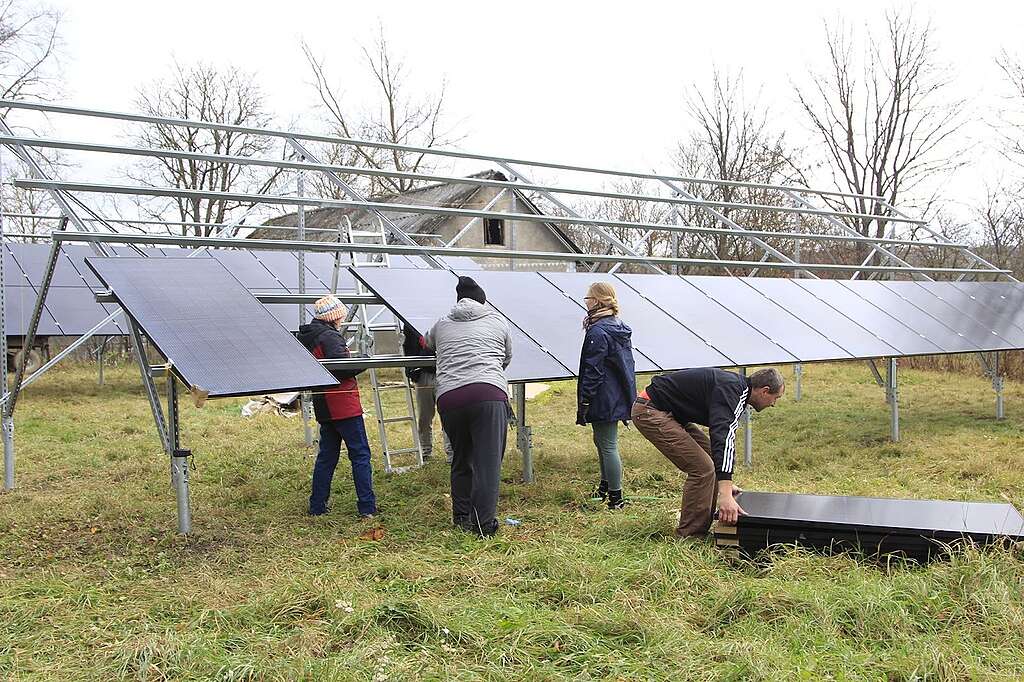
One graduate, Svitlana Shyian, previously worked in the hospitality sector: “The Greenpeace training was a real gift. Green energy is freedom and the future. We assembled the entire station ourselves — and I realized I want to develop my own solar business. It’s a job that gives energy — both literally and symbolically.”
Her colleague, Maryna Skrypnyk from Anthracite, now living in Kharkiv, is the widow of a fallen soldier of the 93rd Brigade. After her husband’s death, she realized that she wanted to work on meaningful projects that would help Ukraine succeed in the future: “This past year has been a year of transformation for me. I challenged myself — to learn how to install solar plants. The Chortkiv hospital is my first hands-on project. I hope it’s just the beginning. Renewable energy is the future, especially now, when the enemy systematically attacks our energy infrastructure. We must be autonomous.”
Another graduate, Tetiana Lukaniuk from Ivano-Frankivsk, a student of Renewable Energy Engineering, completed her internship at Nadvirna Central District Hospital, helping install a 50 kW solar station. The hospital serves around 100,000 patients per year, including over 1,500 internally displaced people.
“We don’t have another planet. We must take care of this one. And renewable energy is the best path to sustainability and energy independence”, says Tetiana.
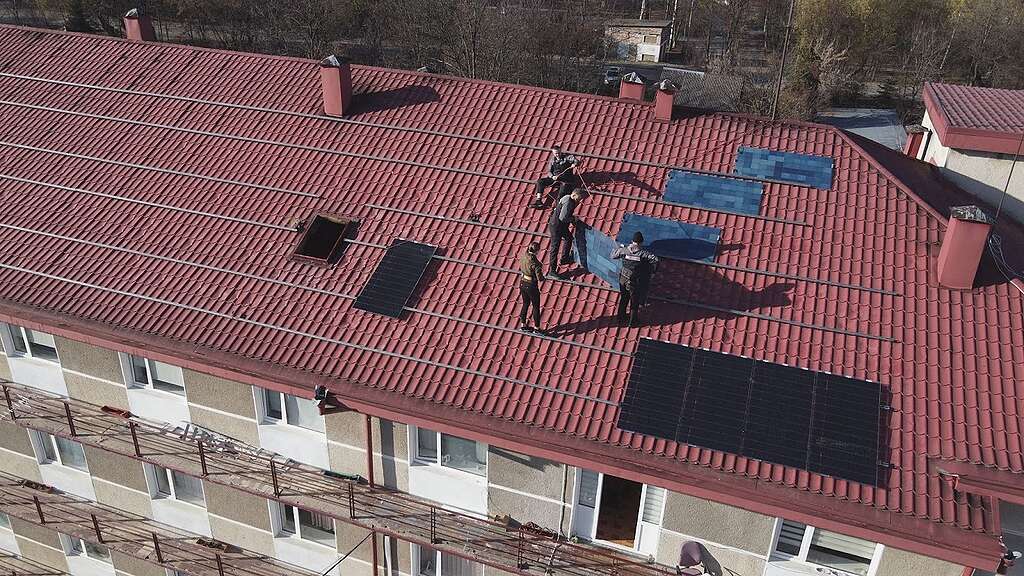
Chortkiv and Nadvirna are just the first examples. Other hospitals that received equipment through the “Sun for Ukraine” competition by Greenpeace Ukraine and the BIOHAUS-Stiftung (Germany) will also become training sites for graduates. Women installers are already preparing for new deployments to support critical infrastructure across communities.
Kharkiv Solar Lab: When Graduates Begin Teaching Others
The training course inspired graduates so much that many began thinking about how to spread solar knowledge in their regions and engage more people in installation work. One answer is the new Solar Lab in Kharkiv, created by graduates at a local vocational education institution. One of them, Elvira Arkhipova, an energy engineer and technology instructor, says:
“We have a digital learning center, modern equipment, 3D programs — and now, thanks to Greenpeace and the German foundation BIOHAUS — solar panels, inverters, tools. We modeled our lab after the Atmosfera Academy to provide high-quality training.”
The Kharkiv lab is oriented primarily toward women, internally displaced persons, veterans, and anyone interested in the profession. According to her, solar installation specialists are in very high demand in the region.
“I want women to believe in themselves, not to fear trying new things, and for society to move past stereotypes about ‘male’ and ‘female’ professions. Every woman is capable of far more than she thinks”, adds Elvira.
The team plans to complete an internship at a Kharkiv hospital that received solar equipment from Greenpeace — and then launch regular training courses in the lab.
“Solar Women Power” demonstrated that combining renewable energy, technical education, and gender equality creates a powerful impact. The stories of graduates prove that when women gain access to high-quality technical training and real-life practice, they become drivers of change in their communities — strengthening energy security, developing local businesses, and expanding educational opportunities.
The project team plans to continue supporting women in employment and involving them in new solar installations across the country — so even more Ukrainian communities can receive stable, clean energy, even in the most challenging times.
The “Solar Women Power” Training – how it all started
The “Solar Women Power” training started as a trial in 2024 and was repeated in 2025. The training was conducted in three waves, each bringing together up to 10 participants. In total, 30 Ukrainian women from five regions (Kharkiv, Lviv, Ivano-Frankivsk, Mykolaiv, and Dnipropetrovsk) mastered a new technical profession and joined the broader movement for social change in Ukraine.
The selection process was highly competitive. Initially, the organizers received about 150 applications, and after the announcement of the next wave — another 250 in less than a month. Despite the requirement to have a technical background, interest was overwhelming: hundreds of women from across Ukraine wanted to try themselves in the solar energy sector.
“The field was historically considered male, with clear gender imbalance. We wanted to see how appealing installation could be for women — and to support them. The number of applications amazed us. Ukrainian women are boldly taking on new roles. They are not just filling gaps — they are leading the change,” says Polina Kolodiazhna, Program Co-Lead at Greenpeace Ukraine and author of the project.
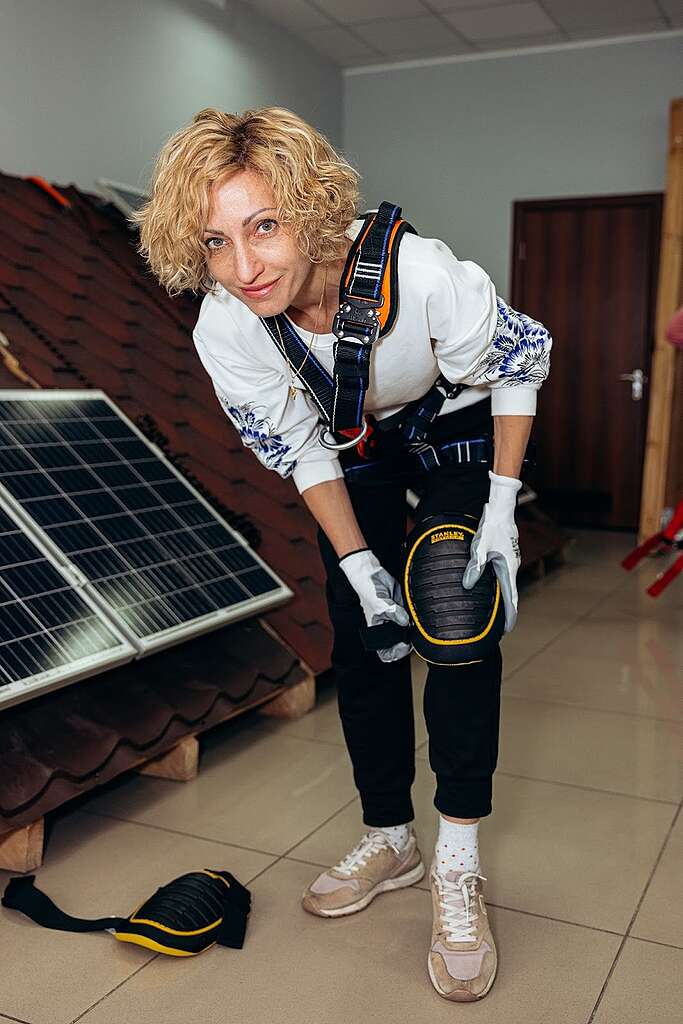
The course consisted of theoretical online modules and an intensive week of hands-on practice in Kyiv at the Atmosfera Academy. Participants worked in a modern training lab, practiced installation on roof mock-ups, assembled electrical circuits, configured inverters, and launched small-scale solar systems.
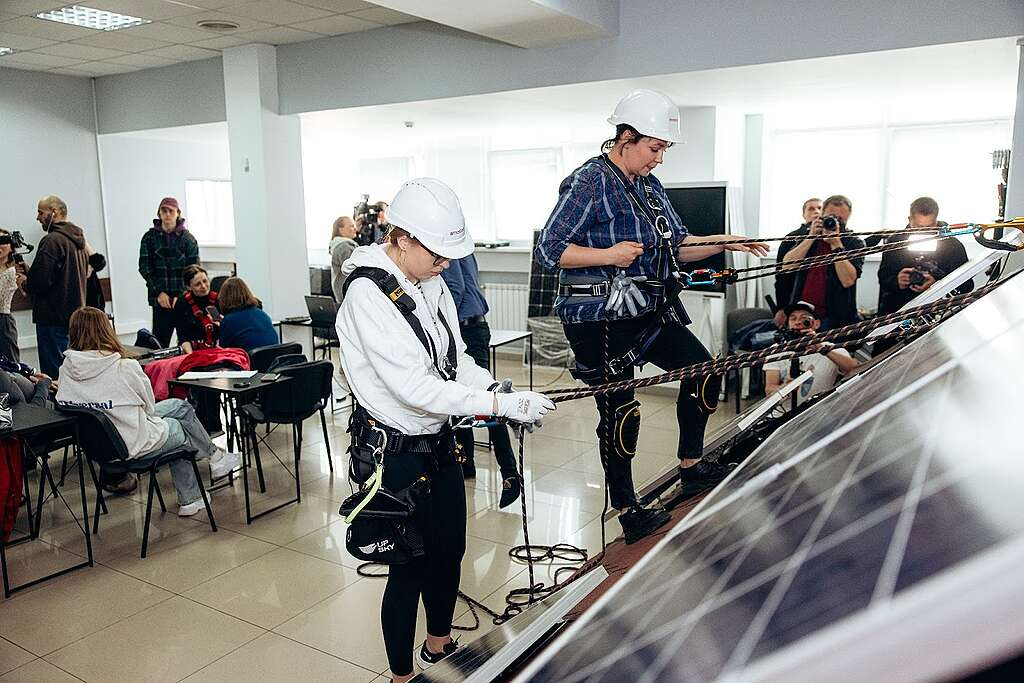
“Women often don’t believe in themselves. Our task is to show that they can”
A key goal of the project was not only to teach technical skills but also to help women gain confidence and envision themselves in new professional roles — as energy specialists, engineers, installers.
“Women often doubt themselves. They think they’re weaker or incapable. One of our tasks is to show by example that they can absolutely do this. When a woman assembles a solar station with her own hands — on a roof or in a lab — it breaks stereotypes much more powerfully than any motivational speech,” says Oksana Zabolotna, Co-founder and Director of Women in Tech Ukraine.
Many graduates experienced exactly that. For some, it was their first step into a technical field; for others, an opportunity to expand their existing profession.
Before the full-scale invasion, Nataliia from Mykolaiv worked as the chief energy engineer at a local industrial company. She was responsible for power supply and maintenance of systems, but had no experience with solar energy — the company had no solar installations.
After the war began, everything changed. Her company in Mykolaiv was destroyed by Russian forces. Other enterprises suffered from power outages, and the issue of energy independence and autonomous supply became critical. Nataliia came across the “Solar Women Power” program and decided to learn a new profession.
The training also helped her better understand how renewable energy works at home. She already had a small system — one solar panel, an inverter, and a battery — but didn’t fully understand how to operate it. “Now I clearly know how everything is installed, what each component does, and how to use the system properly,” she says.
These skills also became the foundation for future plans. Her husband, currently defending Ukraine in the army, has professional experience in installation and electrical work.
“At first he was skeptical, but when I began explaining what we were learning, he got interested. Now we’re discussing starting a family business in solar installation once he returns,” Nataliia adds.
Another graduate, also named Nataliia, 31, from Ivano-Frankivsk, works as a math tutor. Although her career in education is stable, she felt the need for change — to try something entirely new.
“I wanted a profession where I don’t work at a computer. Something hands-on. Something physical. Something meaningful” — She believes that women entering traditionally “male” professions is an important social shift and is proud to be part of it. Despite not engaging in physical labor in her daily life, the training was manageable:
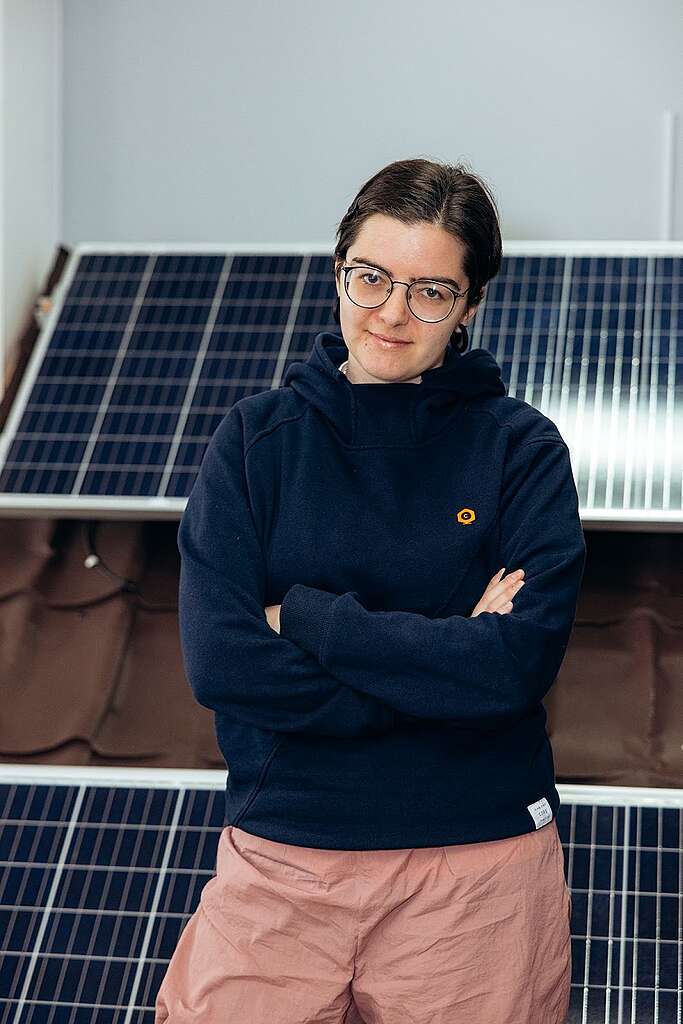
“I won’t say I’m in super shape, but physically it was totally fine. I have volunteer experience — working in all kinds of conditions, sometimes without basic comfort — and when you understand why you’re doing something, everything feels different.”
She is particularly motivated by the social impact of renewable energy, especially projects providing autonomous power for hospitals and social institutions: “This aligns with my values. I want to contribute to solutions that truly help people. And solar energy is exactly that.”

