
About us
Who we are
Greenpeace is a movement passionate about protecting the natural world from destruction. The network was founded in 1971 and now operates in sixty countries, with over 3 million supporters.
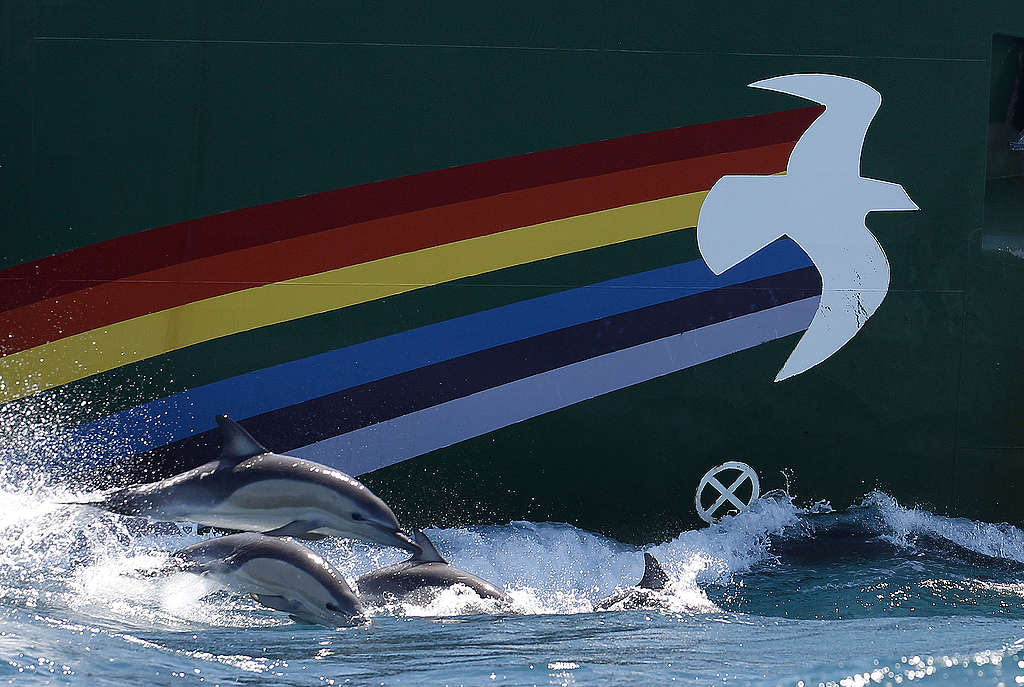
Greenpeace Network: A Legacy of Courage and Environmental Action
Greenpeace network’s history began with a courageous act in September 1971 in Vancouver. A small group of activists, driven by their passion for the environment, decided to stop a U.S. nuclear weapons test. They sailed to Amchitka Island off the coast of Alaska on an old fishing boat named “The Greenpeace.”
This act of bravery has since inspired millions, leading to the organization’s growth to over three million supporters worldwide and a network of environmental activists in more than sixty countries.
In 1975, the initial organizing body of the Greenpeace global network of independent organizations opened its first actual office in Vancouver and launched its most famous campaign, the defense of whales. After centuries of intensive and indiscriminate hunting, many whale species were at risk of extinction without intervention. The decision by the Greenpeace network to directly confront the whaling ships was a bold move that changed the course of history. Activists positioned inflatable dinghies between the whales and the ships to block the harpoons, creating iconic images of harpoons narrowly missing activists and striking the whales instead. Crowds greeted the crew of the Phyllis Cormack upon their return to port, and in 1982, the International Whaling Commission voted to adopt a moratorium on commercial whaling, a decision that remains in effect today.
Since the first campaign, the Greenpeace network has grown significantly, and so has the number of environmental protection actions worldwide. Its mission is to promote radical changes and new solutions to how we live on this planet so that we can all call it home for generations.
Greenpeace Austria: Facilitating Regional Cooperation
After the collapse of the Eastern Bloc and the fall of the Berlin Wall in 1989, the Greenpeace network expanded into the countries of the former Eastern Bloc. Greenpeace Austria played a crucial role in this effort. Since 2000, Greenpeace Austria has facilitated regional cooperation among other Greenpeace organizations in Central and Eastern Europe, including Greenpeace Bulgaria, Greenpeace Poland, Greenpeace Hungary, Greenpeace Croatia, Greenpeace Romania, Greenpeace Slovenia, Greenpeace Slovakia, and Greenpeace Ukraine (since 2024).
Greenpeace Ukraine
Greenpeace Ukraine’s history dates back to the late 1980s, in response to the Chornobyl nuclear disaster. As one of the first international organizations to arrive in Ukraine, they aimed to establish a hospital for children affected by the Chornobyl disaster and equip it with the latest medical technology.
As a result, in 1989, the “Greenpeace Children of Chornobyl” project was launched to provide medical assistance to children in Ukraine. While the hospital was not open, Greenpeace Ukraine equipped a lab in one of Kyiv’s children’s hospitals. This lab was later donated to the city of Kyiv, and Canadian doctors assisted in training their Ukrainian counterparts. The unit, staffed by a pediatrician and lab technicians, screened children for blood deficiencies, working closely with the local pediatric system, which had been severely strained since the 1986 nuclear accident.
Additionally, Greenpeace Ukraine, alongside other environmental organizations, established an independent environmental laboratory to investigate radioactive contamination of soil, food, and water in the Chornobyl area.
The Critical Years and Protests
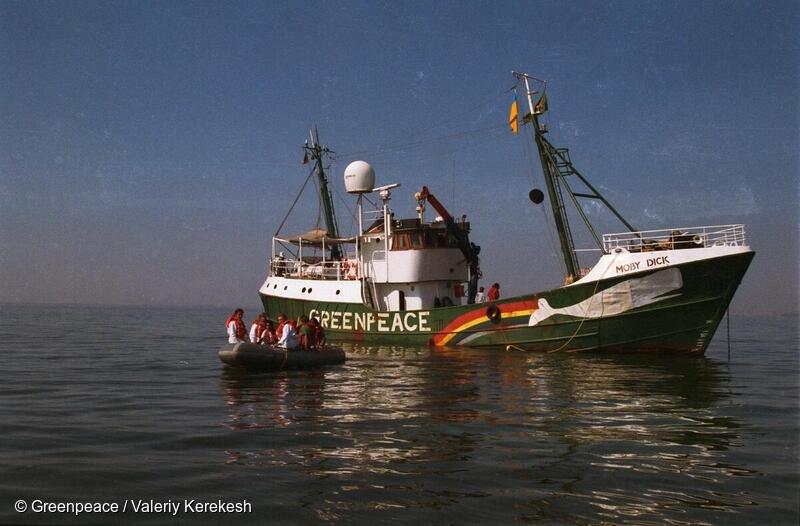
The late 1980s and early 1990s were critical times for environmental activists. In 1993, Greenpeace activists in Ukraine chained themselves near the entrance of the German embassy in Kyiv to protest toxic waste imports, as thousands of tons of toxic waste were exported to Ukraine from Germany every year. Activists also launched many actions against the construction of new nuclear power plants in Ukraine. In 1994, Greenpeace activists from the ship Moby Dick protested against the expansion of the Zaporizhzhia nuclear facility by hanging a banner on the cooling towers. It was the first time a “Greenpeace” ship came to Ukraine to support the activists.
In 1994, Greenpeace Ukraine activists picketed the Kyiv City State Administration, demanding that Kyiv residents have access to clean drinking water. According to research, at that time, the chlorine content in drinking water exceeded the norm several times. They installed a giant crane and a banner with demands in front of the Kyiv City Administration to draw attention to the water quality problem in Kyiv. The campaign partially succeeded as the Kyiv authorities began considering alternative water purification methods in the capital. However, they did not switch to oxygen purification technology, as Greenpeace Ukraine demanded.
A New Era: Responding to Crisis
A new era of organizational work began as a response to Russia’s full-scale invasion of Ukraine. In 2022, Greenpeace Austria launched the “Greening Ukraine Reconstruction” project, advocating for a green recovery and showcasing best practices in eco-reconstruction. Despite not having an organization in Ukraine, Greenpeace Austria, with other regional organizations, completed the reconstruction of the heating system in Horenka Hospital and Hostomel kindergarten, launched two research missions to Chornobyl, and continued to monitor the situation at the Zaporizhzhia nuclear power plant while advocating for sanctions against Rosatom.
In September 2024, Greenpeace Ukraine officially restarted its work in the country.

