Lokolama — 4 December 2025. Greenpeace Africa has completed a community training exchange on agroecology and beekeeping in Lokolama, Equateur Province, bringing together Indigenous Peoples and Local Communities (IPLCs) from the villages of Lokolama and Penzele. The initiative aims to advance food sovereignty, increase climate resilience, and safeguard the Congo Basin’s forests and peatlands — some of the world’s most essential carbon stores.
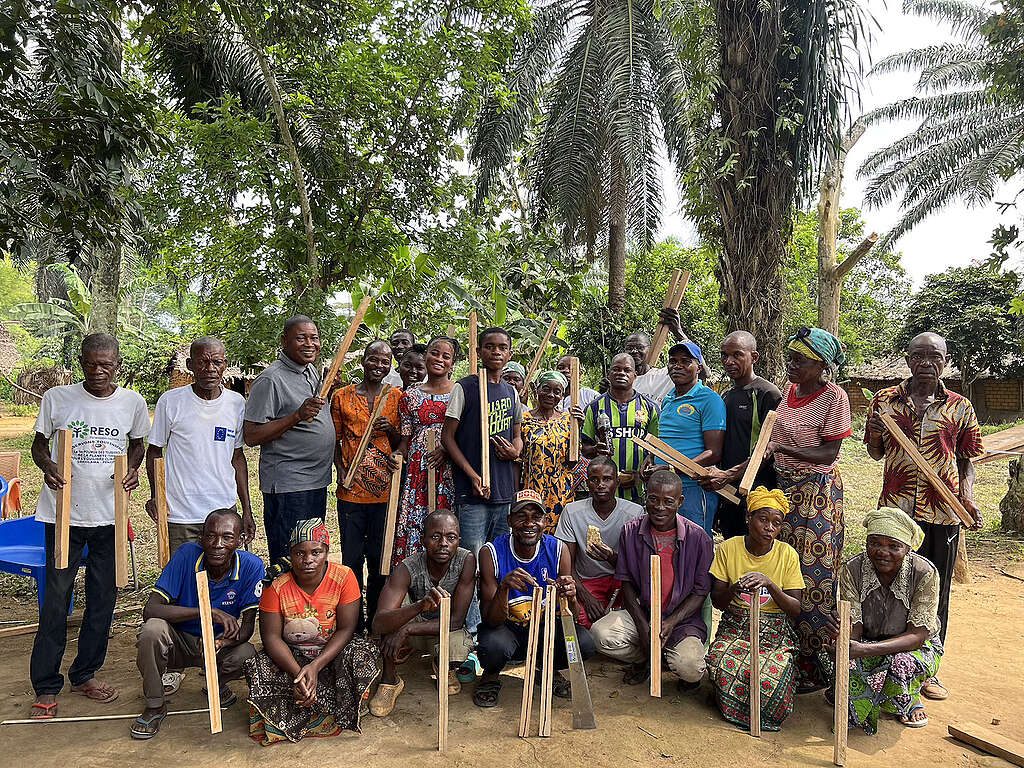
This hands-on training deepened a collaboration first established in April during a community experience-sharing workshop. With growing interest from local leaders and community members, the sessions focused on developing sustainable livelihood strategies rooted in Indigenous knowledge and ecological practices.
Agroecology Training: Strengthening Food Sovereignty
Participants received practical and theoretical training in agroecology, enhancing their understanding of sustainable agriculture, soil protection, and climate-resilient farming techniques. These skills aim to reduce community dependence on forest resources while improving food security.
Despite challenges — including limited training time and difficulties accessing quality seeds — the session succeeded in reinforcing community capacity and motivation for ecological farming.
Beekeeping: A Pathway to Income Diversification and Forest Protection
The beekeeping component, facilitated by local experts, combined traditional Indigenous knowledge with modern sustainable techniques. Participants engaged in:
- theoretical sessions on hive construction, site selection, and seasonal dynamics,
- practical construction of 20 community beehives,
- installation of two experimental beekeeping sites (10 hives per village).
This initiative will serve as a local training hub, ensuring that skills are passed on within the community and providing a long-term source of income while reducing pressure on forest ecosystems.
Women’s participation was strongly encouraged despite the physical nature of the activities — an important step in strengthening gender inclusion within local forest governance.
A Model of Community-Led Climate Solutions
Greenpeace Africa emphasizes that supporting Indigenous and local communities is fundamental to protecting the Congo Basin. Through agroecology and beekeeping, communities are equipped to take concrete action in defense of their forests while securing sustainable livelihoods.
This participatory training was “highly appreciated by the communities and marks an important step in promoting local forest solutions and strengthening self-determination,” according to the field report.
A total of 20 participants took part in the training, with strong representation from young people and women.
Next Steps
To consolidate progress, Greenpeace Africa recommends:
- a follow-up mission by February 2026 to assess hive colonization and honey harvesting timelines,
- a second phase of training on honey extraction, packaging and commercialization,
- support for community governance structures to manage local forest concessions,
- more time on the ground for monitoring and mentorship.
END
Contact:
Raphael Mavambu, Communication and Media, [email protected], Greenpeace Africa