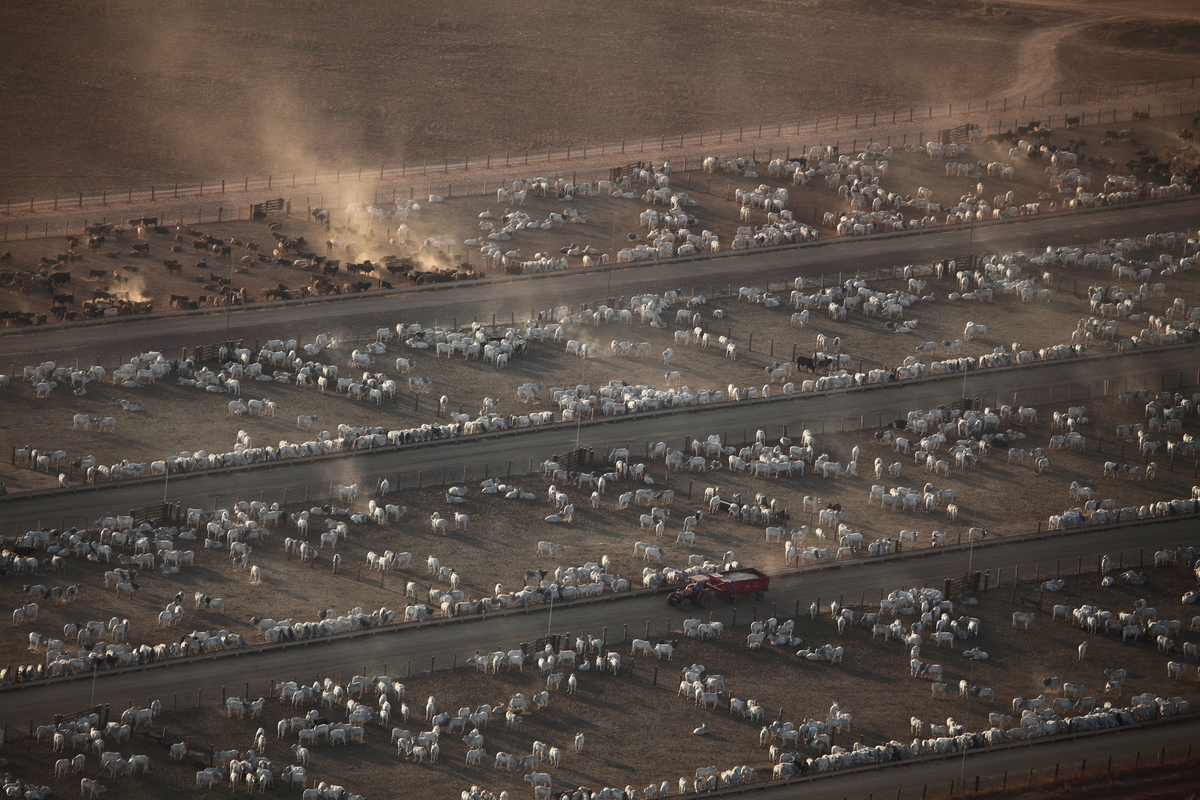
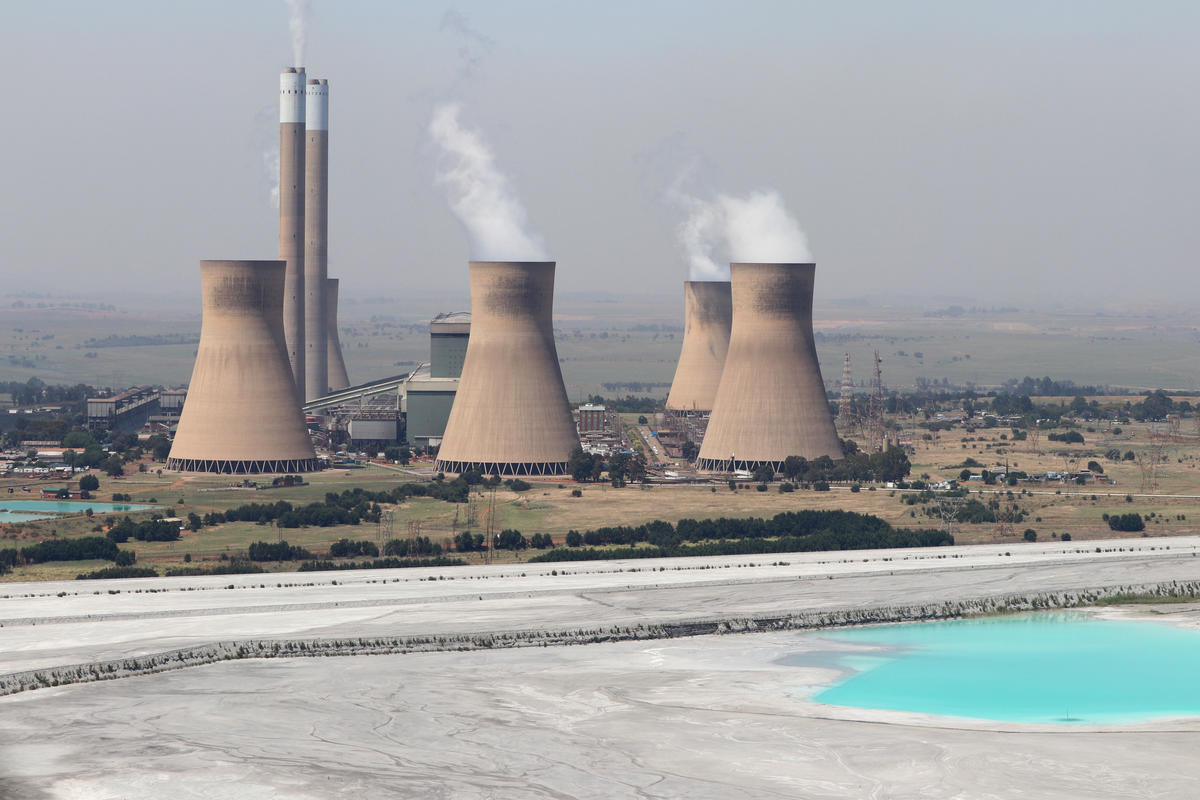
AMSTERDAM, Netherlands, 30 April 2026 – Greenpeace Netherlands has taken the first step towards legal action against meat giant JBS, demanding disclosure of information on its climate, nature and human rights impacts in order to challenge in court its business policies, including its planned US$6 billion global expansion, of which almost half is for Nigeria.
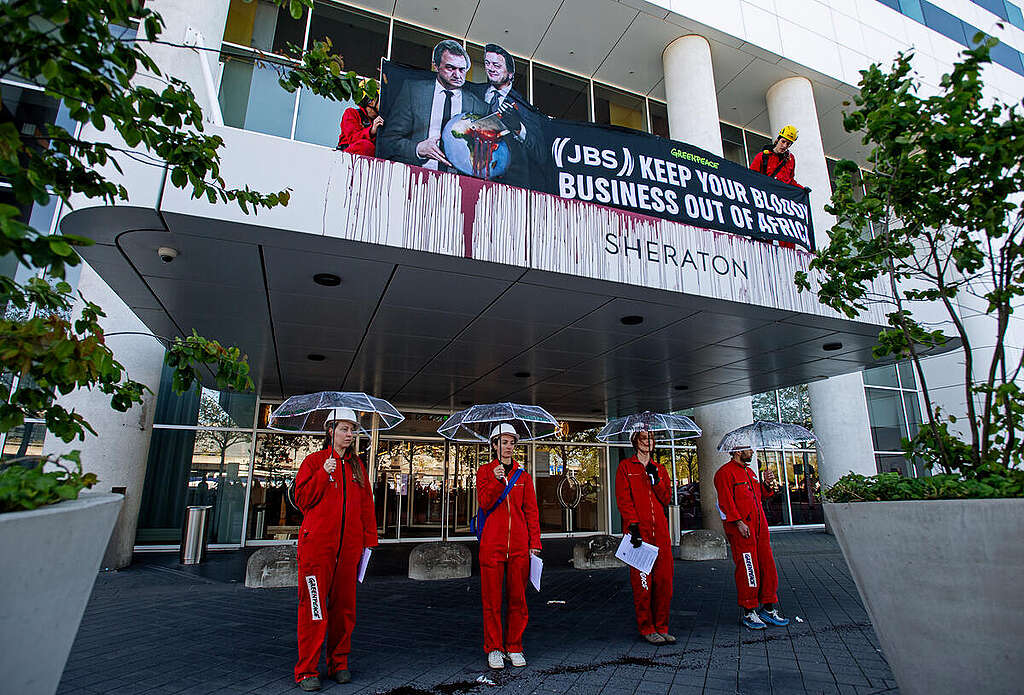
Just hours later, Greenpeace Netherlands activists shut down JBS’ first shareholder meeting in the Netherlands since relocating to the country last year. Activists from across Europe disrupted the meeting at the Sheraton Hotel at Amsterdam’s Schiphol Airport, installing a banner bearing the slogan ‘JBS: Keep Your Bloody Business Out of Africa’, which rained fake blood over the entrance to the hotel.
Inside the hotel, a 10m x 15m banner featuring JBS’ majority shareholders, Brazilian billionaires Joesley and Wesley Batista, was unveiled in the 8-story hotel atrium. Activists then entered the conference room where the meeting was taking place, leading to the suspension of the meeting.
Elizabeth Atieno, Food Campaigner at Greenpeace Africa, said: “The growth of JBS’ meat empire has been hand-in-glove with environmental destruction, colossal emissions, human rights scandals, corruption, and a lack of transparency. Now it plans to export this business model to other sub-Saharan Africa countries. As well as locking-in spiralling emissions for decades to come, JBS’ expansion in Nigeria threatens to cause irreversible environmental damage and displace smallholder farmers to line the pockets of wealthy international elites.
“Nigerians know well from the legacy of companies like Shell the destructive impact wrought by unchecked corporate power. This legal intervention affirms that corporations have obligations to transparency and human rights regardless where they operate in the world. The time of extractive industries operating with impunity on this continent is over. We must stop this new wave of destruction before it starts.”
In a legal letter delivered to the Amsterdam headquarters of JBS parent company JBS N.V. this morning, Greenpeace Netherlands’ lawyers set out multiple alleged breaches by JBS of Dutch law stemming from the extensive emissions and long history of environmental damage and human rights abuses linked to its business. JBS’ expansion plans risk further exacerbating these harms, it argues, raising serious concerns that expansion will be inconsistent with the company’s climate and biodiversity obligations and represent a continued breach of Dutch duty of care, which requires companies to act in line with international human rights law. [1]
Under new legislation that allows access to data held by Dutch companies for the purpose of bringing litigation, the letter demands that JBS disclose within three weeks assessments it holds relating to the climate, nature and human rights impacts of its historic operations and its planned expansion. Should the company fail to comply, Greenpeace Netherlands is entitled to seek the required information in the form of documents and from senior JBS figures under oath, raising the prospect of the Batista brothers being forced to testify in Dutch court.
Marieke Vellekoop, Executive Director at Greenpeace Netherlands, said: “JBS was warned that if it brought its bloody business to the Netherlands, we would do everything in our power to ensure it complies with Dutch law. Today, we are following through on that promise.
“JBS’ six billion dollar global expansion is following its usual playbook: peddling empty promises, refusing transparency and sidelining communities. Greenpeace Netherlands’ innovative legal intervention forces JBS out of the shadows, exposing its historic and ongoing destructive impacts and laying the ground for a first major climate and nature lawsuit against the predatory expansion of the global meat industry.“
In November 2024, JBS announced an agreement with the government of Nigeria for US$ 2.5 billion investment over five years comprising the construction of six meat-processing plants.[2] Civil society groups in Nigeria have raised serious concerns, citing environmental, health, and social risks associated with industrial animal farming, which is yet to establish a foothold in Africa.[3]
“We have seen this before,” said Elujulo Opeyemi, Executive Director at Youth in Agroecology and Restoration Network (YARN), on behalf of Nigeria’s Climate Justice Movement. “A foreign company arrives with big promises: jobs, development, progress, and instead leaves a trail of destruction whose price communities pay for decades. The Niger Delta is our reminder of what happens when governments open the door to destructive corporations without asking the hard questions first. We are asking those questions now, and we expect answers before a single plant is built.”
There is no available evidence that JBS has conducted any environmental and social impact assessments or consultations with communities and other stakeholders in Nigeria, and efforts by civil society to gather more information via Freedom of Information requests have reportedly been ignored.[4] Last month, Greenpeace Africa submitted an amicus curiae brief before the African Court on Human and Peoples’ Rights arguing that allowing multinational corporations to expand without meaningful environmental safeguards constitutes a failure of the State’s duty to protect human rights. The brief points specifically to JBS’ Nigeria expansion as an example.
In June 2025, JBS concluded a decade-long effort to list shares on the New York Stock Exchange. As part of the listing, JBS reconstituted as a Dutch company, moving its headquarters from Sao Paulo to Amsterdam. Before the listing, Greenpeace International warned JBS shareholders that it would ‘do its part to make sure JBS operates within Dutch law’.
ENDS
Photos and videos available from the Greenpeace Media Library.
Notes:
[1] This follows a similar legal reasoning to the recently filed Milieudefensie v Shell case. Media briefing with further details on the legal letter and JBS’ global expansion plans, including in Nigeria. Full letter available here. (Greenpeace Netherlands)
[2] JBS announcement
[3, 4] Experts raise concerns over the risks of industrial animal farming (The Sun Nigeria)
Contacts:
Joe Evans, Agriculture Global Comms Lead at Greenpeace UK, +44 7890 595387, [email protected]
Valerie Kierkels, Press Officer at Greenpeace Netherlands, +31621296895, [email protected]
Ferdinand Omondi, Communications and Storytelling Lead at Greenpeace Africa, +254 722 505 233, [email protected]
Greenpeace International Press Desk, +31 (0)20 718 2470 (available 24 hours), [email protected].