A very small group of ultra-wealthy individuals is associated with disproportionate costs of climate harm, driven alarmingly by their ownership of and investments in high-emitting activities alongside their carbon-intensive lifestyles, a new Greenpeace Africa report revealed. The report illustrates (in $) the sheer enormity of this climate responsibility and the huge concentration by the world’s ultra-wealthy, suggesting this should factor into the debate on ‘who should pay’ for the climate crisis.
In 2022, the investments of the world’s richest 0.01% were associated with an estimated US$992 billion in what the report describes as climate debt – the monetised climate damages associated with emissions exceeding an equitable share of the remaining carbon budget consistent with a 1.5°C pathway. By comparison, the report estimates the consumption-based climate debt of the world’s richest 0.01% at US$405 billion in 2022.
Key takeaways from the report:
- Climate debt is highly concentrated at the very top of the global wealth distribution. As wealth concentration increases, so too does the scale of associated climate debt.
- Ownership-based emissions – those linked to investment portfolios and capital holdings – are considerably more concentrated among the wealthiest groups than consumption-based emissions, highlighting the growing role of capital ownership and investment structures in driving highly unequal climate responsibility.
- Ownership-based climate responsibility and extreme wealth concentration are heavily concentrated among wealthy groups and some jurisdictions, while the countries facing the greatest climate vulnerability, climate damage, or climate finance needs are often located elsewhere.
Greenpeace International is calling on governments to integrate the polluter-pays principle into climate and fiscal policy frameworks and to commit under the UN Tax Convention (UNFCITC) to effective taxation of ultra-high-net-worth individuals and major corporate polluters, including through legally binding rules on taxing rights, transparency and measures to combat tax abuse.
As climate finance needs continue to grow, discussions under the United Nations Framework Convention on Climate Change (UNFCCC) and the UN Tax Convention should increasingly be seen as complementary processes to help mobilise the resources needed for climate action and sustainable development.
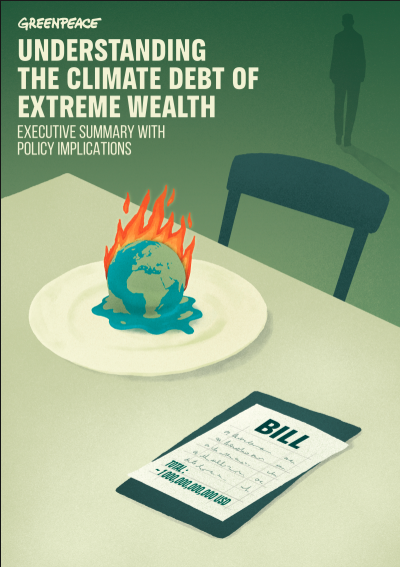
REPORT
Understanding the climate debt of extreme wealth
You can also read executive summary here.
Frequently asked questions
What is climate debt?
Climate debt refers to the estimated monetised climate damages associated with emissions that exceed an equitable share of the remaining carbon budget consistent with a 1.5°C pathway.
This report estimates climate debt by looking at excess emissions and attaching a monetary value to the damage they cause.
What does “ownership-based climate debt” mean?
Ownership-based climate debt refers to the monetised climate damages related to being the owner of carbon-intensive assets and investments (stocks and shares, etc.), rather than to consumption (the responsibility for lifestyle-related climate damages).
In simple terms, it asks: who owns and profits from the industries and economic activities driving emissions?
Why focus on the super rich?
Because the report shows that climate debt is highly concentrated at the very top of the global wealth distribution.
The richest few (the global top 0,01% – individuals with wealth of approximately US$38 million or more) are associated with a disproportionate share of ownership-based emissions and climate debt. The findings suggest that for the ultra-wealthy, climate responsibility is linked not only to consumption, but significantly to the ownership of carbon-intensive assets and investments and that their estimated magnitude of scale is such that, if taxed, could contribute significantly to developing countries’ climate finance needs.
Is this about taxing ordinary people?
No.
This is not about taxing everyday people who are already struggling with rising costs, climate disasters, and broken systems.
This is about taxing extreme wealth and carbon-intensive investments so that those who have contributed most to the crisis help fund the solutions.
What can taxing extreme wealth fund?
Taxing extreme wealth could help fund renewable energy, climate adaptation, loss-and-damage responses, resilient infrastructure, public services, and support for communities most affected by climate change.
What can I do?
You can sign the petition, share the report, talk about climate debt, and join the call to tax extreme wealth and fund a greener, fairer future.
What are key terms and concepts used in the report and what do they mean?
Climate debt
Climate debt is defined as the excess emissions of a specific income or wealth group above an equitable-share benchmark. It is calculated by identifying emissions that exceed an equitable per capita share of the remaining carbon budget and multiplying these excess emissions by a social cost of carbon (SCC).
Excess emissions
Emissions attributed to an income or wealth group that exceed an equitable per capita share of emissions consistent with a 1.5°C pathway.
Equitable share
The equitable per capita emissions share under a 1.5°C pathway. Emissions above this level are treated as excess emissions.
Social cost of carbon (SCC)
An estimate of the economic damage caused by an additional tonne of CO₂ emissions. The report uses an SCC of US$283 per tCO₂ (2020), based on Moore et al. (2024).
Consumption-based emissions
Emissions attributed to individuals based on their consumption of goods and services, including emissions embedded in imported products. This approach captures the full carbon footprint of consumer lifestyles.
Ownership-based emissions
Emissions attributed to individuals based on their ownership of capital assets, such as shares in companies or stakes in private firms. The emissions generated by these assets are assigned to their owners, regardless of their personal consumption.
High-net-worth individuals (HNWIs)
The report applies the concept of climate debt to high-net-worth individuals (HNWIs), focusing on the top 10%, top 1%, top 0.1%, and top 0.01% of the global income and wealth distribution.
Ultra-high-net-worth individuals (UHNWIs)
In this report, the top 0.01% are referred to as ultra-high-net-worth individuals (UHNWIs). The wealth threshold for this group is US$38 million PPP.
Top 0.01%
Approximately 800,000 individuals when referring to the whole world population (or 556,000 adults when using adult-population wealth data).
Polluter-pays principle
The principle that responsibility for climate damages should be linked to responsibility for emissions. The report uses this principle as one of the foundations for applying climate debt to HNWIs.
Ability-to-pay principle
The principle that those with greater economic capacity should contribute more to addressing climate change and climate damages.
Climate vulnerability
The report uses the ND-GAIN Index to assess countries’ vulnerability to climate change and their readiness and capacity to adapt.
Climate finance
Finance for mitigation, adaptation, and loss and damage. The report compares the climate debt of extreme wealth with estimates of global climate finance needs