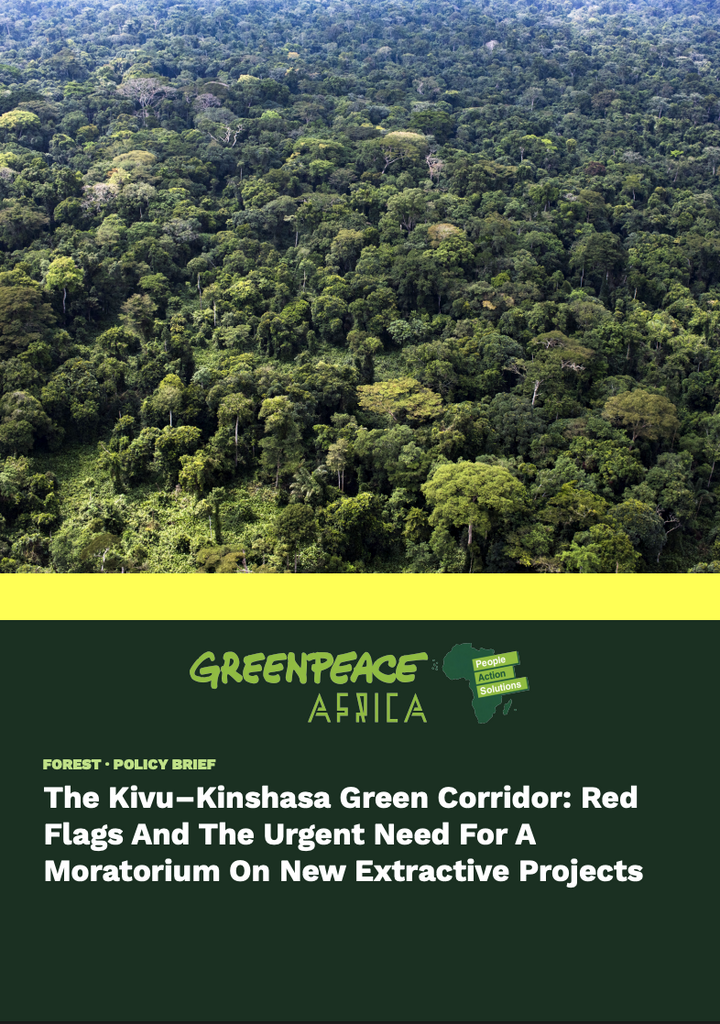
The Kivu–Kinshasa Green Corridor: Red Flags And The Urgent Need For A Moratorium On New Extractive Projects
Kinshasa, 27 July 2026 – Greenpeace Africa today launched The Kivu–Kinshasa Green Corridor: Warning Signs and the Urgent Need for a Moratorium on New Extractive Projects, exposing major contradictions between the Democratic Republic of the Congo’s (DRC) ambitious conservation agenda and the continued expansion of oil, gas and mining activities within one of world’s largest forest reserves.
Established in January 2025 as a flagship conservation and sustainable development initiative covering more than 544,000 km² (roughly the size of France), the Kivu–Kinshasa Green Corridor was designed to protect tropical forests, biodiversity, peatlands and the livelihoods of Indigenous Peoples and Local Communities. A 2025 spatial analysis revealed that 72% of the Green Corridor overlaps with oil blocks. New findings presented in this by Greenpeace Africa today further reveal that 23% of the corridor overlaps with existing mining concessions reinforcing concerns about cumulative impacts of extractive industries on forest, biodiversity and communities’ traditional territories while undermining the Kivu-Kinshasa Green Corridor’s conservation objectives.
Some alarming statistics include:
- 72% of the Green Corridor overlaps with oil blocks
- 12.3 million hectares of mining concessions lie within the Corridor
- 6.5 million hectares of carbon-rich peatlands are threatened by extractive activities
- 63% of community forests are located in areas under extractive pressure.
According to Greenpeace Africa, these findings significantly undermine efforts to position the Green Corridor as a global model for conservation.
“The Kivu–Kinshasa Green Corridor represents a unique opportunity for the DRC to become a global leader in conservation. But that ambition cannot be credible if new oil, gas and mining projects continue to advance at the very heart of the Corridor. The time has come for the government to send a clear political signal by declaring the Green Corridor a genuine No-Go Zone for new extractive activities,” said Bonaventure Bondo, Congo Basin Forest Campaigner at Greenpeace Africa.
The briefing also highlights major governance inconsistencies. This includes establishing the Green Corridor while simultaneously launching the 2025 licensing round for 55 oil blocks putting vast and sensitive biodiversity hotspots in line for fossil fuel projects and destruction, as well as legal and governance shortcomings that fail to adequately protect the rights of Indigenous Peoples and Local Communities.
“Indigenous Peoples and Local Communities cannot remain spectators in an initiative that is presented as community-centred. Their Free, Prior and Informed Consent, secure land rights and meaningful participation in decision-making must become the foundation of any credible conservation model in the Congo Basin,” said Bonaventure Bondo.
Greenpeace Africa urges the Government of the Democratic Republic of the Congo to officially designate the Kivu–Kinshasa Green Corridor as a No-Go Zone for future extractive activities through the adoption of a moratorium on new oil, gas, and mining projects. In addition, the Government should adopt and publish clear investment exclusion criteria to ensure that both public and private investments are not directed toward extractive activities within the Corridor. The organisation also urges the government to maintain the moratorium on new industrial logging concessions, and establish inclusive governance based on human rights and environmental integrity.
“The DRC is facing a historic choice. Either the Green Corridor becomes a global benchmark for rights-based conservation, or it risks becoming a symbol of the contradiction between climate commitments and extractive expansion. Greenpeace Africa calls on decision-makers, development partners, financial institutions and investors to choose coherence and put the protection of people and nature first,” said Bonaventure Bondo.
Through this policy briefing, Greenpeace Africa calls on the DRC Government, international partners, financial institutions, investors and civil society to engage in constructive dialogue to ensure that the Kivu–Kinshasa Green Corridor becomes a global model of sustainable governance, forest protection, biodiversity conservation, community empowerment and rights-based development.
**ENDS**
Contact:
Raphael Mavambu, Communication & Story-Telling Manager, [email protected], Greenpeace Africa