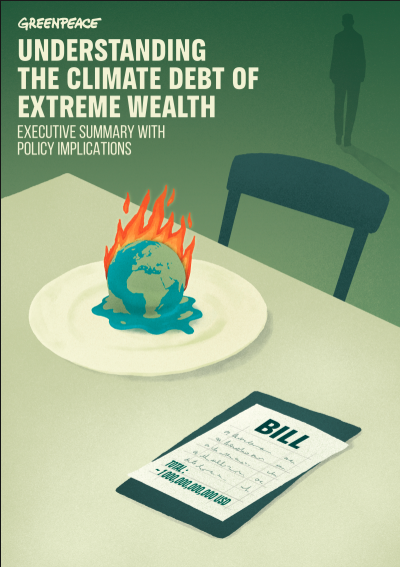
A very small group of ultra-wealthy individuals is associated with disproportionate costs of climate harm, driven alarmingly by their ownership of and investments in high-emitting activities alongside their carbon-intensive lifestyles, a new Greenpeace Africa report revealed. The report illustrates (in $) the sheer enormity of this climate responsibility and the huge concentration by the world’s ultra-wealthy, suggesting this should factor into the debate on ‘who should pay’ for the climate crisis.

In 2022, the investments of the world’s richest 0.01% were associated with an estimated US$992 billion in what the report describes as climate debt – the monetised climate damages associated with emissions exceeding an equitable share of the remaining carbon budget consistent with a 1.5°C pathway. By comparison, the report estimates the consumption-based climate debt of the world’s richest 0.01% at US$405 billion in 2022.

Key takeaways from the report:

  • Climate debt is highly concentrated at the very top of the global wealth distribution. As wealth concentration increases, so too does the scale of associated climate debt.
  • Ownership-based emissions – those linked to investment portfolios and capital holdings – are considerably more concentrated among the wealthiest groups than consumption-based emissions, highlighting the growing role of capital ownership and investment structures in driving highly unequal climate responsibility. 
  • Ownership-based climate responsibility and extreme wealth concentration are heavily concentrated among wealthy groups and some jurisdictions, while the countries facing the greatest climate vulnerability, climate damage, or climate finance needs are often located elsewhere. 

Greenpeace International is calling on governments to integrate the polluter-pays principle into climate and fiscal policy frameworks and to commit under the UN Tax Convention (UNFCITC) to effective taxation of ultra-high-net-worth individuals and major corporate polluters, including through legally binding rules on taxing rights, transparency and measures to combat tax abuse. 

As climate finance needs continue to grow, discussions under the United Nations Framework Convention on Climate Change (UNFCCC) and the UN Tax Convention should increasingly be seen as complementary processes to help mobilise the resources needed for climate action and sustainable development.
<!-- wp:paragraph -->
<p><strong>20 August 2025, New York, US</strong> - Governments have returned to the Global Ocean Treaty talks following the flurry of ratifications at the UN Ocean Conference in June. The Treaty is expected to reach the number of ratifications required for its entry into force in the coming months.</p>
<!-- /wp:paragraph -->

<!-- wp:paragraph -->
<p>The talks, known as the second BBNJ Preparatory Commission, taking place over the coming two weeks in New York, are an important moment to secure the ocean governance needed to achieve a network of ocean sanctuaries on the high seas. Governments must now agree on the process for creating the first protected areas under the Treaty if we are to protect 30% of the world's oceans by 2030.  A goal which scientists agree is absolutely necessary. </p>
<!-- /wp:paragraph -->

<!-- wp:paragraph -->
<p>Greenpeace and its allies are calling for the just and equitable protection of the ocean, and urging progress on priority sites in the Atlantic and across the globe. </p>
<!-- /wp:paragraph -->

<!-- wp:paragraph -->
<p>During the second day of the talks, Greenpeace held an event at the United Nations Headquarters in partnership with activists, scientists and indigenous community members. Together they made the case for large new protected areas of the high seas in the Atlantic, and across the globe, which could help to reach the 30 by 30 target. The event, featuring panellists from Bermuda, Nigeria, and Canada, demanded integrity in recognising and empowering local and Indigenous rights, allowing for co-governance rooted in both scientific and traditional knowledge. This grounded, inclusive approach will ensure these Marine Protected Areas are both ecologically robust and socially just. </p>
<!-- /wp:paragraph -->

<!-- wp:image {"id":58646,"sizeSlug":"large","linkDestination":"none"} -->
<figure class="wp-block-image size-large"><img src="https://www.greenpeace.org/static/planet4-africa-stateless/2025/08/0f5a2ed0-gp0su6ipp-1024x683.jpg" alt="UN Ocean Talks Side Event in New York. © Stephanie Keith / Greenpeace" class="wp-image-58646"/><figcaption class="wp-element-caption">The Greenpeace team poses for a photo. During the second day of the meeting of the Global Ocean Treaty Preparatory Commission, Greenpeace held an event at the United Nations Headquarters in partnership with activists, scientists and indigenous community members. Together they made the case for large new protected areas of the high seas in the Atlantic, and across the globe, which could help to reach the 30 by 30 target. The event, featuring panelists from Bermuda, Nigeria, and Canada, demanded integrity in recognizing and empowering local and Indigenous rights, allowing for co-governance rooted in both scientific and traditional knowledge. This grounded, inclusive approach will ensure these Marine Protected Areas are both ecologically robust and socially just.</figcaption></figure>
<!-- /wp:image -->

<!-- wp:paragraph -->
<p><strong>Noelle Young, Sustainability Solutionist & Environmental Justice Delegate from Bermuda, who spoke at the event, said:</strong> "The Sargasso Sea must become one of the first high seas marine protected areas under the High Seas Treaty.  It is one of the most studied, storied, and data rich regions of the global ocean - a borderless sea, alive with the migratory journeys of countless species. Bermuda is the only nation physically bound to the Sargasso.  All that we are is deeply tied to the health of this unique oceanic system; from our food security and fresh water access to human health and economic fragility. Bermuda - alongside other subnational island jurisdictions - must be granted permissions to help steer this Treaty toward true environmental justice.  Like many currents joining one sea, the voices of fishers, shipping companies, local and indigenous communities, governments and NGOs must flow together in guiding our future."</p>
<!-- /wp:paragraph -->

<!-- wp:paragraph -->
<p><strong>Professor Babajide Alo, from Nigeria, Scientific Advisor and Lead AGN Negotiator for the BBNJ, who also spoke at the event, said: </strong>“The science is clear: Sanctuaries play a critical role in preserving biodiversity and sustaining food security for the billions who depend on ocean resources. Africa has vast marine and coastal ecosystems, including critical areas like the Gulf of Guinea, Red Sea, Western Indian Ocean, and Southern Atlantic. Empowered local scientists are the foundation for resilient, equitable, and evidence-based ocean sanctuaries. One of the core parts of the BBNJ Treaty is capacity building for developing countries. The Treaty must be a tool to meaningfully engage with and strengthen the scientific and technical skills of African researchers. This will reduce dependency on external experts and promote local ownership of the new ocean sanctuaries.”</p>
<!-- /wp:paragraph -->

<!-- wp:paragraph -->
<p>The talks will also focus on the Treaty’s future sticking points and its ability to protect 30% of the oceans by 2030. The Treaty must have the power to implement measures quickly without relying on bodies like fisheries management organisations - which have overseen destruction of the oceans for decades - to deliver the levels of protection that the ocean needs. The talks will also address observer participation in future Ocean Conferences of Parties (COPs). This will be vital to ensure transparency and equal participation for civil society, Indigenous Peoples and local communities.</p>
<!-- /wp:paragraph -->

<!-- wp:paragraph -->
<p>No final decisions will be made at these talks, but they will begin to unpack these key points of contention. These will be crucial to whether or not the Treaty will be able to deliver effective management measures in international waters, including the levels of protection for marine protected areas set up by the Treaty.</p>
<!-- /wp:paragraph -->

<!-- wp:paragraph -->
<p><strong>Megan Randles, Head of Delegation, Greenpeace said: </strong>“For years, the key sticking points of the Treaty have been left waiting in the wings. During these talks, Governments have the chance to resolve these tough questions and avoid the Treaty only being able to deliver paper parks - areas protected on paper but with no tangible management measures to stop destructive human activities. Instead, the Treaty must revolutionise global ocean governance by closing vast areas of ocean to extractive and destructive human activities, and protect 30% of the world’s oceans by 2030.”</p>
<!-- /wp:paragraph -->

<!-- wp:paragraph -->
<p>52 countries (plus the European Union) have currently ratified the Global Ocean Treaty. 60 ratifications by countries are needed for it to enter into force. Greenpeace is urging Governments to ratify the Treaty as soon as possible. </p>
<!-- /wp:paragraph -->

<!-- wp:paragraph -->
<p>ENDS</p>
<!-- /wp:paragraph -->

<!-- wp:paragraph -->
<p><strong>Notes to Editors </strong></p>
<!-- /wp:paragraph -->

<!-- wp:paragraph {"backgroundColor":"beige-100"} -->
<p class="has-beige-100-background-color has-background"><strong>Contacts: </strong><br><br>Greenpeace International Press Desk: <a href="mailto:pressdesk.int@greenpeace.org">pressdesk.int@greenpeace.org</a>, +31 (0) 20 718 2470 (available 24 hours); <br><br>Florri Burton, Greenpeace global oceans media lead, <a href="mailto:florri.burton@greenpeace.org">florri.burton@greenpeace.org</a> +447896523839; <br><br>Alexandra Sedgwick, Greenpeace UK press officer, <a href="mailto:alexandra.sedgwick@greenpeace.org">alexandra.sedgwick@greenpeace.org</a>, +44 7739 963 301. </p>
<!-- /wp:paragraph -->

<!-- wp:paragraph -->
<p><strong>Photos of the event are available in the </strong><a href="https://media.greenpeace.org/Detail/27MZIFJRKBWQ1"><strong>Greenpeace Media Library </strong></a></p>
<!-- /wp:paragraph -->

<!-- wp:paragraph -->
<p>Greenpeace spokespeople are available in English, French and German throughout PrepCom please contact Florri Burton for more info. </p>
<!-- /wp:paragraph -->

<!-- wp:paragraph -->
<p></p>
<!-- /wp:paragraph -->

REPORT

Understanding the climate debt of extreme wealth

You can also read executive summary here.

Frequently asked questions 

What is climate debt?

Climate debt refers to the estimated monetised climate damages associated with emissions that exceed an equitable share of the remaining carbon budget consistent with a 1.5°C pathway.

This report estimates climate debt by looking at excess emissions and attaching a monetary value to the damage they cause.

What does “ownership-based climate debt” mean?

Ownership-based climate debt refers to the monetised climate damages related to being the owner of carbon-intensive assets and investments (stocks and shares, etc.), rather than to consumption (the responsibility for lifestyle-related climate damages).

In simple terms, it asks: who owns and profits from the industries and economic activities driving emissions?

Why focus on the super rich?

Because the report shows that climate debt is highly concentrated at the very top of the global wealth distribution.

The richest few (the global top 0,01% – individuals with wealth of  approximately US$38 million or more) are associated with a disproportionate share of ownership-based emissions and climate debt. The findings suggest that for the ultra-wealthy, climate responsibility is linked not only to consumption, but significantly to the ownership of carbon-intensive assets and investments and that their estimated magnitude of scale is such that, if taxed, could contribute significantly to developing countries’ climate finance needs. 

Is this about taxing ordinary people?

No.

This is not about taxing everyday people who are already struggling with rising costs, climate disasters, and broken systems.

This is about taxing extreme wealth and carbon-intensive investments so that those who have contributed most to the crisis help fund the solutions.

What can taxing extreme wealth fund?

Taxing extreme wealth could help fund renewable energy, climate adaptation, loss-and-damage responses, resilient infrastructure, public services, and support for communities most affected by climate change.

What can I do?

You can sign the petition, share the report, talk about climate debt, and join the call to tax extreme wealth and fund a greener, fairer future.

What are key terms and concepts used in the report and what do they mean?

Climate debt

Climate debt is defined as the excess emissions of a specific income or wealth group above an equitable-share benchmark. It is calculated by identifying emissions that exceed an equitable per capita share of the remaining carbon budget and multiplying these excess emissions by a social cost of carbon (SCC).

Excess emissions

Emissions attributed to an income or wealth group that exceed an equitable per capita share of emissions consistent with a 1.5°C pathway.

Equitable share

The equitable per capita emissions share under a 1.5°C pathway. Emissions above this level are treated as excess emissions.

Social cost of carbon (SCC)

An estimate of the economic damage caused by an additional tonne of CO₂ emissions. The report uses an SCC of US$283 per tCO₂ (2020), based on Moore et al. (2024).

Consumption-based emissions

Emissions attributed to individuals based on their consumption of goods and services, including emissions embedded in imported products. This approach captures the full carbon footprint of consumer lifestyles.

Ownership-based emissions

Emissions attributed to individuals based on their ownership of capital assets, such as shares in companies or stakes in private firms. The emissions generated by these assets are assigned to their owners, regardless of their personal consumption.

High-net-worth individuals (HNWIs)

The report applies the concept of climate debt to high-net-worth individuals (HNWIs), focusing on the top 10%, top 1%, top 0.1%, and top 0.01% of the global income and wealth distribution.

Ultra-high-net-worth individuals (UHNWIs)

In this report, the top 0.01% are referred to as ultra-high-net-worth individuals (UHNWIs). The wealth threshold for this group is US$38 million PPP.

Top 0.01%

Approximately 800,000 individuals when referring to the whole world population (or 556,000 adults when using adult-population wealth data).

Polluter-pays principle

The principle that responsibility for climate damages should be linked to responsibility for emissions. The report uses this principle as one of the foundations for applying climate debt to HNWIs.

Ability-to-pay principle

The principle that those with greater economic capacity should contribute more to addressing climate change and climate damages.

Climate vulnerability

The report uses the ND-GAIN Index to assess countries’ vulnerability to climate change and their readiness and capacity to adapt.

Climate finance

Finance for mitigation, adaptation, and loss and damage. The report compares the climate debt of extreme wealth with estimates of global climate finance needs