Two decades ago, I spent my nights working the overnight shift on the support line of the Toronto Rape Crisis Centre/Multi-cultural Women Against Rape. For hours, I’d hold space for survivors of complex harm; violence they’d endured as children, teens and adults. Back then, our work was grounded in a core understanding that gender-based and sexual violence is rarely about “gratification” or even sex. It is about the assertion of power; about entitlement, greed and a demand to take what one wants without consequence.
This year has made that truth inescapable again. The release of the Epstein-related disclosures has been devastating — not only because of what they reveal, but because of how they reveal it. We’ve watched, in real time, how extraordinarily powerful men leveraged the lives and bodies of women and girls as pawns in their own political and financial power games: to blackmail, to extort, to connect, to compromise, to coerce. These exchanges were transactions between men; women (both cis and trans) and girls were simply the currency, the ones hurt most and spoken of the least.
Even the release of the files themselves has become another form of extraction: data dumps turned into political theatre, consumed as spectacle. Again, there is no real centering of survivors, no reckoning for those who lived through the violence, nor for those who didn’t survive it. Their trauma is treated as public property. What should be a call for justice has become another landscape to mine for scandal.
For most of my career, I worked in or adjacent to the gender-based violence (GBV) movement — through my work as a counsellor and organizer, as editorial director at Shameless magazine, and as a founder and Creative Director at The Public Studio. It’s been a varied and non-linear path, but the grounding always circled back to the same space: those nights on the crisis line, listening and holding space for the complex ways power itself carries its own violence.
Last year, I made a major career shift into environmental justice, becoming the Head of Nature and Biodiversity at Greenpeace Canada. When I shared the news with a friend over lunch, she asked what many were likely already thinking: After so many years in the GBV sector, what did I know about environmental justice?
The connection between my past and present work feels undeniable. Every part of my role at Greenpeace touches the same parts of me that were activated in my early days of front-line GBV work. In December, I collaborated with artist Nicole Wolf on a commissioned mural on deep sea mining. For those unfamiliar (as I was when I first entered this role), deep-sea mining refers to proposals to extract metals from the seafloor several kilometres below the surface — one of the most remote, fragile, and least understood ecosystems on Earth. Scientists warn that disturbing these ancient habitats could cause irreversible harm, from destroying slow-growing species to disrupting ocean carbon cycles and threatening the livelihoods of Pacific communities. Despite these risks, a handful of companies and governments are pushing to open the deep ocean to industrial extraction before the science, safeguards, or global consensus are in place.
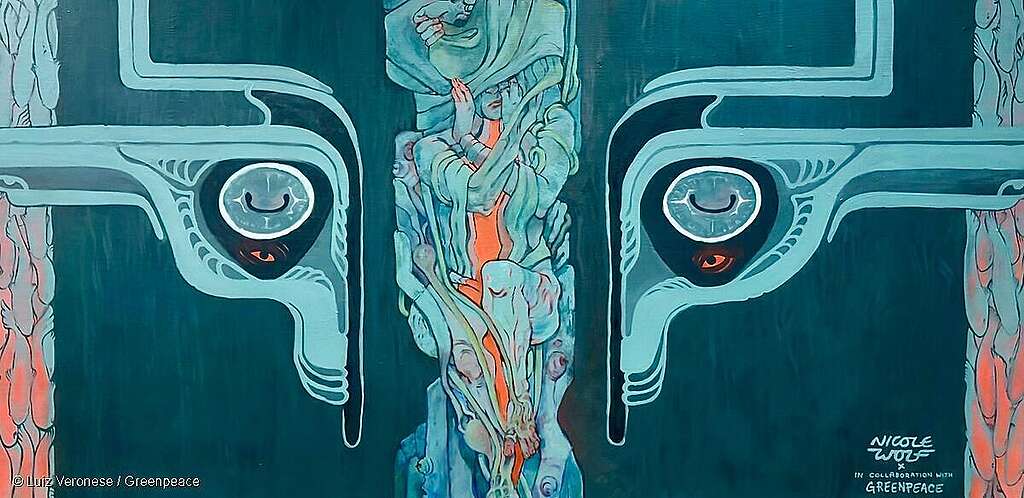
In the mural, she depicts the ocean anthropomorphized as a woman fighting back against Canada-based The Metals Company, currently leading the race to tear apart the deep sea floor, and against extractivist violence more broadly. The piece is powerful and haunting. And it wasn’t lost on me that when we speak of the earth, we instinctively gender it as “she” — a mother, a body, a giver of life. I can’t help but wonder whether that very feminization makes it easier for people to justify the idea that she is ours for the taking.
We see this dynamic play out across Canada. On land, the principle of Free, Prior, and Informed Consent (FPIC) for Indigenous peoples, the original stewards of these lands and waters, is still something we have to fight for, rather than a baseline expectation [1]. We’re seeing it again in the fast-tracking of Bill C-5 related projects, where human needs are framed as separate from the ecosystems we’re part of [2]. And we see it beyond our borders, where harmful Canadian corporate actors are contributing to the destruction of ecosystems abroad [3].
This is the culture of extraction — one that normalizes taking, using and discarding, whether the target is a person or a place. Not only does this mirror the political structures that sustain settler colonialism in places like Canada and Palestine, but it also drives the resource-driven reach of United States imperial power. It is all part of the same system of domination that we see in gender-based violence: the belief that some lives, some lands and some ecosystems exist to be extracted from without accountability.
Right now is a critical moment to challenge this culture. On the environmental front, we can join campaigns to stop deep-sea mining, center Indigenous voices, pressure governments and corporations to halt extractive projects, and support grassroots conservation and access initiatives; but on a deeper level, we can start drawing clearer connections between violence in all its forms. We can stop privileging domination over care, extraction over reciprocity and exploitation over respect. We can rethink power itself, confront greed in all its forms, and dismantle the entitlement that makes exploitation seem natural. We can and we must, imagine a global order and daily practice grounded in care for all life. We don’t need to wait to practice this in our daily choices and we don’t need to wait to demand better: International Women’s Day is as good a time as any to begin.

We need Canada to stop deep sea mining before it starts. Join the campaign now.
Take action[1] https://amnesty.ca/human-rights-news/bill-c-5-sidelines-indigenous-rights/