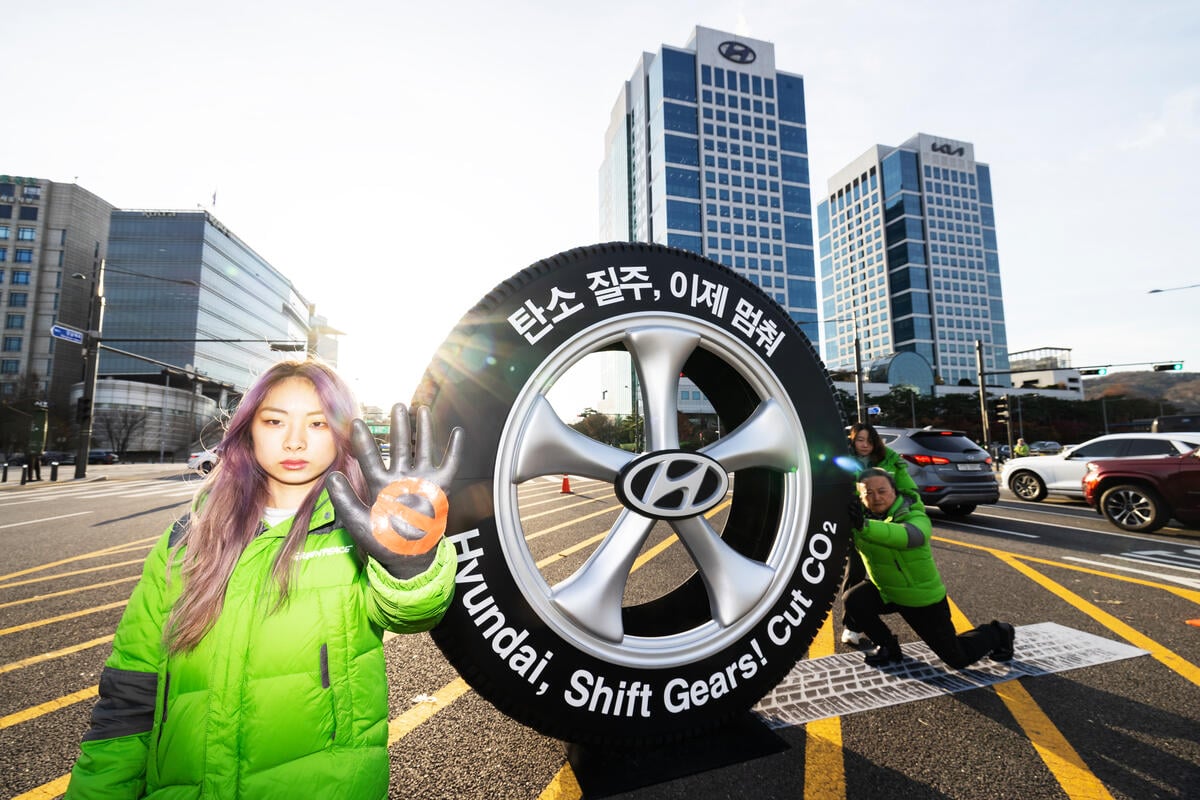
SEOUL — Greenpeace activists staged a high-profile protest targeting Hyundai Motor Group headquarters today, flashing symbolic referee “red cards” to the FIFA World Cup sponsor. The action demands that the world’s third-largest automotive giant immediately address severe human rights violations, labor exploitation, and carbon-intensive risks linked to its global supply chain, while reversing a recent corporate backtrack on its electric vehicle (EV) transition.
The Seoul demonstration marks the climax of a month-long, coordinated global wave of actions targeting Hyundai-Kia’s high-profile World Cup sponsorship. While today’s finale in South Korea was spearheaded on the ground by Greenpeace East Asia, the broader international campaign is backed by a global coalition of 11 environmental and human rights organizations, aiming to highlight what the coalition describes as a gap between Hyundai’s public sustainability messaging and reported harms linked to parts of its supply chain behind the automaker’s multi-million dollar “eco-friendly” sports marketing campaign.
The global escalation follows a series of major actions timed around key World Cup matches:
- Guadalajara, Mexico: A rally at Plaza de La Liberación ahead of the Mexico-South Korea match to highlight environmental defenders forcibly disappeared after opposing mines run by steelmaker Ternium, a major iron ore supplier for Hyundai.
- Monterrey, Mexico: Activists held a mock soccer match and concert at Parque Libertad to expose Ternium as one of the region’s worst polluters, linking Hyundai’s supply choices to local premature deaths and massive healthcare costs.
- New York & Los Angeles, USA: Protests in both cities targeted documented human and workers’ rights abuses within the U.S. automotive supply chain, including worker injury and deaths, prison labor, child labor, worker trafficking, as well as the local economic displacement caused by the World Cup itself.
The international coalition previously delivered an Open Letter to Hyundai Executive Chair Euisun Chung, demanding that the company leverage its position as a premier FIFA sponsor to implement structural climate commitments and enforceable corporate accountability measures.
Market Risk: Hyundai Lags in Clean Transition and Supply Chain Governance
While Hyundai leverages its FIFA sponsorship to showcase a sustainable corporate image, internal combustion engine vehicles still comprise 93% of Hyundai-Kia’s 6.8 million annual sales. Consequently, the group’s combined annual footprint stands at 250 million tonnes of CO₂ equivalent—on par with the total national emissions of Spain. Recent independent automotive sustainability benchmarks rank Hyundai significantly behind global competitors like Tesla, Volkswagen, and Mercedes-Benz in supply chain decarbonization and human rights due diligence.
The South Korean automaker faces compounding regulatory and reputational pressures to strengthen oversight of its manufacturing pipeline and sourcing relationships. Independent investigations by organizations including Steel Watch, Mighty Earth, and Jobs to Move America have identified serious environmental and labor concerns at parts of the company’s tier-one suppliers. Notably, Hyundai Steel’s continued reliance on coal-based production methods has also drawn scrutiny over air pollution and billions of dollars in associated public health costs across manufacturing hubs in South Korea and Brazil.
Statements from the Global Coalition
Erin Eunseo Choi, climate and energy campaigner at Greenpeace East Asia:
“Hyundai Motor’s latest sustainability report talks about ‘Electrification and Our Climate Response,’ but quietly dropping its concrete 2030 battery EV sales targets sends a very different signal. By shifting its roadmap to focus heavily on hybrids and Extended-Range EVs (EREVs)—vehicles that still rely on internal combustion engines—Hyundai is pursuing a false transition.
While EREVs may masquerade as electric, they are not a true zero-emission solution; instead, they risk locking in reliance on fossil fuels and diverting vital resources from full battery electrification. When the vehicles Hyundai sells account for 79% of its Scope 3 emissions, slowing electrification is like pulling your striker off the pitch in the middle of a match. As war-driven oil price spikes fast-track the shift toward EVs, any indecision in making a true transition risks a further loss of market share.”
Nish Humphreys, Campaign Manager at Ekō:
“Hyundai wants the world watching its Football World Cup ads, not the dark side of its supply chain. On the field, it’s sponsoring kids’ dreams. But behind the scenes, it’s a different game. Public reporting has raised serious concerns about child labor, worker deaths, and injuries, along with the unexplained disappearance of Indigenous activists in Mexico who protected Hyundai’s steel supplier.
Together with the activists on the ground, over 7,400 people have ‘red-carded’ Hyundai in our virtual protest, joining a global crowd of 52,000 citizens, football fans, and Hyundai drivers who have signed the Ekō petition demanding the company clean up its supply chain before the final whistle blows.“
Abhilasha Bhola, Climate Campaigns Director at Public Citizen:
“The record is clear: Hyundai‑Kia’s supply chain is marred by documented human rights abuses, environmental destruction, and labor exploitation. The World Cup’s corporate sponsors cannot continue to profit while workers, communities, and our planet bear the deep impacts of corporate misconduct.”
Strategic Demands to Hyundai Motor Group
The global coalition outlines three non-negotiable directives for Hyundai’s executive leadership:
- Publish an absolute, time-bound phase-out schedule for internal combustion engine vehicles across all global jurisdictions, accelerating the transition to 100% battery EV sales by 2030.
- Enforce rigorous human rights and environmental standards across all tiers of the supply chain—from critical mineral extraction to steel production—ensuring verified compliance and remediation for affected workers and frontline communities.
- Align corporate sponsorships with genuine climate performance by establishing transparent, independently audited emissions milestones subject to public disclosure.
ENDS
Media Documentation & Assets
Media Contact:
Yujie Xue, International Communications Officer, Greenpeace East Asia, +852 51273416, [email protected]