Southeast Asia’s automotive market is undergoing a massive shift. The region, long dominated by Japanese carmakers, is now being rapidly reshaped by the rise of electric vehicles (EVs). It raises a pressing question for legacy automakers like Toyota and Honda: can they adapt quickly enough to stay relevant?
On June 24, Greenpeace Japan hosted an online seminar focused on Indonesia’s fast-growing EV market and implications for traditional Japanese automakers. The event brought together Aditya Mahalana, a senior researcher at the International Council on Clean Transportation (ICCT), and Achmad Rofiqi, vice chairman of PR & Education at the Indonesian EV Industry Association (PERIKLINDO), to share their insights into Indonesia and the wider ASEAN landscape.
The Rapid Rise of Indonesia’s EV Market
Southeast Asia’s EV boom is not following the usual script. Clean technology has typically taken off first in wealthier economies before spreading elsewhere. But in this case, middle-income economies like Indonesia are adopting EVs faster than wealthier nations, according to Mahalana. Because these nations don’t have a legacy domestic auto industry to protect, they usually face fewer political hurdles and import barriers—making it much easier to welcome affordable green tech, he said.
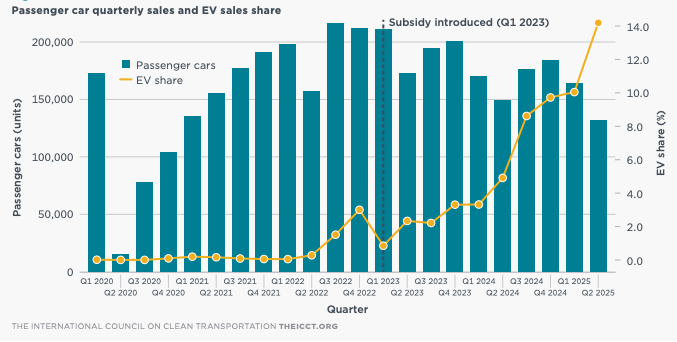
Data from the ICCT Market Spotlight reflects this shift: Indonesia’s EV sales skyrocketed from fewer than 150 units in 2020 to more than 22,000 by the second quarter of 2025, pushing the country’s total EV stock past 100,000 units. By Q2 2025, EVs made up 15.2% of all passenger car sales, driven by a massive 40% jump from the previous quarter alone.

Indonesia’s natural resources are driving a lot of this momentum. As the world’s largest nickel producer, with a 40% global share, Indonesia has a natural head start for building EV batteries, according to PERIKLINDO’s Rofiqi.
At the same time, domestic adoption is accelerating thanks to more affordable models, lower running costs, and expanding infrastructure. By 2024, more than 2,300 public charging stations were operating across 300 cities in Indonesia, according to Rofiqi. The country’s EV adoption has officially moved from early adopters to mainstream consumers, he said.
New Competitors Rewriting the Playbook
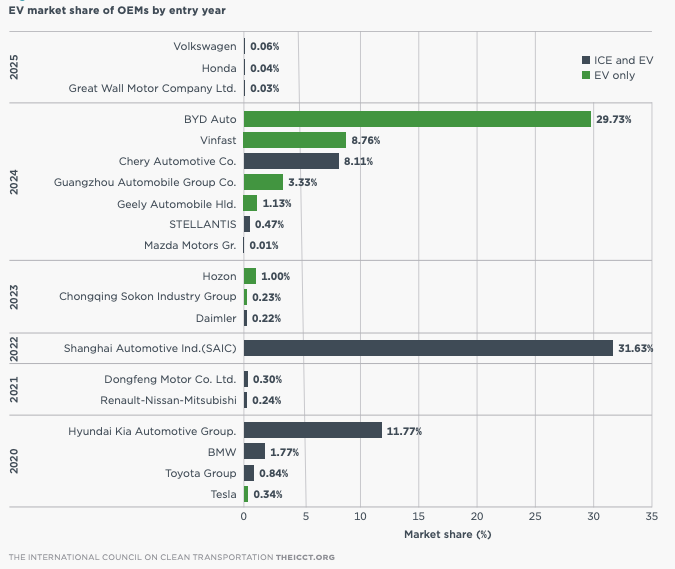
This rapid transition is completely reshaping the competitive landscape. For decades, legacy Japanese brands like Toyota, Honda, and Nissan comfortably dominated the ASEAN market through manufacturing excellence and deep brand loyalty. But while they still lead in conventional gas-powered cars, the EV segment tells a totally different story.
Chinese automakers, particularly BYD and SAIC’s Wuling, now account for nearly 60% of all BEV sales in Indonesia, according to the ICCT. Their edge goes beyond simply aggressive pricing, but includes vertically integrated battery supply chains, advanced digital features, and incredibly fast product development cycles—often bringing new models to market in just 12 to 18 months.
The Urgency for Japanese Automakers to Pivot
“The rules of the competition are evolving. Companies that can adapt quickly will be positioned for long-term success,” said Rofiqi from PERIKLINDO.
Japanese companies still hold powerful advantages, including world-class engineering, top-tier safety track records, and generations of customer trust. But to stay relevant, companies like Toyota need to move away from defensive lobbying strategies that delay electrification. Instead, they have an opportunity to help lead the region toward a cleaner future by focusing on key areas below:
- Managing the hybrid-to-EV transition: Using their current dominance in hybrids as a bridge, reducing emissions right now while easing customers into full EV adoption.
- Targeting the mass market: Delivering high-quality, reliable, and affordable EVs tailored for Southeast Asia’s growing middle class.
- Electrifying commercial fleets: Providing end-to-end EV solutions for businesses, delivery services, and last-mile logistics.
- Localizing EV production: Shifting manufacturing directly into ASEAN countries to build cars efficiently and keep costs down for local buyers.
- Leading the circular economy: Taking charge of battery recycling, resource recovery, and finding second-life uses for old batteries.
- Building the charging ecosystem: Collaborating on widespread charging infrastructure to make public charging accessible and boost driver confidence.
- Partnering on battery supply chains: Forming strategic alliances to secure raw materials and scale up battery production quickly.
“The opportunity for Japanese automakers remains substantial… But maintaining leadership will require accelerated EV product development, localized strategies, and deeper engagement with the emerging EV ecosystem,” Rofiqi concluded. “The future does not have to be a competition between countries. It can be a collaboration that benefits the entire region.“
Greenpeace’s View: Connecting Market Growth to Climate Action
The rapid market shift discussed in the webinar underscores a critical timeline for our planet. For ASEAN nations, bypassing traditional internal combustion engines is a powerful way to prevent decades of future carbon lock-in. According to the International Energy Agency (IEA) global EV forecast, the transition to electric mobility is now entirely unavoidable, with global EV sales on track to hit 23 million vehicles this year. This massive shift is projected to displace up to 5 million barrels of oil per day by 2030, making it an indispensable pillar in the race to mitigate climate disaster.
Erin Eunseo Choi, Climate and Energy Campaigner at Greenpeace East Asia, said:
“Indonesia’s rapid EV adoption proves the market is ready. For legacy brands like Toyota, it exposes the real risk of the slow-walk strategies favored by traditional automakers. Relying on a defensive ‘multi-pathway’ approach that protects combustion engines and hybrids is no longer viable and is already costing them market share to faster competitors. Amid geopolitical oil shocks and severe El Niño events this year, decarbonizing the transport sector through battery electric vehicles is urgent. Japanese automakers must accelerate their EV strategies and set ambitious greenhouse gas reduction targets to achieve substantial cuts in total emissions.”
Read the Next Session in Our Webinar Series
Interested in how global carmakers compare on zero-emission targets, market shares, and climate ratings? Read our full recap of the second installment in the series:
Greenpeace Webinar: Who is Winning the Race to Electric Vehicles — and Who is Getting Left Behind?