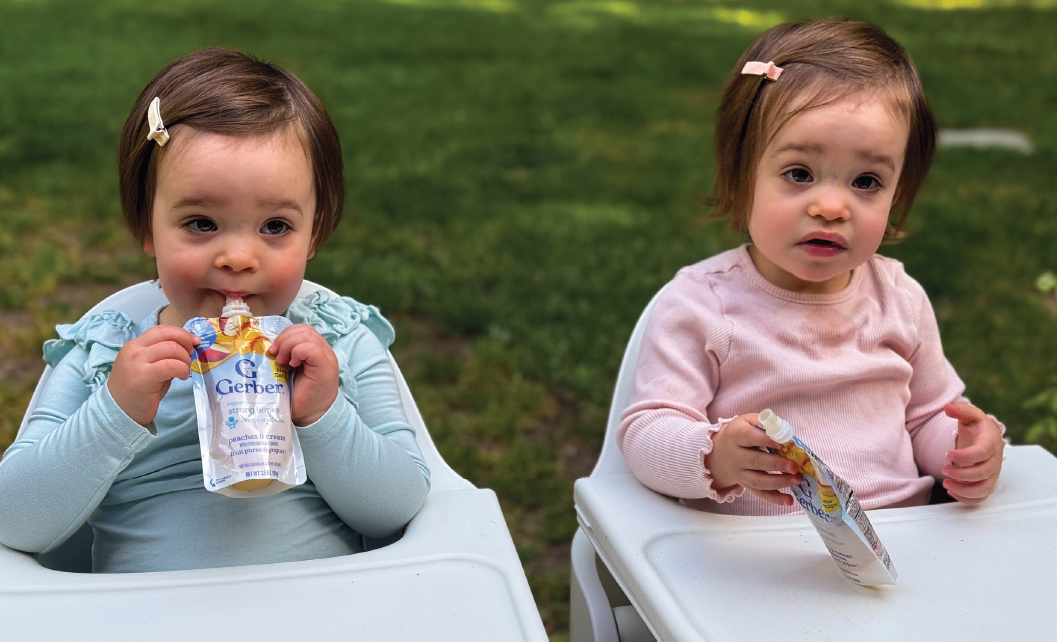
The hidden risks of plastic pouches for baby food.
EXECUTIVE SUMMARY
It has been less than 20 years since baby food in plastic pouches first appeared on supermarket shelves. [1] Since then, these convenient and popular “squeeze-and-suck” products have become the dominant packaging for baby food, transforming the way that millions of babies are fed around the world. But emerging evidence raises concerns that big food brands are feeding our children plastic pollution with unknown consequences, by selling baby food in flexible plastic packaging.
Testing commissioned by Greenpeace International in 2025 found plastic particles in the baby food products of two global consumer goods companies – Danone and Nestlé. The study suggests a link between the type of plastic the pouches are lined with – polyethylene – and some of the microplastics found. Tests also suggest a range of plastic-associated chemicals in the packaging and food of both products. [2]
The findings add to the growing body of work suggesting that babies may be routinely exposed to tiny plastic fragments and a cocktail of packaging-related chemicals. [3] Babies are vulnerable to hazardous substances due to their developing bodies and organs. [4]
KEY FINDINGS AND TAKEAWAYS
A new study by SINTEF Ocean conducted on Danone’s Happy Baby Organics brand and Nestlé’s Gerber branded baby food packaged in plastic spout pouches found the following:
- For each gram of food, there were up to 99 microplastic particles in the Danone Happy Baby Organics branded fruit puree pouches, and up to 54 particles in Nestlé Gerber branded yoghurt pouches, on average. [5]
- That’s equivalent to an estimated total of more than 11,000 microplastic particles in each Danone Happy Baby Organics pouch, and more than 5,000 particles in each Nestlé Gerber Organics pouch. [6]
The tests also tentatively identified:
- A link between the type of plastic the pouches are lined with – polyethylene – and some of the microplastics found in the baby food tested;
- A chemical that may be harmful to human health in Nestlé Gerber branded food and packaging; and
- A host of plastic-associated chemicals in the tested packaging as well as in baby food of both brands.
Scientific evidence suggests extensive exposure risk. Studies have also confirmed that microplastics and even nanoplastics can be shed into food from plastic containers under typical usage conditions.
One recent study calculated that just 3 minutes of microwaving a plastic container for baby food could release up to an estimated 4 million microplastic particles, while another container released up to 2 billion nanoplastic particles per square centimeter of packaging. [7]
Researchers have identified dozens of chemicals leaching from baby food packaging, many of them potentially toxic non-intentionally added substances. [8,9] Even low doses of endocrine disrupting chemicals at critical developmental stages such as infancy, can have outsized effects on reproductive systems, growth, metabolism, and the future health of babies and children. [10]
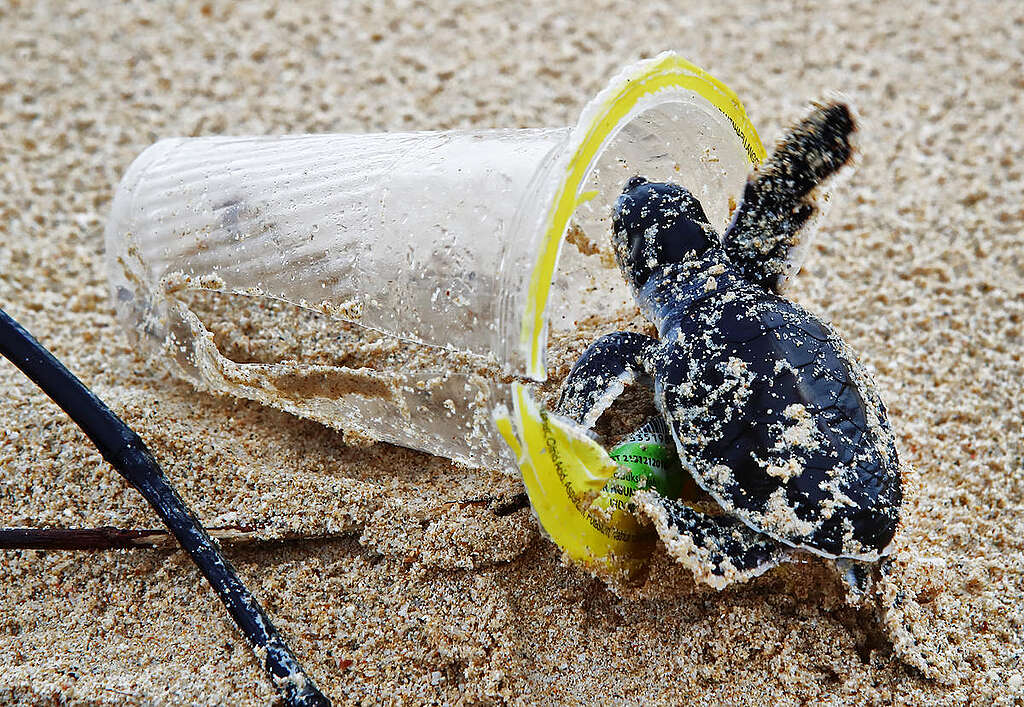
We have a rare chance to turn the tide on plastic. Add your name before the final Global Plastics Treaty talks this August.
Sign PetitionNotes:
- Timetoast website, Timeline: Baby Food Pouches; https://www.timetoast.com/timelines/baby-food-pouches
- Plastchem defines plastic chemicals as “all chemicals that can be present in plastic materials and products, including the polymer
backbone, intentionally added substances (i.e., starting substances, processing aids, additives), and NIAS (e.g., impurities, unreacted
intermediates, reaction by-products, and degradation products).”
Monclús L., Arp H.P.H., Groh K.J. et. al., 2025, Mapping the chemical complexity of plastics. Nature 643, 349–355 (2025). https://doi.
org/10.1038/s41586-025-09184-8
Also see State of the Science on Plastic Chemicals; https://plastchem-project.org/ - Nadarasan S., Phuna Z.X., Zaman R., Tan C.K., Ahmad Bustami N., Ho Y.B., Kosasih S.J., Tan E.S.S., 2025, Microplastics and child health:
A scoping review of prenatal and early-life exposure routes and potential health risks, Toxicology Reports, Volume 15, 2025, 102143,
ISSN 2214-7500; https://www.sciencedirect.com/science/article/pii/S2214750025002628 - Nadarasan S., et al., 2025, op.cit.
- Both brands were tested in triplicate and the total per gram is the average of the three.
- Polyethylene microplastics were the most detected type of microplastic in each sample (38% of all microplastics in the fruit puree
and 70% in the yoghurt), however other microplastic types (e.g. polyamide) were also detected. The identification of particles as these
plastic types should be considered tentative due to other food materials also present in the food, and as such the results should be
interpreted with this identification in mind. - Hussain K.A., Romanova S., Okur I., Zhang D., Kuebler J., Huang X., Wang B., Fernandez-Ballester L., Lu Y., Schubert M., Li Y., 2023,
Assessing the Release of Microplastics and Nanoplastics from Plastic Containers and Reusable Food Pouches: Implications for
Human Health. Environ Sci Technol. 2023 Jul 4;57(26):9782-9792. doi: https://doi.org/10.1021/acs.est.3c01942 - Stevens S., Bartosova Z., Völker J., Wagner M., 2024, Migration of endocrine and metabolism disrupting chemicals from plastic food
packaging, Environment International, Volume 189, 2024, 108791, ISSN 0160-4120, https://doi.org/10.1016/j.envint.2024.108791 - Bauer A., Jesús F., Gómez Ramos M.J., Lozano A., Fernández-Alba A.R., 2019, Identification of unexpected chemical contaminants in
baby food coming from plastic packaging migration by high resolution accurate mass spectrometry, Food Chemistry, Volume 295,
2019, Pages 274-288, ISSN 0308-8146; https://doi.org/10.1016/j.foodchem.2019.05.105 - Flaws R.J., Damdimopoulou P., Patisaul H.B., Gore A., Raetzman L., Vandenberg L.N., 2020, Plastics, EDCs & Health: a guide for public
interest organizations and policy-makers on endocrine disrupting chemicals & plastics, Endocrine Society, IPEN, December 2020;
https://www.endocrine.org/-/media/endocrine/files/topics/edc_guide_2020_v1_6chqennew-version.pdf