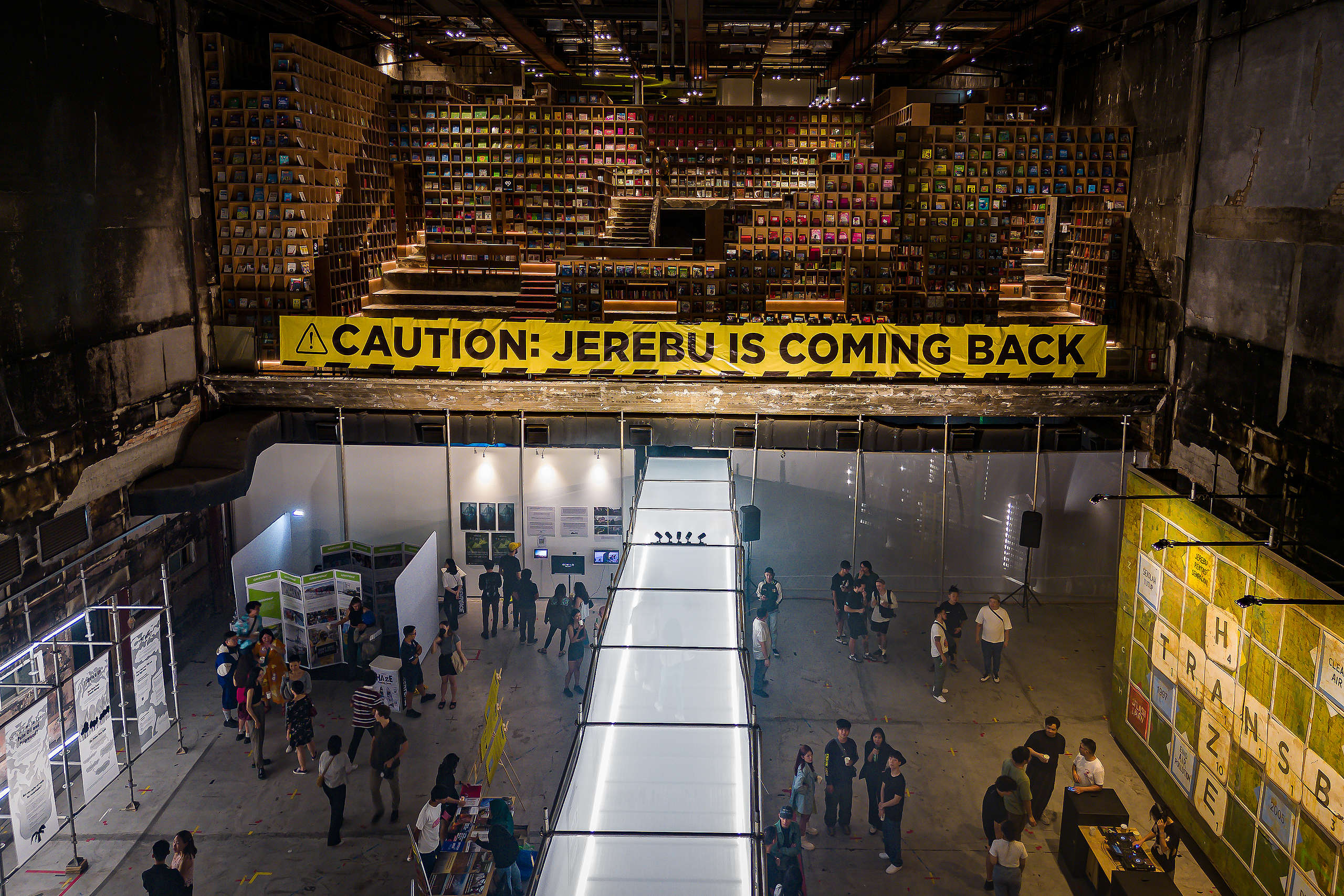
KUALA LUMPUR, 1 April 2026 – On 1st April 2025, a section of the Peninsular Gas Utilisation (PGU) Phase II pipeline failed at Jalan Putra Harmoni, creating an 8-meter-deep crater and injuring over 110 individuals, damaging over 500 homes and hundreds of vehicles, injured more than 110 people, and forcing the evacuation of more than 600 households. One year later, The Artivist Network, Greenpeace Malaysia and RimbaWatch are calling for the immediate establishment of a Royal Commission of Inquiry (RCI) and the enforcement of international safety standards to protect the public.
These calls for an RCI follow today’s launch of a policy brief, “Putra Heights One Year On: Unanswered Questions Remain”, prepared by Greenpeace Malaysia and RimbaWatch, which identifies numerous key issues that were not addressed by the Parliamentary Special Select Committee (PSSC) on Infrastructure, Transport and Communications, the agency tasked with investigating the explosion.
The policy brief notes, for example, that historical records from the 1988-2010 Petaling Jaya and Klang District Structure Plan demonstrate that, before its completion, the pipeline was zoned through both existing and planned suburban residential areas. Despite this, the PSSC did not identify key zoning questions related to the pipeline.
Further, critical questions remain regarding PGB’s monitoring protocols: public documentation suggests that the company has utilised advanced technologies like InSAR for pipeline monitoring, which can detect ground deformations down to a 2mm scale. However, no agency was able to detect the 243mm soil subsidence that the PSSC ultimately cited as the geotechnical cause of the explosion. Predictive pipeline monitoring tools such as PrAn3G, which utilise drone footage to identify geohazards like soil subsidence, similarly did not trigger the necessary safety interventions prior to the explosion, the PSSC did not assess pipeline monitoring and related safeguards.
Up until this date, it remains unclear if Environmental Impact Assessments (EIAs) or Quantitative Risk Assessments (QRAs) were conducted for this section of the pipeline, highlighting a profound lack of transparency in Malaysia’s regulatory framework. Compounding the situation, the existing pipeline right-of-way of roughly 50 meters is far lower than the estimated ‘Potential Impact Radius’ of the pipeline of 240 meters, as defined by the ASME B31.8 standard, a global industry benchmark to which PGB claims conformance. Similarly, the standard mandates that operators keep the public informed about integrity management and emergency procedures; however, a review of public documentation suggests that such procedures were not communicated to the public prior to the pipeline rupture. These issues were not included in the PSSCs’ investigation of the explosion.
Worryingly, the PSSC also did not address the environmental and public health impacts of the 400 million standard cubic feet of gas released during the event. This release resulted in concentrations of an estimated 27,000 tons of CO2, equivalent to the annual emissions of over 7,000 vehicles, at the blast site. The sudden concentration of high-level greenhouse gases and combustion by-products is known to lead to severe respiratory issues and cognitive decline. It is concerning that any potential health toll from these emissions on these residents has been excluded from the official investigative narrative.
RimbaWatch Director Adam Farhan said, “Fossil gas infrastructure in Malaysia has been marked by repeated operational and safety issues, including five publicly known incidents on the Sabah-Sarawak Gas Pipeline (SSGP) between 2014 and 2022. Given that past safety assurances have been inadequate to protect residents along pipelines, we seek to overhaul this system. Malaysia must move toward a transparent, community-led energy model that prioritises the lives of the people over the expansion of fossil fuel networks.”
Greenpeace Malaysia Climate and Energy Campaigner Hamizah Shamsudeen said, “One year on from the Putra Heights gas explosion incident, the affected residents are still living with uncertainty and a lack of an effective grievance mechanism. Based on our findings, the community is seeking basic accountability, transparency, and clear communication throughout the repair and remedy process. The lack of risk awareness and emergency preparedness has only deepened the physical and emotional toll on residents, raising serious questions about whether enough was done to safeguard both the pipeline system and the communities living around it.”
The Parliamentary Special Select Committee (PSSC) on Infrastructure, Transport and Communications investigation lacked the necessary independence to provide an unbiased account of this disaster. The committee, which includes various Members of Parliament, conducted its investigation in direct collaboration with PGB and other government agencies, relying almost exclusively on their internal technical presentations and forensic reports. This partnership raises significant concerns regarding independent oversight, as the entities responsible for the pipeline’s safety were effectively allowed to investigate themselves.
The families of Putra Heights deserve accountability and a future free from the threat of fossil fuel infernos. To ensure true accountability, we recommend the immediate establishment of the RCI and prioritise that independent experts are given full investigative powers.
Noting that Principle 10 of the Rio Declaration on Environment and Development states that information on hazardous materials and activities within communities must be accessible to all citizens, Rimbawatch, Greenpeace Malaysia, and Artivism Network call on the Special Select Committee to ensure the following:
- Establish a Royal Commission of Inquiry (RCI): The independent, appointed Commission must mandate a full investigation into the root causes of the Incident, including absolute transparency on what procedures were adopted for pipeline monitoring in urban areas, and ensure the results of these investigations are made public in full. This must include an urgent, non-negotiable review of existing pipeline integrity measures, city plans and pipeline maps to ensure they comply with current safety regulations and buffer zone requirements.
- Strengthen the Energy Commission (EC) as the Lead Safety Agency: The EC must establish and enforce minimum pipeline safety standards, including buffer zones based on the Potential Impact Radius (PIR) formula. Ensure the Occupational Safety and Health Act 1994 and EIA Guidelines include mandatory buffer zones and technical risk assessments for offsite populations.
- Public Access to Air Quality Data: The Committee must ensure the results of all air quality monitoring before, during, and after the Incident are made public in full and at a sufficient level of granularity.
- Independent Health Impact Study: We call on the Committee to commission an independent study into the short and potential long-term health and safety impacts caused by the Incident, benchmarked against WHO standards.
- Disclosure of Methane Emissions: The Committee must ensure the full disclosure of the methane emissions caused by the Incident in corporate and national-level reporting frameworks.
- Accelerate phasing out fossil fuels: Include a recommendation for the government to phase out fossil fuels as a primary energy source in the near future, along with an expansion into renewable energy solutions suitable for Malaysia, such as solar energy.
- Just Energy Transition (JET): Given the safety risks posed by the existing energy system, we call on the Committee to recommend that the government spearhead a real Just Energy Transition (JET) from fossil fuels to safer and cleaner alternatives such as energy efficiency and renewable energy.
- Rapid Renewable Development: Adopt a National Grid Development Roadmap to achieve 100% renewable energy by 2050, supported by economy-wide carbon pricing and smart grid investment.
- Mandatory Independent Audits: The EC must implement an independent assurance system with periodical audits that are made fully available to the public.
A summary of the policy brief and full report by Rimbawatch and Greenpeace Malaysia is available at this link.
About
RimbaWatch is an environmental think-tank conducting research and advocacy on climate-related issues in the Maritime Southeast Asian region. rimbawatchmy.com
Greenpeace Malaysia is part of Greenpeace, an independent global campaigning organisation that acts to protect the environment through research, advocacy, public mobilisation, and non-violent peaceful action. https://www.greenpeace.org/malaysia/
Artivism Network is a collective of arts-activists and facilitators who support the movements in strategically engaging creativity and arts-organising to create change. https://www.artivistnetwork.org