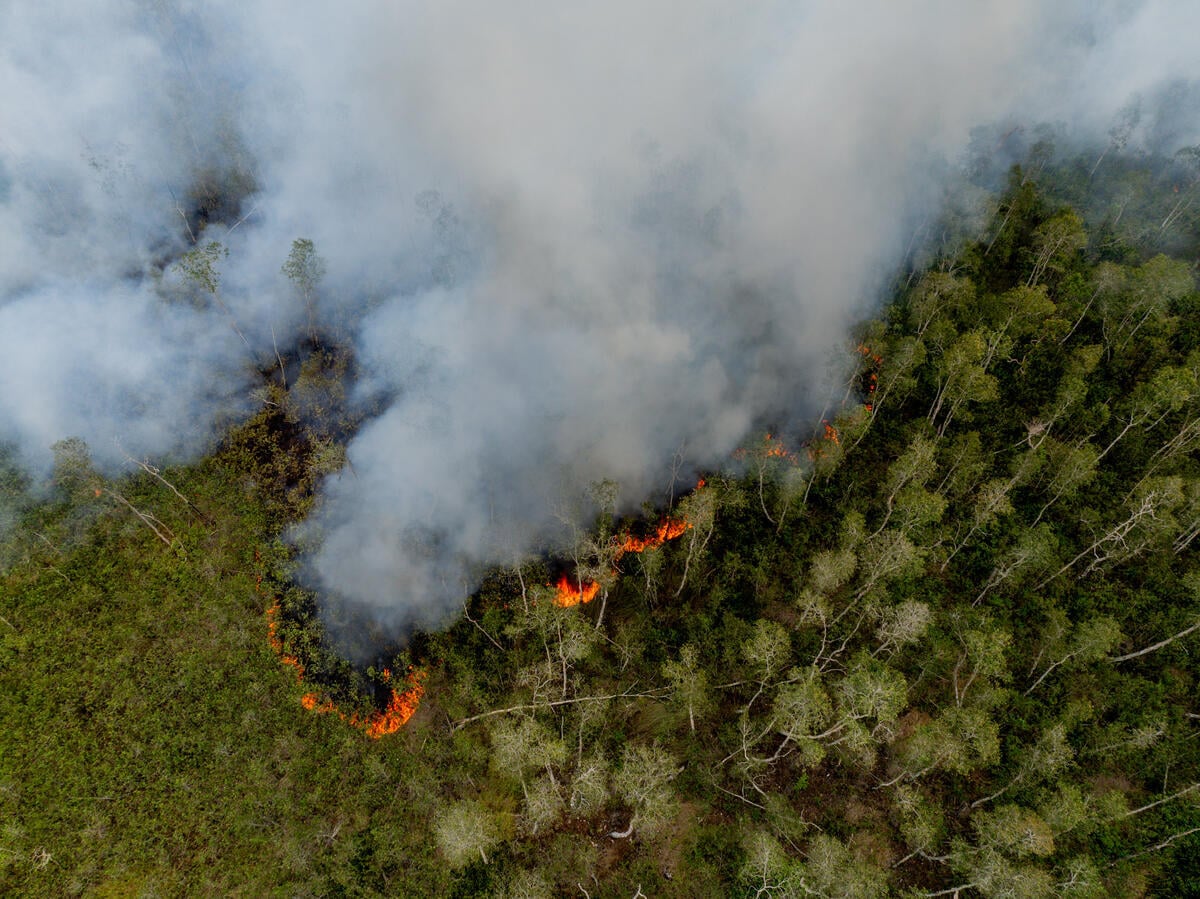
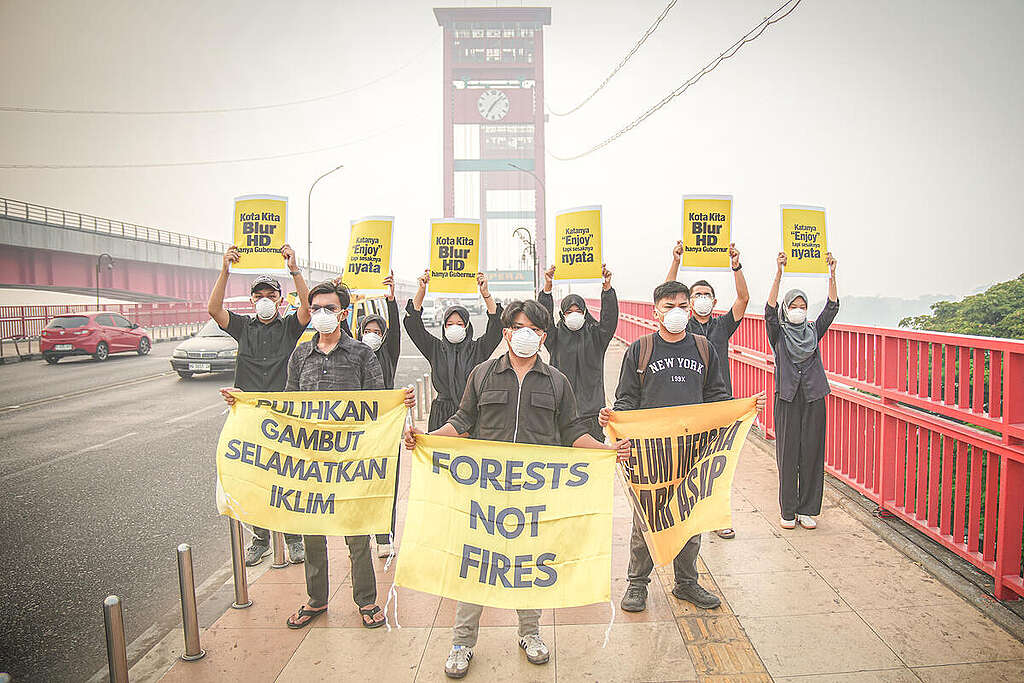
Jakarta, 21 October 2026 – For the past three months, Indonesia’s forest and peatland fire crisis has forced millions of people across Southeast Asia to struggle for air amid a pall of toxic smoke, with strengthening El Niño conditions only expected to intensify the fires. As demands mount for accountability over the transboundary haze, Greenpeace Indonesia calls on ASEAN governments to adopt new strategies and urges Indonesia’s Supreme Court to deliver justice for haze victims.
In Singapore, the National Environment Agency has issued notices to ten Indonesian plantation companies that it says are sending smoke haze across the border, threatening enforcement action under its Transboundary Haze Pollution Act. Senior Minister K. Shanmugam has said that the government will, for the first time, target the corporate groups and beneficial owners behind the individual plantations and “explore a wider range of legal, regulatory and economic measures” both in Singapore and overseas.[1] Meanwhile, Malaysian lawmakers have called for compensation and legal action against local companies whose Indonesian operations are likewise polluting Malaysian skies.
“We encourage the Singaporean and Malaysian governments to recognise their own share of responsibility for the crisis, and the shortcomings in their softly-softly approach during previous haze crises. For the sake of everyone’s health, they must take strong new measures to end the transboundary haze,” said Kiki Taufik, head of Greenpeace Indonesia’s Forest Campaign. “As our research shows, a number of the corporate groups responsible for the haze are based in or linked to Singapore and Malaysia.[2] Furthermore, Singapore is the region’s financial hub, and much of the destructive plantation expansion is bankrolled by financial institutions with offices there, or by capital-raising via its stock exchange.”[3]
In Indonesia too, the government must get serious about changing the practices of pulpwood and palm oil companies with recurring fires in their concessions. A handful of companies have been sued by previous administrations, but have often managed to avoid paying the fines, or may simply have treated them as a cost of continuing business as usual. Instead, small-scale farmers have been scapegoated over traditional land practices, and few company directors have faced criminal sanctions. The corporate groups continue to benefit from a regulatory system that allows them to drain peatlands and clear forests, which experts identify as the underlying cause of the perennial fire and haze problems.
Three of the ten companies subject to notices sent by Singapore’s National Environment Agency are already being sued by residents of South Sumatra who were impacted by fires on company-controlled lands in 2019 and 2023. They are PT Bumi Andalas Permai, PT Bumi Mekar Hijau and PT SBA Wood Industries, all part of the Asia Pulp & Paper (APP) business group. The lawsuit is pending a final cassation decision by the Indonesian Supreme Court.
Greenpeace Indonesia senior forest campaigner Asep Komarudin said:
“All eyes are on the Supreme Court justices, who have a rare opportunity to bring about meaningful change to one of the most fire-affected areas of Indonesia. The legal case brought by South Sumatran residents asks for compensation for haze impacts, and demands the three companies restore the damaged peatlands within their concessions. It also seeks a court order compelling the companies to prevent further peatland drainage, fires, and the spread of haze from their licensed areas.”
Notes
[1] Groups that were mentioned were First Resources, Golden Agri-Resources (GAR), Wilmar International, Kencana Agri, Indofood Agri and TSH Resources.
[2] See ‘Fires and Their Links to Malaysian and Singaporean Entities’ in Indonesia Forest and Peatland Fire Facts Report 2026
[3] See ‘Bankrolling Ecosystem Destruction’ (2024)
Contacts
Lovenila Dewi, Greenpeace Indonesia, +62 896-1544-5051
Greenpeace Indonesia additional media contact: +61 414 288 424