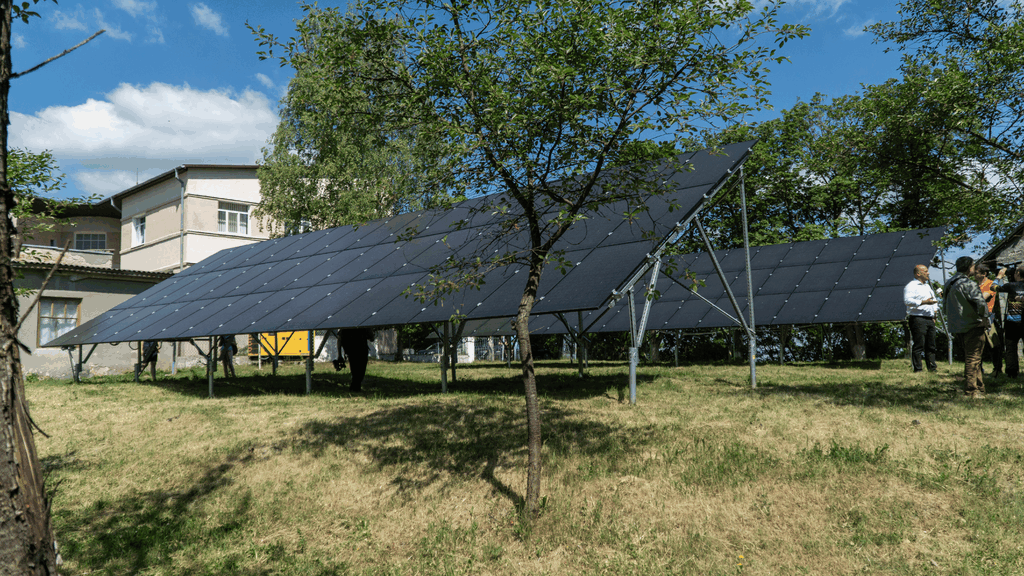
While Russia continues to attack Ukrainian energy infrastructure, local communities are proving that the future belongs to clean, decentralized, and resilient energy. This exact experience of wartime green reconstruction was what media professionals from six European countries came to witness during a media tour organized by Greenpeace Central and Eastern Europe.
In late May 2026, initiated by Greenpeace Central and Eastern Europe, a media tour across Ukraine took place for 16 journalists from Bulgaria, Hungary, Poland, Romania, Slovakia, and the Netherlands.
Over the course of four days, the participants saw a side of Ukraine that isn’t always highlighted in war news—a country where communities are not just rebuilding what has been destroyed, but are leveraging the crisis as an opportunity for change to build a modern, clean, and more resilient energy system.
From a wind farm in western Ukraine to an energy-independent apartment building in Kyiv, every location demonstrated that renewable energy is already functioning as a security tool. Solar panels power hospitals and shelters, energy cooperatives help communities achieve self-sufficiency, and residential buildings keep critical infrastructure running even during blackouts caused by Russian strikes.
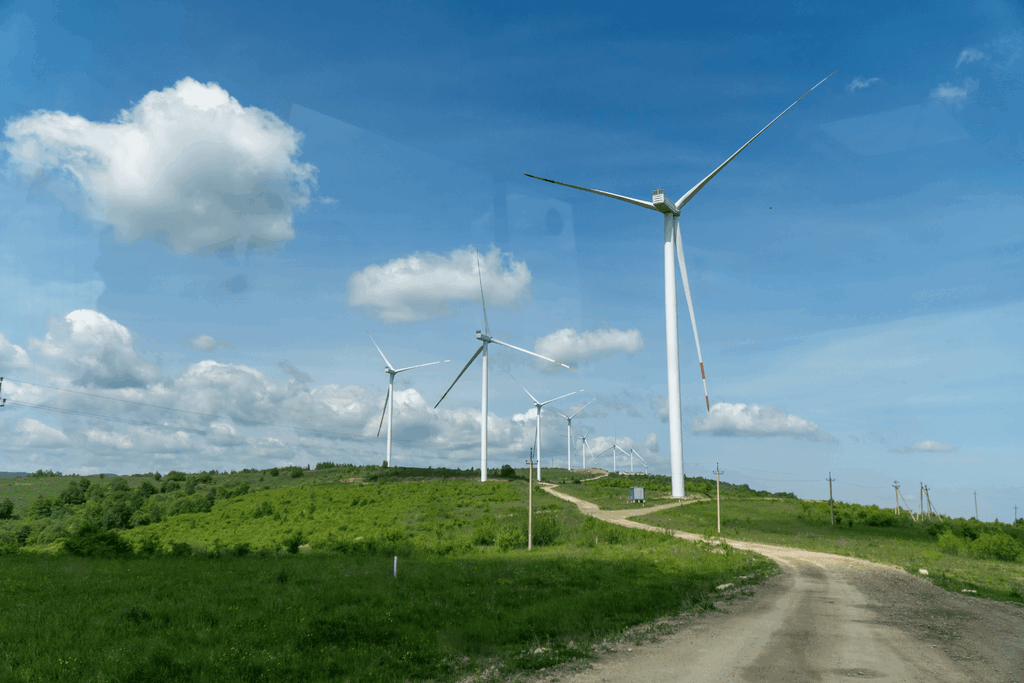
The media tour began with a visit to one of the largest wind farms in western Ukraine, built after the start of the full-scale invasion. Despite the war, security risks, and the challenges of securing contractors, the project was completed, primarily by Ukrainian specialists. For the tour participants, this location served as a symbolic example that Ukraine is not only defending its energy system against Russian attacks but is also continuing to invest in its future—one that is clean, decentralized, and free from fossil fuels.
Chortkiv, in the Ternopil region, made a particularly strong impression on the guests. It is the first community in Europe to set the ambitious goal of completely phasing out gas in its municipal sector. Here, journalists saw Greenpeace-funded solar power plants powering the local hospital and critical infrastructure, spoke with residents of the “Chortkiv Unites” social housing project, and saw firsthand how renewable energy solutions help people cope with the consequences of the war.
It was during the media tour in Chortkiv that a memorandum was signed to phase out gas usage in the community’s municipal sector. This is not just a symbolic step, but further proof that Ukrainian cities are ready to invest in energy independence and abandon fossil fuels even in the most challenging times.
“Today, Ukraine is not only a country resisting Russian aggression, but also a country shaping new approaches to reconstruction. During this media tour, we wanted to show European journalists that renewable energy is already helping communities become more resilient in the face of wartime challenges, ensuring the uninterrupted operation of hospitals, schools, and housing. This experience could be useful far beyond Ukraine,” noted Marine Abramyan, Green Energy Campaign Coordinator at Greenpeace Ukraine.
In Slavutych, journalists witnessed another unexpected example of energy transformation. The city, originally built after the Chornobyl disaster for plant workers and their families, now has an ambitious goal: to become a 100% renewable energy community. Representatives of the media visited the “Sonyachne Misto” (Sunny City) energy cooperative, where residents co-invest in solar generation and build their own decentralized grid. For a city whose history has been inextricably linked to nuclear energy for decades, this direction is not just a practical solution, but a symbol of a new vision for the energy future.

“Slavutych is an incredibly interesting example for all of Europe. This is a city born from the largest nuclear catastrophe in history, which survived for decades thanks to nuclear power. Today, its residents are showing how a future can be built on renewable energy and community participation. Stories like this prove that the energy transition is first and foremost about people who are ready to take responsibility for their future,” said Polina Kolodyazhna, Program Leader at Greenpeace Ukraine.
In the Kyiv region, the participants visited Horenka and Hostomel—communities among the first to experience the full-scale invasion in 2022. In Horenka, journalists visited a clinic known nationwide that was damaged during the Russian occupation and rebuilt according to green recovery principles. Thanks to a hybrid solar power plant, the medical facility can keep operating during power outages, ensuring access to medical services for thousands of local residents. Furthermore, a heat pump keeps the clinic warm even when temperatures drop to -20°C.
In Hostomel, the tour group saw another symbol of recovery: a kindergarten that had been damaged during hostilities. Thanks to a solar power plant and an energy storage system, the facility now has reliable backup power for classes and the bomb shelter, giving children a sense of safety despite the ongoing war.
The media tour concluded in Kyiv with a visit to the “Poryadok Sheptytskoho 12” homeowners association—one of the most famous examples of energy-resilient housing in the capital. Following Russian attacks on the power grid, the building’s residents invested in their own solar power plant, batteries, and a heat pump. Today, the system keeps elevators running, powers water pumps, lights common areas, and runs the heating station even during prolonged blackouts. For European journalists, this was a clear demonstration of how the energy transition can begin not just at the state or community level, but within a single apartment building.
“When we talk about green recovery, we aren’t just talking about technology or infrastructure. We are talking about people—doctors, teachers, community residents, and internally displaced persons who prove every day that even during a war, it is possible to build a better future. This media tour showed that Ukraine is not just recovering from destruction, but is creating new solutions that can inspire other European countries as well,” stated Illya Kuksenko, Junior Campaigner at Greenpeace Ukraine.
Today, the Ukrainian experience of green recovery is becoming part of a broader European dialogue on energy security, climate resilience, and the transition away from fossil fuels. As the war continues, Ukrainian communities continue to demonstrate that the future of energy can be clean and sustainable. Concurrently, they are beginning to inspire Europeans with their green choices, flexibility in times of crisis, and decisive steps toward energy independence.
Photo – Pavlo Siromenko