A satellite analysis commissioned by Greenpeace Ukraine has also found that the surface area of the cooling pond decreased by more than 100,000 m² over the summer of 2025, while fortified military positions and anti-drone structures have appeared around the nuclear facility.
A new study on the continued militarization of the Zaporizhzhia Nuclear Power Plant (ZNPP) in 2025, prepared by McKenzie Intelligence Services (MIS) at the request of Greenpeace Ukraine, confirms the continued and systematic militarization of the Zaporizhzhia Nuclear Power Plant and its associated infrastructure. Analysis of very high-resolution satellite imagery from 1 June and 15 October 2025 documents the expansion of military fortifications. MIS has worked with Greenpeace to provide satellite imagery analysis of Russia’s war against Ukraine nuclear plants since 2022. “New satellite data shows the continued and systematic militarization by Russia of the Zaporizhzhia Nuclear Power Plant — from the construction of a dam to building fortified military structures at strategic points. The ZNPP is functioning as a Russian military base, and this is happening with the involvement of Russia’s state nuclear corporation, Rosatom. The IAEA is blocked from accessing much of these areas and is not reporting on Russian violations of nuclear safety and security principles.. Russia and Rosatom must finally be included in a full nuclear sanctions regime for its role in the illegal occupation and militarization of Europe’s largest nuclear plant,” said Shaun Burnie, Senior Nuclear Specialist at Greenpeace Ukraine.
Cooling Pond Status
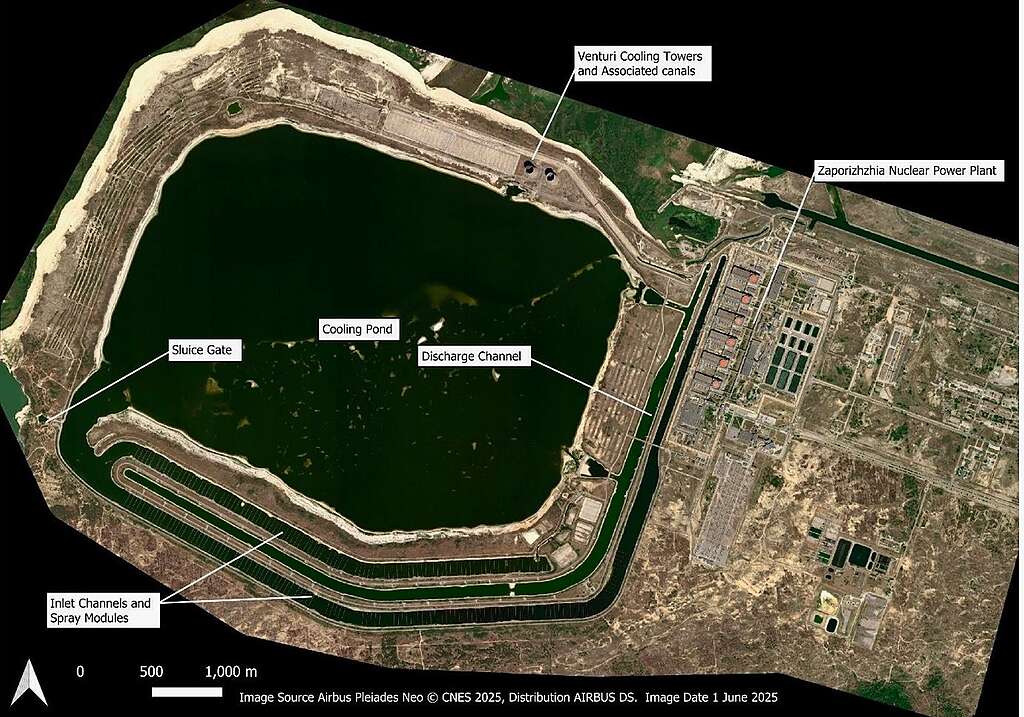
The decline in the ZNPP cooling pond since the Russian destruction of the Kakhovka dam in 2023 continues. Satellite analysis shows that on 3 July 2022 the surface area of the cooling pond measured 9,599,617 m², on 1 June 2025 it had decreased to 8,767,820 m², and by 12 August 2025 it had fallen further to 8,662,141 m².
Between June and August 2025 alone, the water surface area decreased by more than 105,000m². During the same period, the discharge channel shrank by an additional 63,797 m².
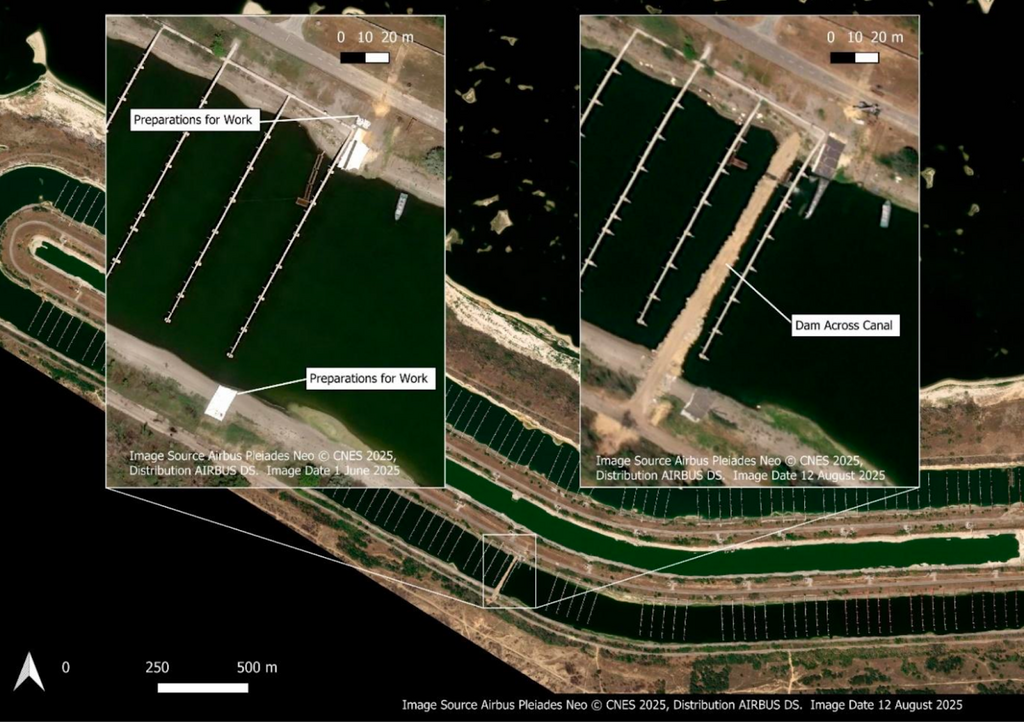
The satellite imagery shows the construction of a dam in the water intake channel, effectively creating a smaller, separate cooling pond isolated from the main reservoir. This structure allows local regulation of the water level.
In addition, the imagery reveals a significant difference in water color on either side of the newly constructed dam. A light green hue on one side may indicate algal bloom and changes in water circulation.
The construction of the dam wall by Russia is a consequence of the dramatic decline in the overall water volume in the cooling pond and in particular the cooling water inlet channel which is essential for providing service and emergency cooling water to the reactors. These are direct consequences of Russia’s military operations and are unprecedented at a nuclear plant having been conducted illegally and without any legitimate regulatory oversight.
Bunkers and Command Positions
In the areas around the sluice gates and along the western and northern banks of the cooling pond, satellite imagery shows the further construction of reinforced permanent structures. The images document the evolution of these structures — from deep excavations with beams to covered and fortified constructions consistent with reinforced bunkers.
Analysts suggest these structures may serve as command-and-control positions. Their locations correspond to key points of control over the plant’s water infrastructure.
This indicates not a temporary military presence, but systematic fortification of the territory.
ZNPP as a Military Base: Sangars, Anti-Drone Cages and Armored Vehicles
Along the perimeter of the nuclear plant itself, the construction of sangars — defensive firing positions typical of forward military bases — has been identified. Some of these are protected by steel cages commonly used as anti-drone defenses. MIS concludes that “it is highly likely that the addition of these aggressive security structures is feeding the Russian narrative that ZNPP is under threat whereas in reality, no threat exists. Ukraine is almost certainly not going to conduct any operations that will compromise nuclear safety at ZNPP. Although it cannot be determined from imagery, it is highly likely that these positions will be manned by troops equipped with small arms and likely up to larger heavy machine guns.”
The images also confirm continued parking of military vehicles under elevated structures, the presence of fortified positions with signs of stored crates that may contain military equipment, and prepared positions for armored personnel carriers.
Such fortifications are characteristic of active combat zones, not civilian nuclear facilities.
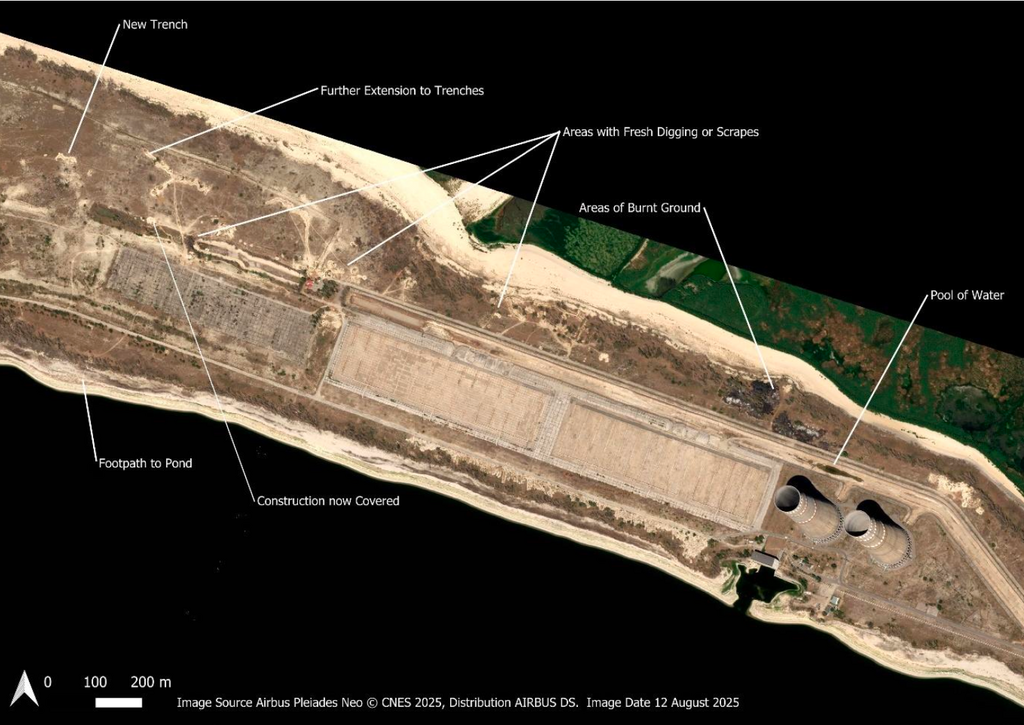
“The militarization of the Zaporizhzhia Nuclear Power Plant has now entered its fourth year and is becoming increasingly systematic. The construction of bunkers, trenches, anti-drone fortifications and interference with the cooling system are clear signs of Russia’s efforts to maintain long-term military control over a nuclear facility,” said Jan Vande Putte, nuclear expert at Greenpeace Ukraine. “The presence of troops and military equipment at Europe’s largest nuclear power plant creates a constant risk to nuclear safety for all of Ukraine and the wider region. The Zaporizhzhia Nuclear Power Plant must be de-occupied of Russian forces, including Rosatom,and returned to full Ukrainian control in accordance with international law.”
The full study can be accessed here.